
Stories
The Birth of Srimati Radharani
Last updated 25 July 2026
The short answer
Srimati Radharani's birth is told mainly in the Garga Samhita and the Brahma Vaivarta Purana. She appeared on Bhadrapada Shukla Ashtami, the day kept as Radhashtami, as the daughter of King Vrishabhanu of Braj. Devotional tradition says she was found as a radiant infant on a golden lotus and kept her eyes closed until she first saw Krishna. The Bhagavata Purana speaks of her without using her name, at 10.30.28.
Key takeaways
- Radha's birth is narrated in the Garga Samhita (Canto 1, Chapter 8) and the Brahma Vaivarta Purana. The Bhagavata Purana speaks of her without using her name, at 10.30.28.
- Her appearance day is Radhashtami, Bhadrapada Shukla Ashtami, about a fortnight after Krishna Janmashtami.
- Her father is King Vrishabhanu of Braj. Her mother is Kalavati in the Garga Samhita and Kirti (Kirtida) in popular tradition.
- Devotional tradition says she appeared ayonija, not from a womb, on a golden lotus, and kept her eyes closed until she first saw Krishna.
- Her birthplace is given as Raval in some accounts and Barsana in others.
Srimati Radharani's birth is told mainly in two texts: the Garga Samhita and the Brahma Vaivarta Purana. She appeared on Bhadrapada Shukla Ashtami, the day the tradition keeps as Radhashtami, as the daughter of King Vrishabhanu of Braj. Devotional tradition says she was found as a radiant infant on a golden lotus and kept her eyes closed until she first saw Krishna. The Bhagavata Purana, the most famous Krishna text of all, speaks of her without using her name, in the gopi Krishna takes aside at 10.30.28.
The most-loved details of her birth come from more than one book, and the books tell it in more than one way. This page lays them out text by text, so you can see what each one holds. For the wider love story, start at Radha Krishna and the full set of Stories.
What is the story of Srimati Radharani's birth?
In the Garga Samhita, King Vrishabhanu of Braj finds a radiant baby girl and raises her as his daughter with his queen. This is the source the tradition leans on most for the birth, and the chapter is named for it: Canto 1, Chapter 8, "Description of Shri Radhika's Birth."
The retelling most people know adds the well-loved scene. Vrishabhanu goes to the Yamuna and finds a golden lotus with a baby girl inside it, glowing like a thousand suns. He and his queen bring her home and name her Radha.
Soon they notice the child will not open her eyes. They fear she was born blind. The sage Narada visits and tells them to hold the birth celebration regardless, and to invite all of Braj, especially Nanda Maharaj and his family.
On the day of the feast, the infant Krishna is brought before Radha's cradle. Her eyes open for the first time, and she looks only at him. She had kept them shut, the tradition says, because she did not want the first thing she saw to be anything other than Krishna.
Why did Radharani take birth on earth?
Radharani descends to earth to be with Krishna during his childhood pastimes in Braj. In the Vaishnava reading, she is his hladini shakti, the power of his own bliss and love, so where he appears, she appears with him. Many traditions also identify her with the goddess Lakshmi.
The Brahma Vaivarta Purana frames her origin differently from a birth. There she belongs to Goloka, Krishna's eternal realm, and manifests from Krishna's own left side. Her descent to earth is tied to a curse: the cowherd Sridama and Radha exchange harsh words in Goloka, and Sridama curses her to be parted from Krishna and to live for a time in the mortal world. Her earthly appearance follows from that.
The two accounts sit together easily once you see what each is doing. The Garga Samhita tells the sweet human story of a baby found in Braj. The Brahma Vaivarta Purana explains the cosmic reason she came down at all.
Who were Radha's parents, and where was she born?
Radha's father is King Vrishabhanu of Braj in every account. Her mother's name is where the texts part ways. The Garga Samhita calls her Kalavati. Popular and later devotional tradition calls her Kirti, also written Kirtida. You will see both, and both are legitimate; they come from different sources.
Her birthplace is also given two ways. Several accounts place her birth at Raval, a village on the bank of the Yamuna near Gokul, and say she grew up in Barsana after her father settled there. Other accounts name Barsana directly. Barsana is the town most bound to her today, and its grandest festival is her appearance day.
Was Radha born from a lotus?
The lotus is the most repeated image, but it is not the only one, and the texts describe her arrival in more than one way. Here is what each says.
| Text or tradition | What it says about her origin | Named parents | How to read it |
|---|---|---|---|
| Garga Samhita (Canto 1, Ch. 8) | She appears ayonija, not born from a womb, as a radiant infant, and is received by Vrishabhanu | Vrishabhanu and Kalavati | Explicitly in a named scripture |
| Brahma Vaivarta Purana (Krishna Janma Khanda) | She belongs to Goloka and manifests from Krishna's left side; descends to earth after Sridama's curse | Vrishabhanu (earthly father) | Explicitly in a named scripture |
| Popular Gaudiya devotional retelling | Found as a baby on a golden lotus on the Yamuna; born with eyes closed; opens them on seeing Krishna | Vrishabhanu and Kirti (Kirtida) | Later devotional literature and tradition |
| Bhagavata Purana (10.30) | Speaks of the one gopi Krishna favors and takes aside, without using Radha's name | Not given | Named scripture that conceals her rather than omitting her |
So the lotus and the closed eyes are treasured details of the devotional tradition and the Garga Samhita account. The Bhagavata Purana, which most people assume is the source for everything about Krishna, keeps her veiled rather than absent. The Gaudiya acharyas find her in the favored gopi of chapter 30 and hear her name inside aradhita, the word the gopis use at 10.30.28 when they say Krishna was perfectly worshipped by her. The account of her appearance, with a father, a mother and a day, comes from the Puranas that name her.
Was Radha born blind, and why did she open her eyes?
She could see from the first. In the devotional account, the infant Radha simply kept her eyes closed after birth, which frightened her parents. On Narada's counsel they celebrated her arrival anyway, and when the child Krishna was brought before her, she opened her eyes for the first time and fixed them on him alone.
The point of the scene is devotional, not medical. Her first sight is Krishna, and the tradition reads her closed eyes as a choice: she would not open them for the ordinary world.
Was Radha older than Krishna?
Most traditions hold that Radha appeared a little before Krishna's childhood pastimes, which is what lets her open her eyes when she first sees him. That makes her older in the ordinary sense.
The texts give the sequence rather than a figure. The specific claim you often read, that she was born a set number of months before Krishna, comes from modern retelling. What scripture holds is the order itself: she is there, waiting, when he arrives.
When is the birth of Radharani celebrated?
Radha's appearance is celebrated on Radhashtami, the eighth day of the bright fortnight of the month of Bhadrapada, which falls in August or September. It comes about fifteen days after Krishna Janmashtami, his own appearance day in the dark fortnight of the same month.
The largest celebrations are in Barsana, the town most tied to her. Devotees fast, bathe the deity, and sing her glories. For the lighter side of Braj, there is the afternoon when Krishna dressed as a gopi. If you keep the festivals of Braj, Radhashtami sits at the heart of them. You can also read her many names in the Radha Sahasranama.
Frequently asked questions
Who were Radha's parents?
Radha's father is King Vrishabhanu of Braj in every account. Her mother is named Kalavati in the Garga Samhita and Kirti, also called Kirtida, in popular and later devotional tradition. Both names circulate widely, which is why you see the two side by side.
Where was Radha born?
Traditions differ. Many accounts place her birth at Raval, a village on the Yamuna near Gokul, and say she grew up in Barsana after Vrishabhanu moved there. Other accounts name Barsana itself as her birthplace. Barsana is the town most associated with her today.
Was Radha born from a lotus?
In the Garga Samhita and the broader devotional tradition, Radha appeared ayonija, not born from a womb, and was found by Vrishabhanu as a radiant infant on a golden lotus.
Popular retellings also describe her as the daughter born to Vrishabhanu and his queen. The lotus image is the most repeated one.
Was Radha born blind, and why did she open her eyes?
Devotional tradition says the infant Radha kept her eyes closed, and her parents feared she was blind. On Narada's advice they held the birth celebration anyway.
When the infant Krishna was brought before her cradle, she opened her eyes for the first time and looked only at him. She could see all along; she had kept her eyes shut until she could see him.
Who was born first, Radha or Krishna?
Most traditions hold that Radha appeared shortly before Krishna's childhood pastimes, so that she could open her eyes when she first saw him.
Scripture gives the sequence rather than a figure. The common claim that she was born a set number of months before Krishna comes from modern retelling.
When is the birth of Radharani celebrated?
Radha's appearance is celebrated on Radhashtami, the eighth day of the bright fortnight of Bhadrapada (August to September). It falls about fifteen days after Krishna Janmashtami. The largest celebrations are held in Barsana, the town most tied to her.
Sources
Continue reading
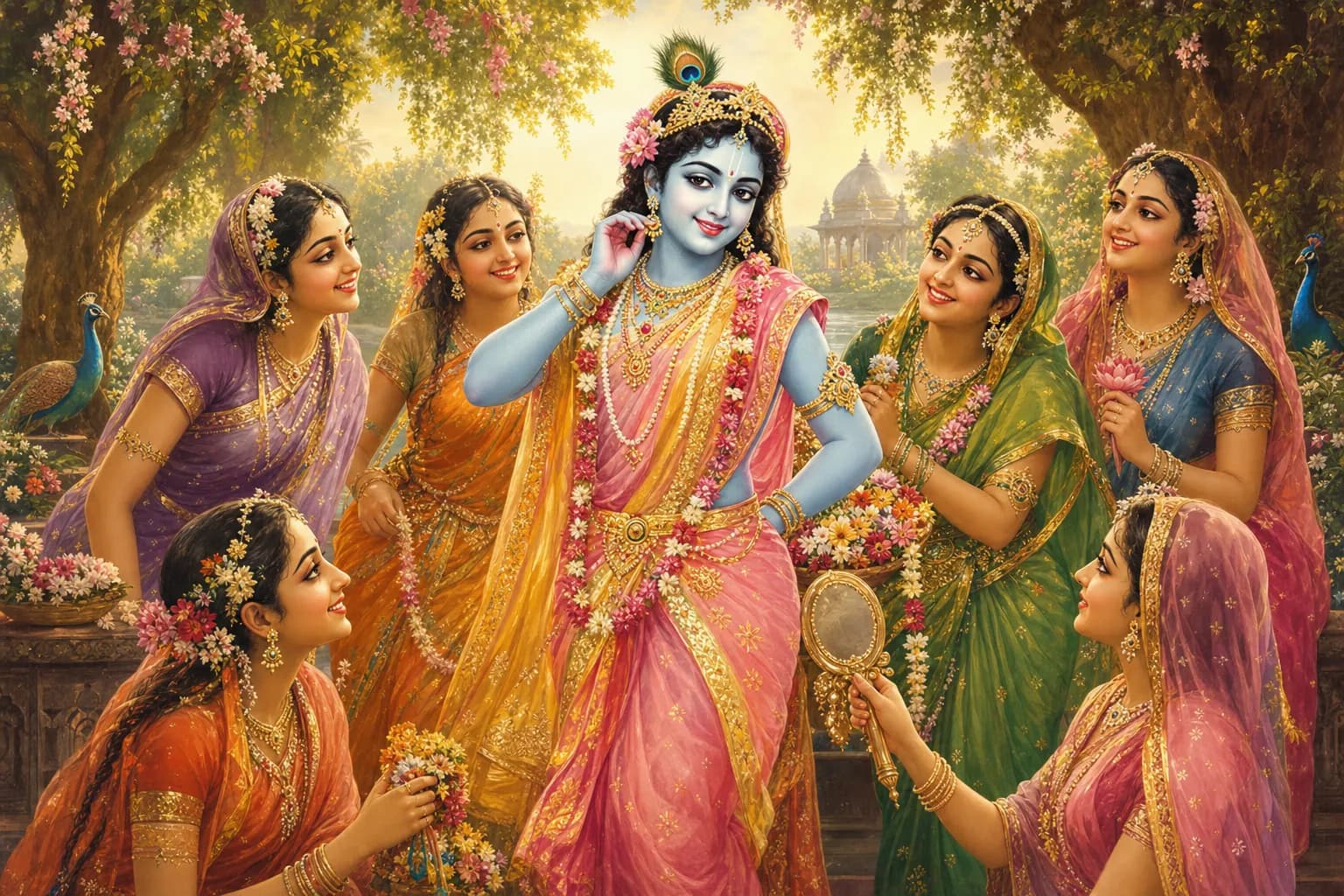
When Krishna Dressed as a Gopi
Why Krishna disguised himself as a gopi to end Radha's maan, where the story comes from, and how it differs from two other gopi tales.
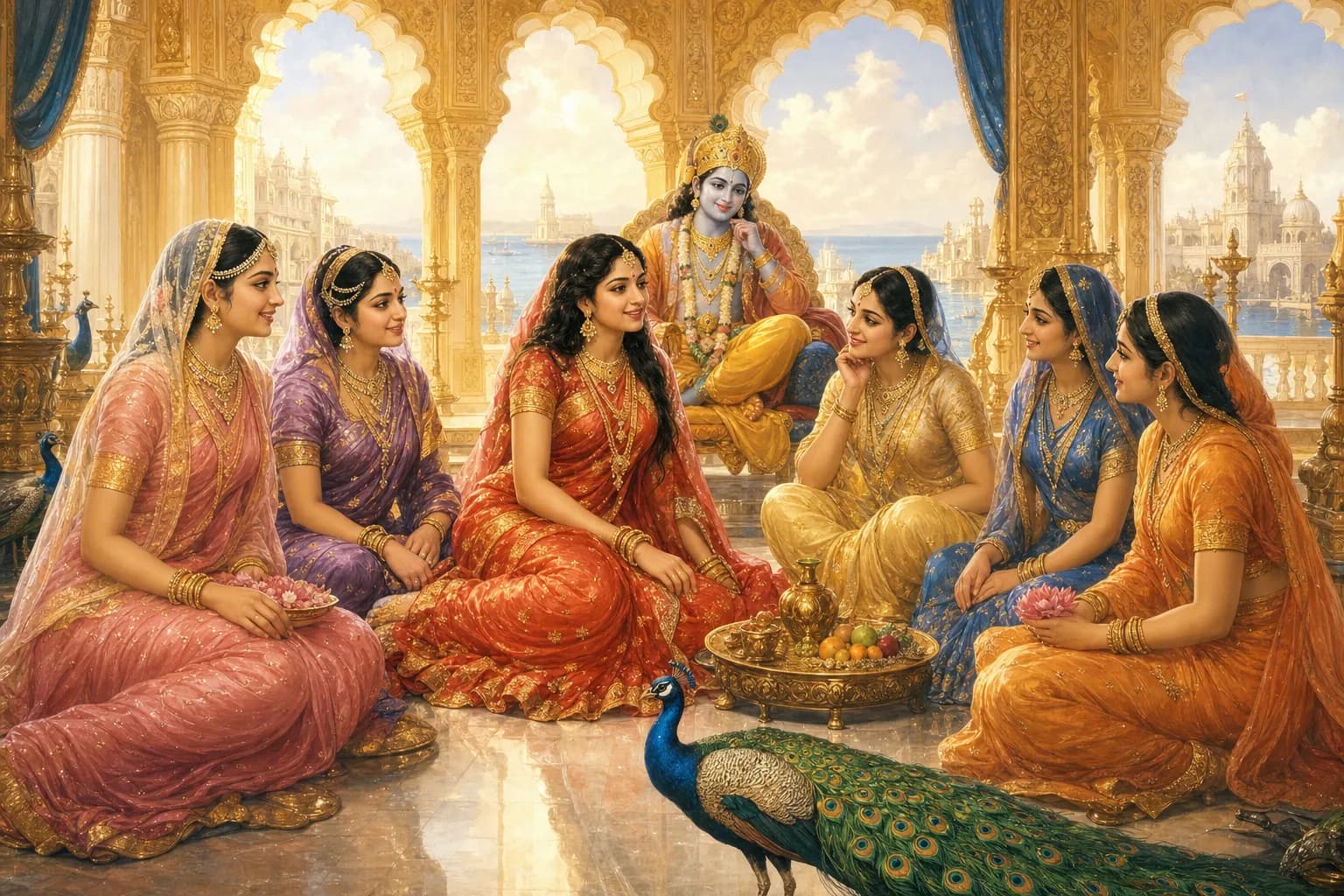
When Draupadi Met Krishna's Queens
How Draupadi asked each of Krishna's eight queens the way she married him, told in Bhagavata Purana Canto 10, Chapter 83.
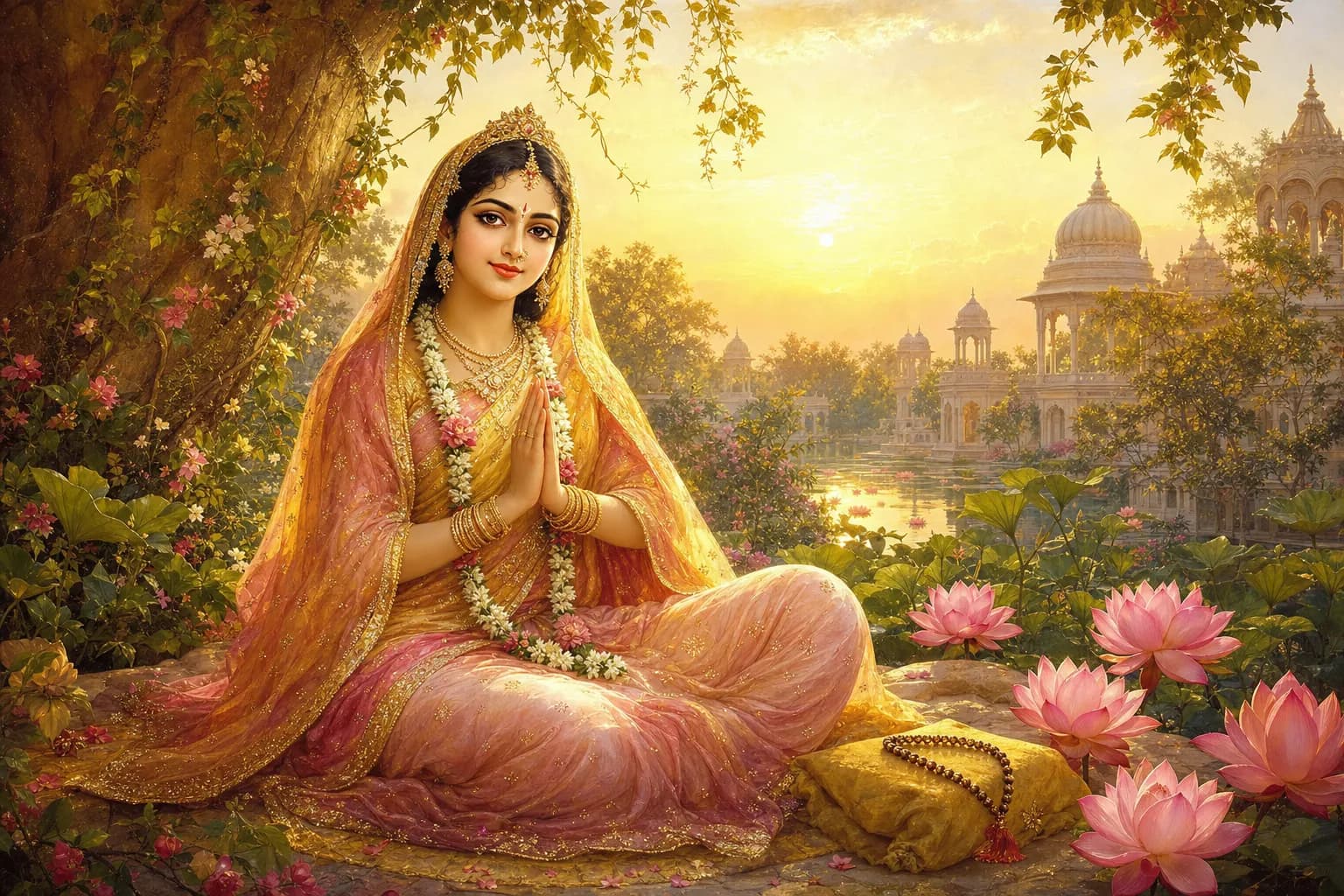
Radha Sahasranama: The 1008 Names of Radha Rani
The Radha Sahasranama, the thousand names of Srimati Radharani: where it comes from, why devotees chant it, and the full sung name list.