
Radha Krishna
Radha Krishna
Radha and Krishna are worshipped together as one divine reality. Krishna is the Supreme Lord of Vrindavan and Radha is his eternal beloved and perfect devotee, so most Vaishnava schools treat her as his own inner energy rather than a separate goddess. Their love is read as the union of the soul with God, which is why bhakti places her name first and greets with Radhe Radhe.
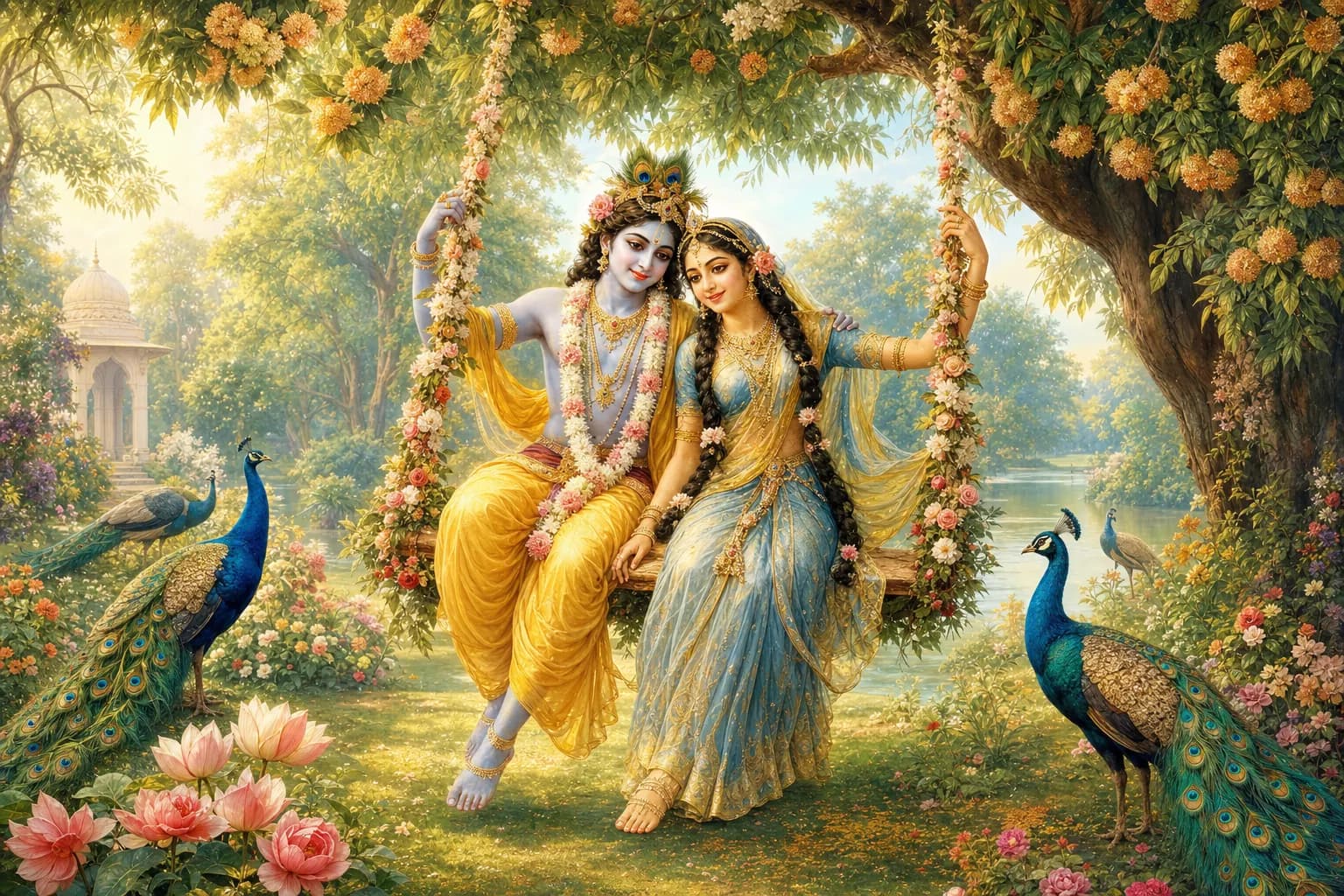
What Does Radha Krishna's Love Symbolize?
Radha Krishna's love symbolizes the union of the soul and God, the bhakti ideal of pure devotion. Here is what each scripture and tradition actually says.
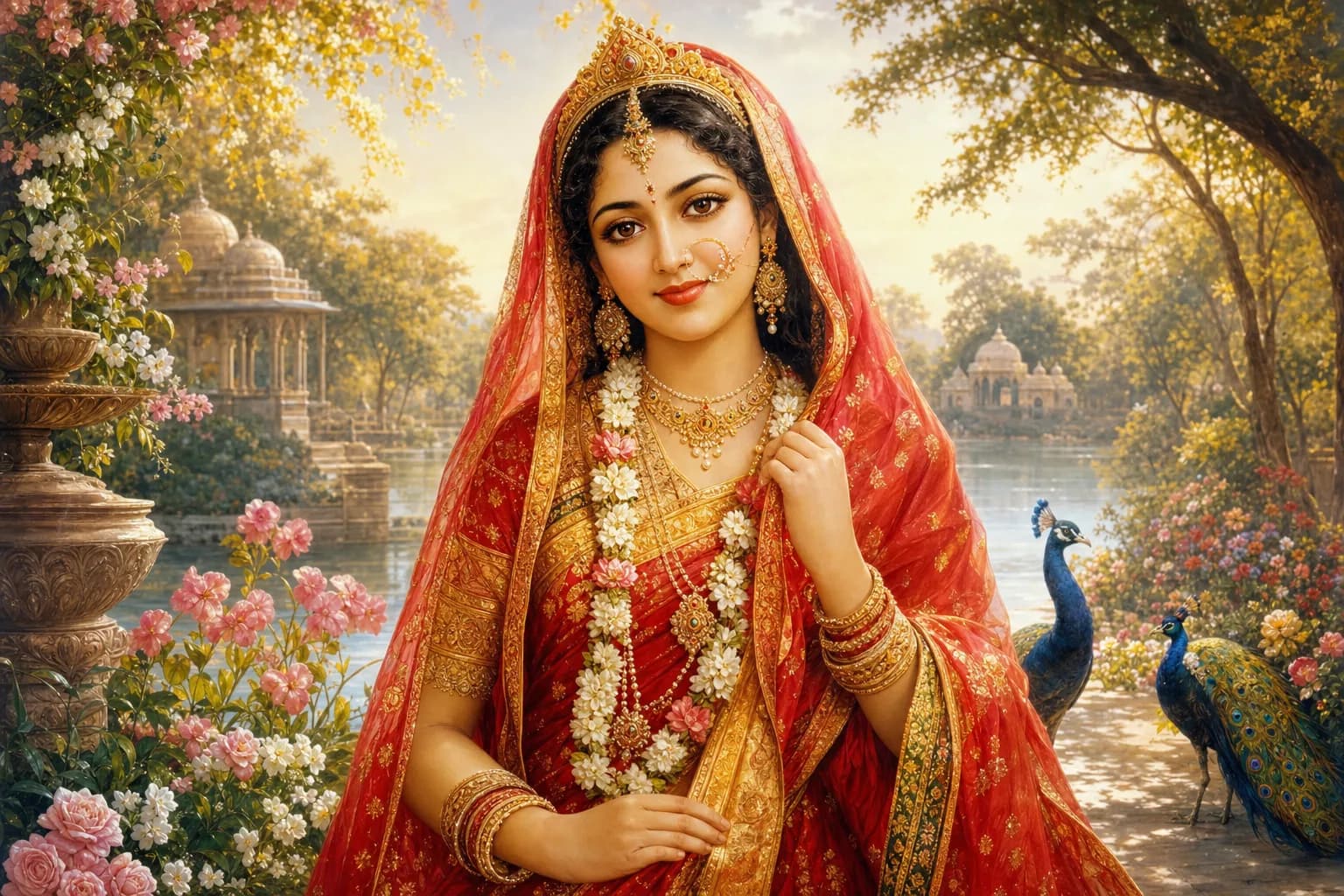
Who is Radha?
Who Radha is, the scriptures she appears in, and what each Vaishnava tradition says about Krishna's beloved, sourced and labelled.
Radha and Krishna are worshipped together as one divine reality. Krishna is the Supreme Lord of Vrindavan and Radha is his eternal beloved and perfect devotee, so most Vaishnava schools treat her as his own inner energy rather than a separate goddess. Their love is read as the union of the soul with God, which is why bhakti places her name first.
This is the starting point for everything on this site. Below is who they are, where their story happens, when it is celebrated, and where to go next.
Who are Radha and Krishna?
Krishna is God in his most approachable form. Not a distant ruler, but a cowherd boy who steals butter, plays the flute, and lets himself be tied up by his mother. That accessibility is the point. The Bhagavata Purana gives him a full life, from Mathura to Vrindavan to Dwarka, and the Bhagavad Gita gives him his teaching.
Radha is the answer to that God. She is the greatest of the gopis of Vrindavan and the one whose love for Krishna exceeds everyone else's. Her name comes from the Sanskrit root radh, to worship or to bring to perfection, so the name itself means the perfect worshipper. Who is Radha sets out the texts she appears in and what each tradition teaches about her.
Put the two together and you have the whole of bhakti in one image. Krishna shows what God is. Radha shows what a devotee is.
Why are they worshipped as one and not as two?
Because the tradition does not treat Radha as a second deity standing next to Krishna. Gaudiya theology calls her his hladini shakti, his own pleasure potency taking a separate form, which is why the Chaitanya Charitamrita (Adi-lila 1.5) describes the two as one identity in two bodies. Nimbarka's school was among the earliest to worship the pair together as the supreme divine couple.
You can see it in the deities themselves. In Vrindavan, Banke Bihari is worshipped as Radha and Krishna merged into a single form.
There is one thing worth knowing early, because it surprises people. The Bhagavata Purana speaks of Radha without naming her. She is the favoured gopi of verse 10.30.28, whose word aradhita means "she who worshipped him perfectly", and the acharyas read that veiling as concealment, the text guarding what is most intimate rather than displaying it. Her name comes into full view later, above all in Jayadeva's Gita Govinda. What their love symbolizes works through what that means.
Where does their story actually take place?
In Braj, a stretch of country around Mathura in Uttar Pradesh that pilgrims still walk today. The story is not set in an abstract heaven. It has an address.
| Place | What it is known for |
|---|---|
| Mathura | Krishna's birthplace, where he was born in Kansa's prison |
| Gokul | Where Nanda and Yashoda raised him as an infant |
| Vrindavan | The forest of his youth and the raas lila; still the centre of Radha Krishna worship |
| Barsana | Radha's town, with the Radha Rani temple on the hill and the famous Lathmar Holi |
| Nandgaon | Nanda's village, the family's home after they left Gokul |
| Govardhan | The hill Krishna lifted to shelter Braj from Indra, circled on a 21 km parikrama |
| Radha Kund and Shyam Kund | Twin ponds on the Govardhan route, among the most revered spots in Gaudiya practice |
Gaudiya tradition places Radha's birth at Raval and her later home at Barsana, while most popular accounts name Barsana directly. The birth of Radharani lays out both. Our temples section covers where to have darshan.
When are Radha and Krishna celebrated?
Four festivals carry the pair through the Hindu year. Dates shift against the Gregorian calendar because they follow lunar tithis.
| Festival | Hindu month | What is celebrated |
|---|---|---|
| Holi and Lathmar Holi | Phalguna purnima (Feb to Mar) | Spring and colour; at Barsana the men of Nandgaon are driven off with sticks by Radha's women, replaying a Braj legend |
| Krishna Janmashtami | Bhadrapada, krishna paksha ashtami (Aug to Sep) | Krishna's birth, observed at midnight |
| Radhashtami | Bhadrapada, shukla paksha ashtami (Aug to Sep) | Radha's appearance day, fifteen days after Janmashtami |
| Sharad Purnima | Ashwin purnima (Sep to Oct) | The full moon night of the maha raas, described in Bhagavata Purana 10.29 to 10.33 |
The festivals section goes deeper on each.
How do devotees actually worship them?
Mostly by saying their names. In Braj the ordinary greeting is not hello, it is Radhe Radhe, and it is painted on walls and tree trunks across Vrindavan. Radhe is the vocative of Radha, so the greeting is a small act of calling on her.
Beyond that, the practice is chanting. The Hare Krishna maha mantra is the most widely chanted of all, and many devotees read Hare as an address to Radha herself. The Radha Sahasranama gives her thousand names, chanted especially around Radhashtami. All of it sits in prayers and mantras.
Where should I start on this site?
Depends what brought you here.
If you want the theology, read who Radha is and then what their love symbolizes.
If you want the narrative, the stories section has Radha's birth and the day Krishna dressed as a gopi.
If you came with a specific doubt, the questions section answers the ones people ask most, with sources: why Krishna did not marry Radha, whether Radha is an incarnation of Lakshmi, and why Krishna is blue.
Frequently asked questions
Are Radha and Krishna married?
Braj and Gaudiya tradition describes a secret gandharva marriage at Bhandirvan officiated by Brahma. The Bhagavata Purana records no marriage between them, and Krishna's royal marriages to Rukmini and others belong to his later life in Dwarka.
In the Vrindavan lila their love is deliberately kept outside marriage as the model of love that asks for nothing back.
Is the Radha Krishna love story real?
Devotees hold their lila to be eternal rather than an event fixed to a date. Krishna appears across the Mahabharata, the Bhagavad Gita and the Bhagavata Purana, and Braj treats every hill and pond in the story as real ground.
Radha comes into full view by name later, in poetry like Jayadeva's Gita Govinda in the 12th century. Taken together this is scripture and devotion rather than documented history.
Where did Radha and Krishna first meet?
Braj tradition gives more than one answer. Prem Sarovar near Barsana is widely shown as the spot of their first meeting, and Sanket, between Barsana and Nandgaon, is honoured as the place where their meetings were arranged.
Braj remembers this in more than one place, and local tradition carries it further here than any single text.
What does Radha Krishna symbolize?
The union of the individual soul with God. Krishna is the divine, Radha is the soul in perfect longing, and their love is the language bhakti uses for that relationship.
Their separation carries the same weight as their union, because a heart that remembers God in his absence is treated as the most devoted of all.
Which book should I read to understand their complete story?
Start with the Bhagavata Purana, Canto 10, chapters 29 to 33, which holds the raas lila. Then read Jayadeva's Gita Govinda, the first great poem to put Radha at the centre.
For the theology of why the two are one, read the opening chapters of the Chaitanya Charitamrita. The Brahma Vaivarta Purana and the Garga Samhita develop Radha's own story in most detail.