
Prayers
Prayers & Mantras
Prayers to Radha and Krishna come in a few distinct forms. A mantra is a short sound formula you repeat, like the Hare Krishna maha mantra. A stotra is a Sanskrit hymn of praise, like the Madhurashtakam. A bhajan is a devotional song, kirtan is that singing done together, and aarti is sung while lamps are offered. This section gathers them with lyrics, sources and meaning.
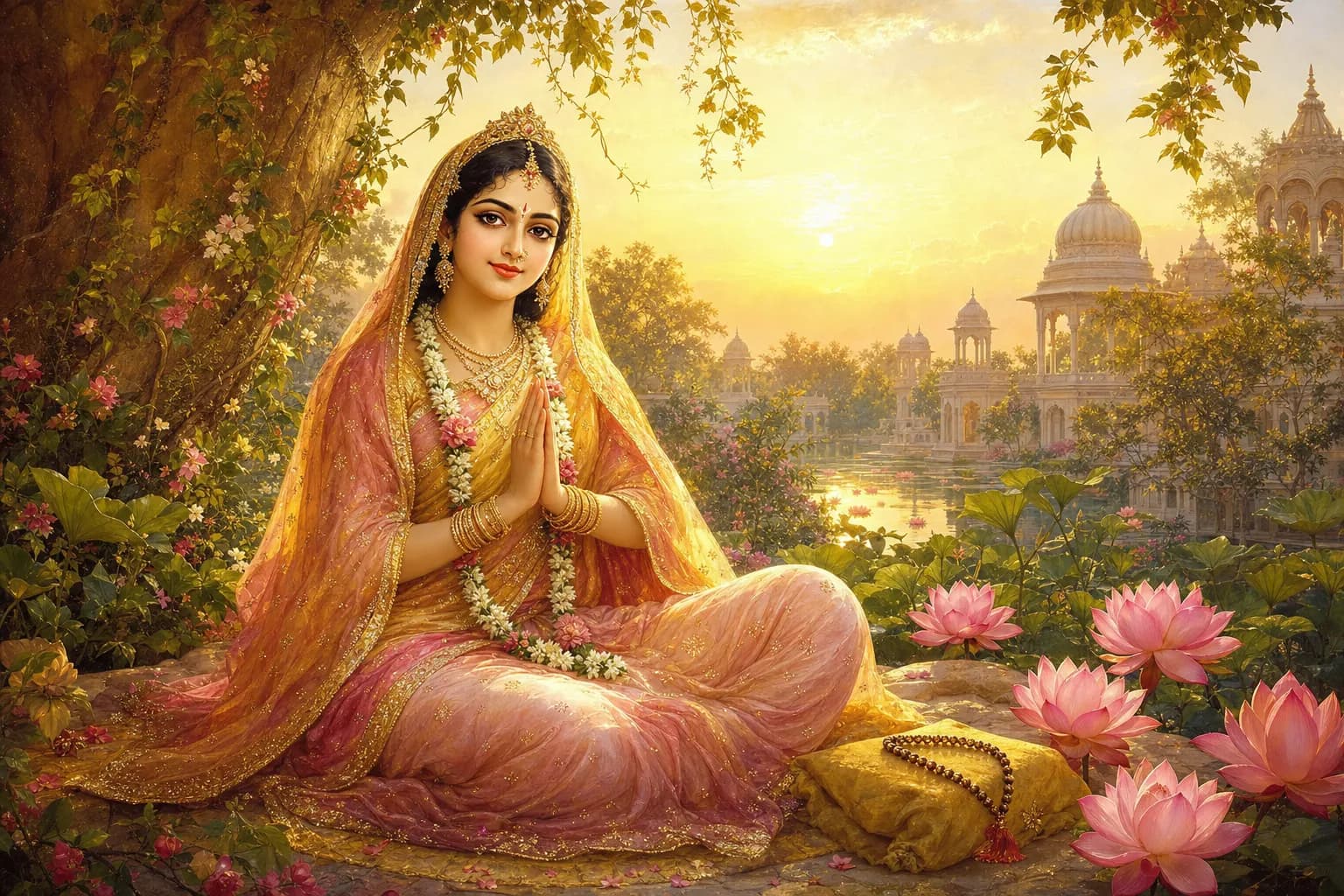
Radha Sahasranama: The 1008 Names of Radha Rani
The Radha Sahasranama, the thousand names of Srimati Radharani: where it comes from, why devotees chant it, and the full sung name list.
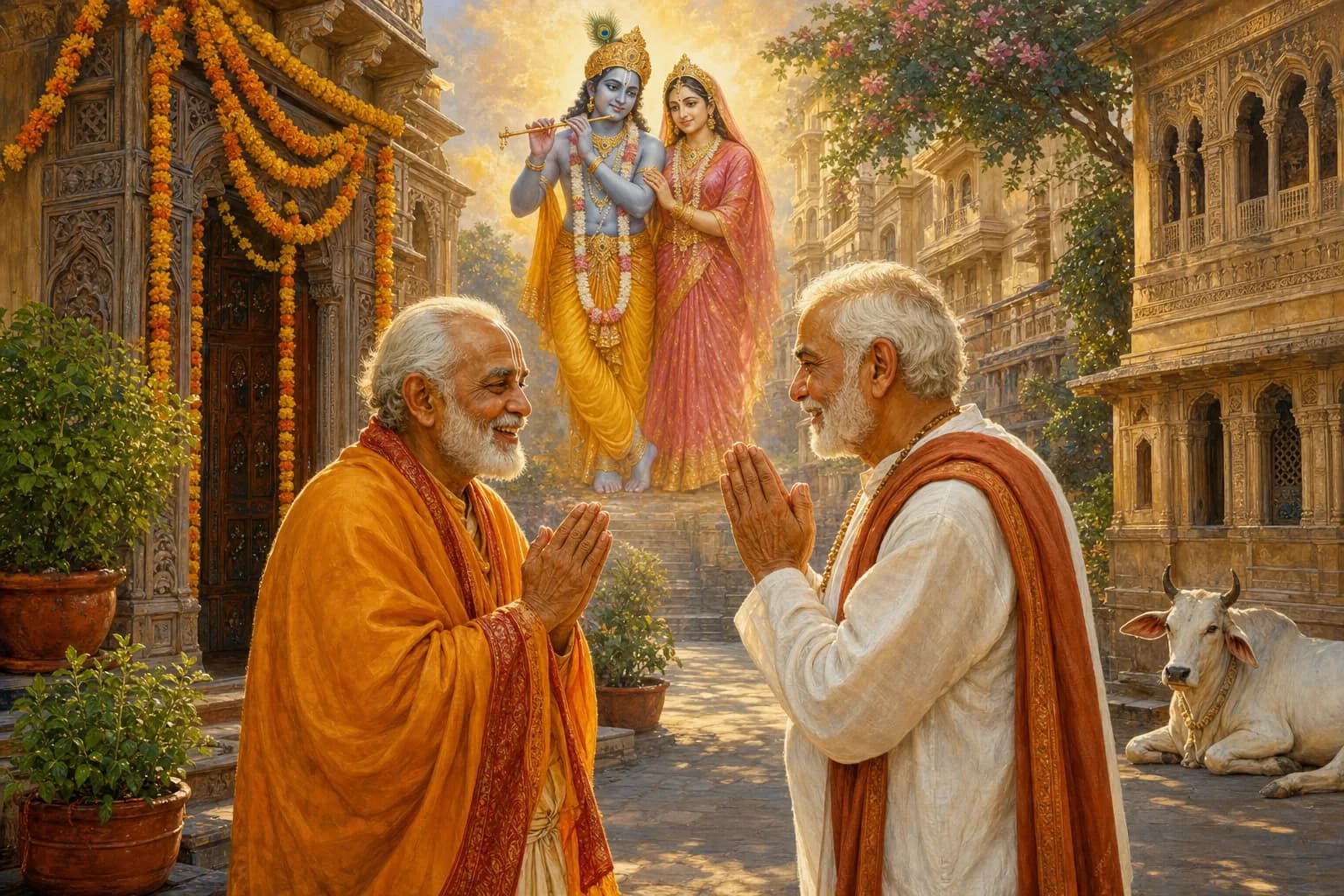
Radhe Radhe
Radhe Radhe, the greeting of Braj and the name our lineage holds above all others. What it means, why it is said twice, what to reply, and how devotees chant it.
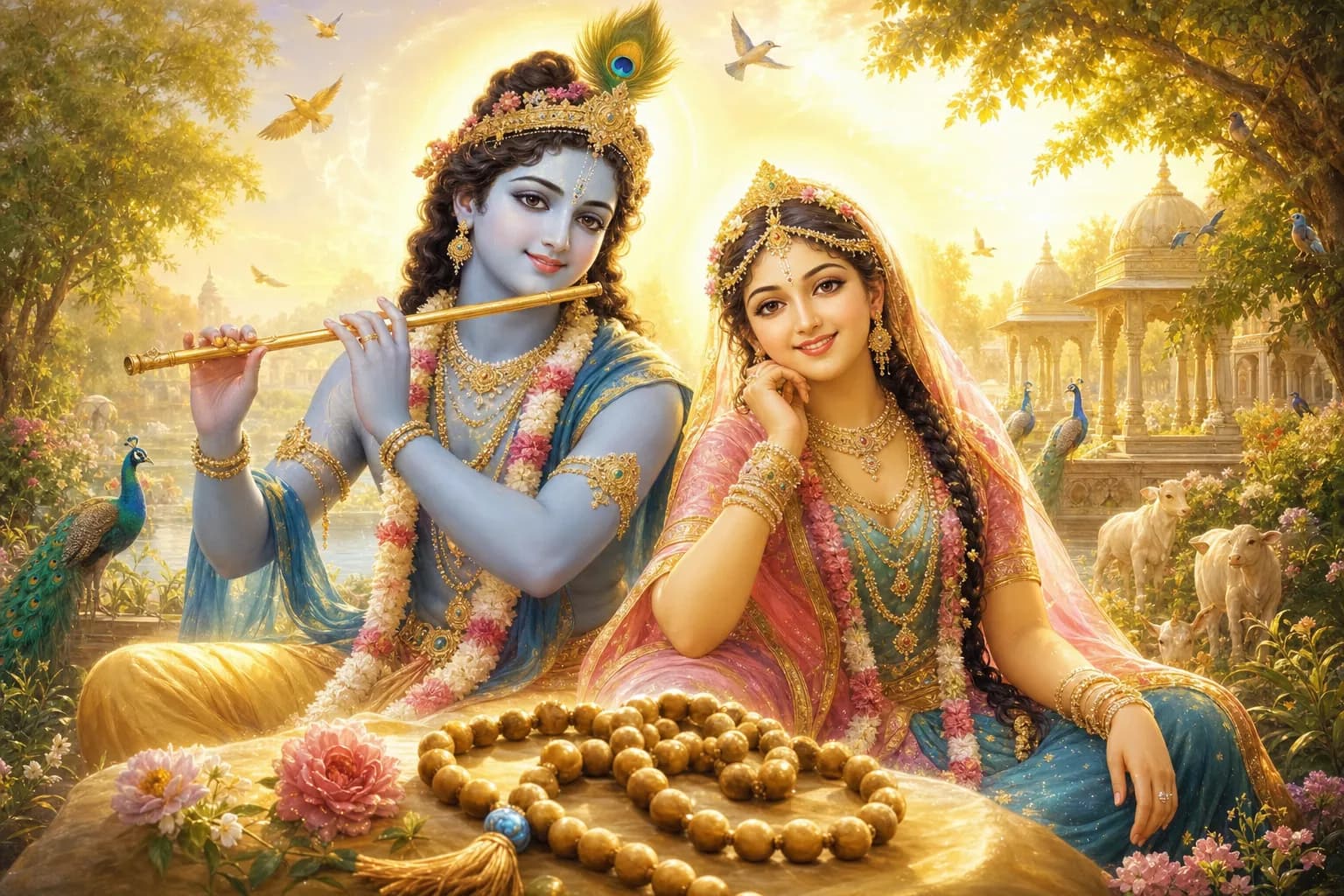
The Hare Krishna Maha Mantra
The Hare Krishna maha mantra explained: its 16 words, meaning, scriptural source in the Kali-Santarana Upanishad, and how to chant it.
Prayers to Radha and Krishna come in a few distinct forms, and knowing which is which makes this whole section easier to use. A mantra is a short sound formula you repeat. A stotra is a Sanskrit hymn of praise. A bhajan is a devotional song, kirtan is that singing done together, and aarti is what is sung while lamps are offered. Everything gathered here is one of those.
What is the difference between a mantra, a stotra and a bhajan?
They are not interchangeable words for prayer. Each has its own shape and its own setting.
| Form | What it is | Example | How it is usually done |
|---|---|---|---|
| Mantra | A short sound formula, repeated | Hare Krishna maha mantra | Alone and counted, on a 108-bead mala |
| Naam jap | Repetition of a single name | Radhe Radhe | Any time, aloud or under the breath |
| Stotra | A Sanskrit hymn of praise, recited once through | Madhurashtakam, by Vallabhacharya | Recited, often at morning worship |
| Bhajan | A devotional song, often in a regional language | Radha Sahastra Naam Yatra | Sung solo or with a small group |
| Kirtan | Call and response singing of the names | Hare Krishna kirtan | Together, with harmonium, mridanga, kartals |
| Aarti | A song sung while lamps are offered to the deity | Temple aarti | At the fixed hours of temple worship |
The line that matters most is repetition. A mantra is said over and over. A stotra or a bhajan runs from a first verse to a last one. You might chant Hare Krishna a thousand times in a morning. You would not do that with the Madhurashtakam, you would recite its eight verses.
Which mantra should you chant for Radha Krishna?
There is no single official answer here, and anyone who gives you one is speaking for their tradition rather than for Hinduism as a whole. Three are the most widely chanted.
The Hare Krishna maha mantra is the best known. Sixteen names, thirty-two syllables, and a named scriptural source in the Kali-Santarana Upanishad of the Krishna Yajurveda. Gaudiya Vaishnavas and ISKCON build an entire practice on it. Read the Hare Krishna maha mantra for the words, what each name means, and the honest disagreement about which half comes first.
Radhe Radhe is the simplest. Radhe is the vocative of Radha, so you are calling her by name, twice. In Braj it doubles as an everyday greeting in place of hello, and you will see it painted on walls and tree trunks across Vrindavan and Barsana. In temples the variant Jai Shri Radhe is common.
The names of Radha herself. The Braj traditions chant her name first and reach Krishna through her. The Radha Sahastra Naam Yatra is a sung journey through a thousand and eight of those names.
If you are choosing for the first time, pick the one you can actually keep saying. Attention beats ambition.
Is there a right time, a minimum count, or rules to clear first?
This is the commonest worry, and the tradition's own answer is reassuring.
Chaitanya Mahaprabhu's Shikshashtaka, verse 2, quoted in the Chaitanya Charitamrita (Antya 20.16), says God has invested all his potency in his names and placed no restriction of time on remembering them. The phrase is niyamitah smarane na kalah, no consideration of time. The Kali-Santarana Upanishad makes the same point about the maha mantra, that it can be chanted whatever state you happen to be in. So on the questions people quietly search for, can I chant at night, without a bath, during my period, the tradition's own texts say yes.
Counting is a tool rather than a rule. Japa is done on a mala of 108 beads, one repetition per bead, and a full circuit is called a round. ISKCON initiates vow to sixteen rounds a day. That is a vow inside one movement, not a universal minimum, and Vaishnava teachers are open that the number 108 comes down through parampara rather than from a single quoted verse.
Scripture is warm on the practice itself. In the Bhagavad Gita 10.25 Krishna says that among sacrifices he is japa, the chanting of names. Prahlada's list of the nine limbs of devotion in the Bhagavata Purana 7.5.23 opens with shravanam and kirtanam, hearing and chanting. And the Bhagavata Purana 12.3.51 says the one great virtue of this difficult age is that by kirtana of Krishna a person can be freed.
Do you need a guru, or Sanskrit?
For a diksha mantra, the initiation mantra a sampradaya gives you, yes. That is the whole point of it. The Vaishnava lines each have their own, and it arrives with a relationship, a discipline, and a teacher who answers for you.
For the maha mantra, for Radhe Radhe, for singing a bhajan at home, no. These are public and always have been. Chaitanya's movement in sixteenth-century Bengal was built on handing them out in the street. Sanskrit is not a gate either. Knowing what the words mean helps your attention, so it is worth learning, but nobody has to pass a language test first. Every page here carries a translation for that reason.
What else belongs in this section?
Devotional poetry for this pair goes well beyond the short mantras. Vallabhacharya's Madhurashtakam, eight verses in which everything about Krishna is sweet, is a Pushtimarg favourite. Jayadeva's Gita Govinda, a twelve-canto Sanskrit poem from the twelfth century, is the work that put Radha at the centre of the tradition's imagination. Aartis, ashtakams and the Braj bhajans sit in the same family. We are adding them one at a time, each with lyrics, transliteration, meaning and a sourced note on where it comes from.
Where to go next
For the pair behind the prayer, start with Radha Krishna and who Radha is. The stories give you the pastimes these songs keep referring to, which is why a line about the flute or the kadamba tree lands differently once you know the leela behind it.
For the scriptural questions, including why Krishna never married Radha, see questions. The festivals are when most of this singing actually happens, and the temples of Braj are where you can still hear it at four in the morning.
Frequently asked questions
Which mantra should I chant for Radha Krishna?
There is no single official one. The three most widely chanted are the Hare Krishna maha mantra, the name Radhe Radhe, and the names of Radha herself.
Gaudiya Vaishnavas and ISKCON centre on the maha mantra, while Braj traditions lean on Radha's name. Pick the one you can keep saying with attention rather than the one that sounds most impressive.
Are a stotra and a mantra the same thing?
No. A mantra is a short sound formula meant to be repeated, often thousands of times, usually counted on beads. A stotra is a hymn of praise with a beginning and an end, recited once through.
The Hare Krishna maha mantra is a mantra. The Madhurashtakam, Vallabhacharya's eight verses on Krishna's sweetness, is a stotra.
What happens if I chant Radhe Radhe, and why say it twice?
Radhe is the vocative form of Radha, so Radhe Radhe means O Radha, O Radha. It is a calling, not a statement, and the doubling is how the name is naturally addressed in Braj.
In the Braj region it works as an everyday greeting in place of hello, and it is painted on walls and tree trunks around Vrindavan and Barsana. Jai Shri Radhe is the common temple variant.
How many times should I chant Radha's name?
No text sets a number that applies to everyone. Japa is counted on a mala of 108 beads, one repetition per bead, and a full circuit is called a round.
ISKCON initiates vow to sixteen rounds a day, but that is a vow inside one movement, not a general rule. A small count held with attention is worth more than a large one said absently.
Can I chant a mantra without a guru, or without knowing Sanskrit?
For a diksha mantra, the initiation mantra a sampradaya gives you, a guru is the whole point.
For the Hare Krishna maha mantra, for Radhe Radhe, and for any bhajan, no guru is needed. Chaitanya Mahaprabhu's movement was built on giving those away in the street. Sanskrit is not needed either, though knowing what the words mean will hold your attention better.