
Stories
Stories of Radha Krishna
The stories of Radha and Krishna are called lilas, the Sanskrit word for play. Most of Krishna's Vrindavan pastimes, from Putana to the Raas Lila, are told in the tenth canto of the Bhagavata Purana, which holds Radha within them unnamed. She is named and central in the Garga Samhita and the Brahma Vaivarta Purana, and in Jayadeva's Gita Govinda.
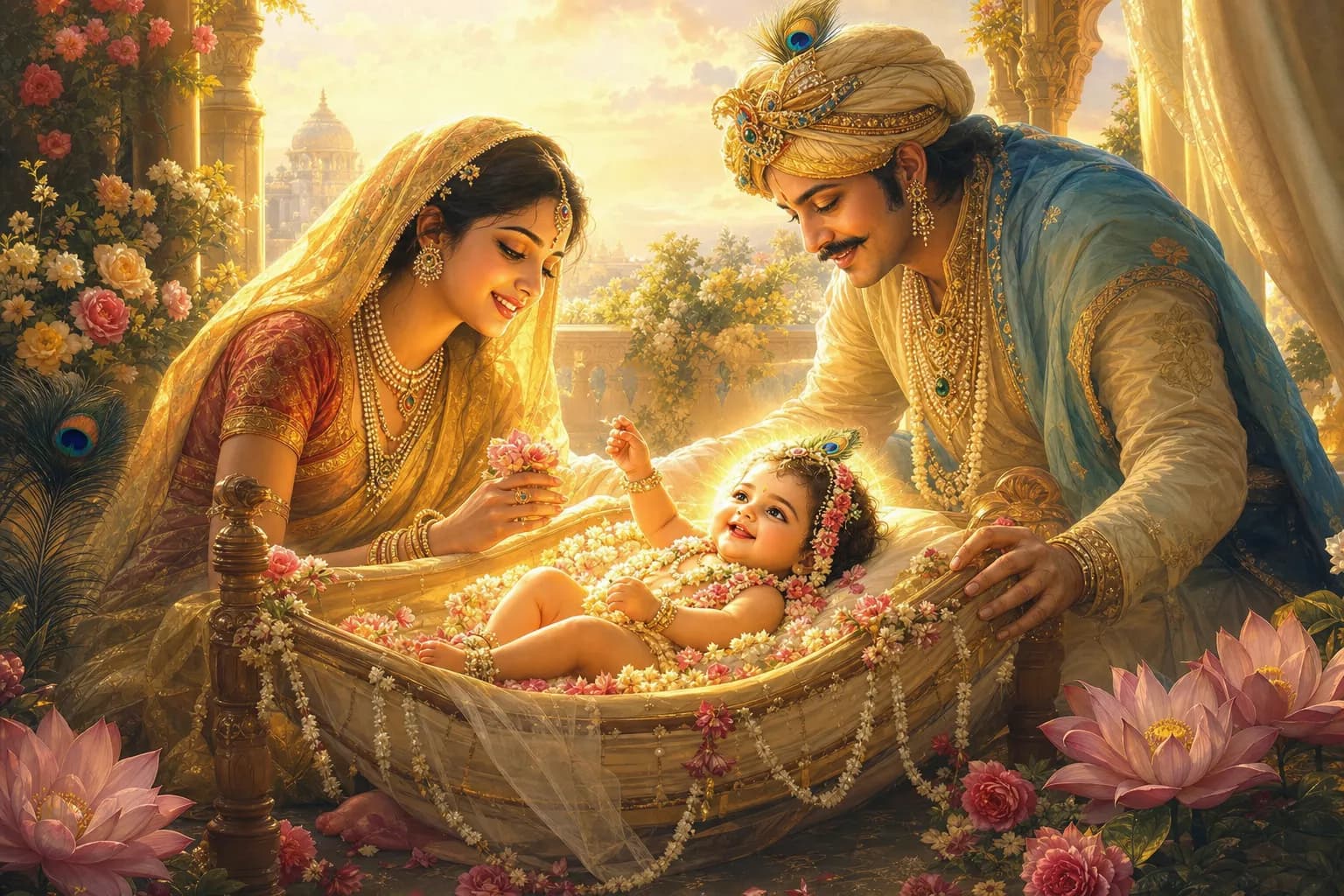
The Birth of Srimati Radharani
How Srimati Radharani was born, told scripture by scripture: the Garga Samhita, the Brahma Vaivarta Purana, her parents, the lotus, and Radhashtami.
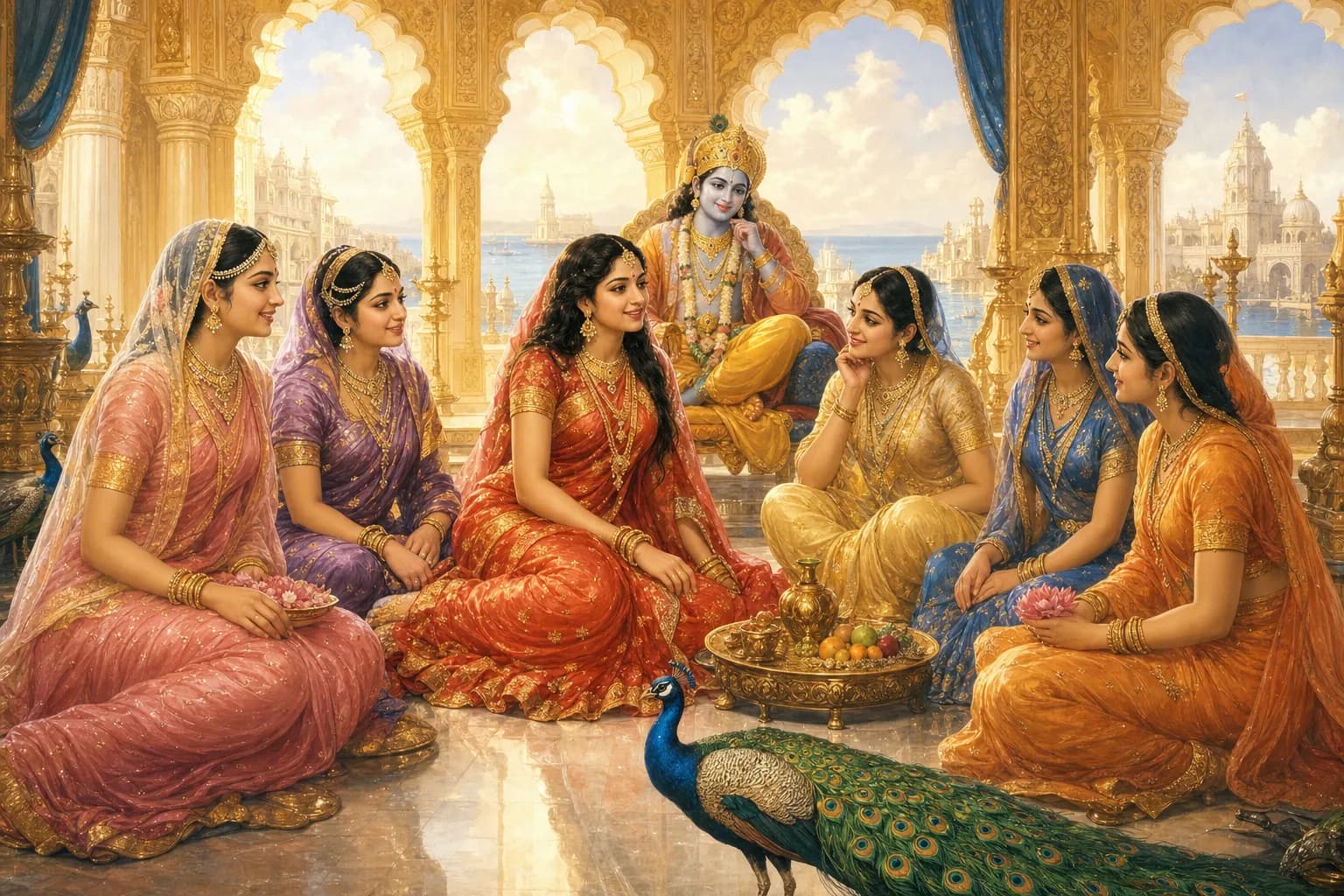
When Draupadi Met Krishna's Queens
How Draupadi asked each of Krishna's eight queens the way she married him, told in Bhagavata Purana Canto 10, Chapter 83.
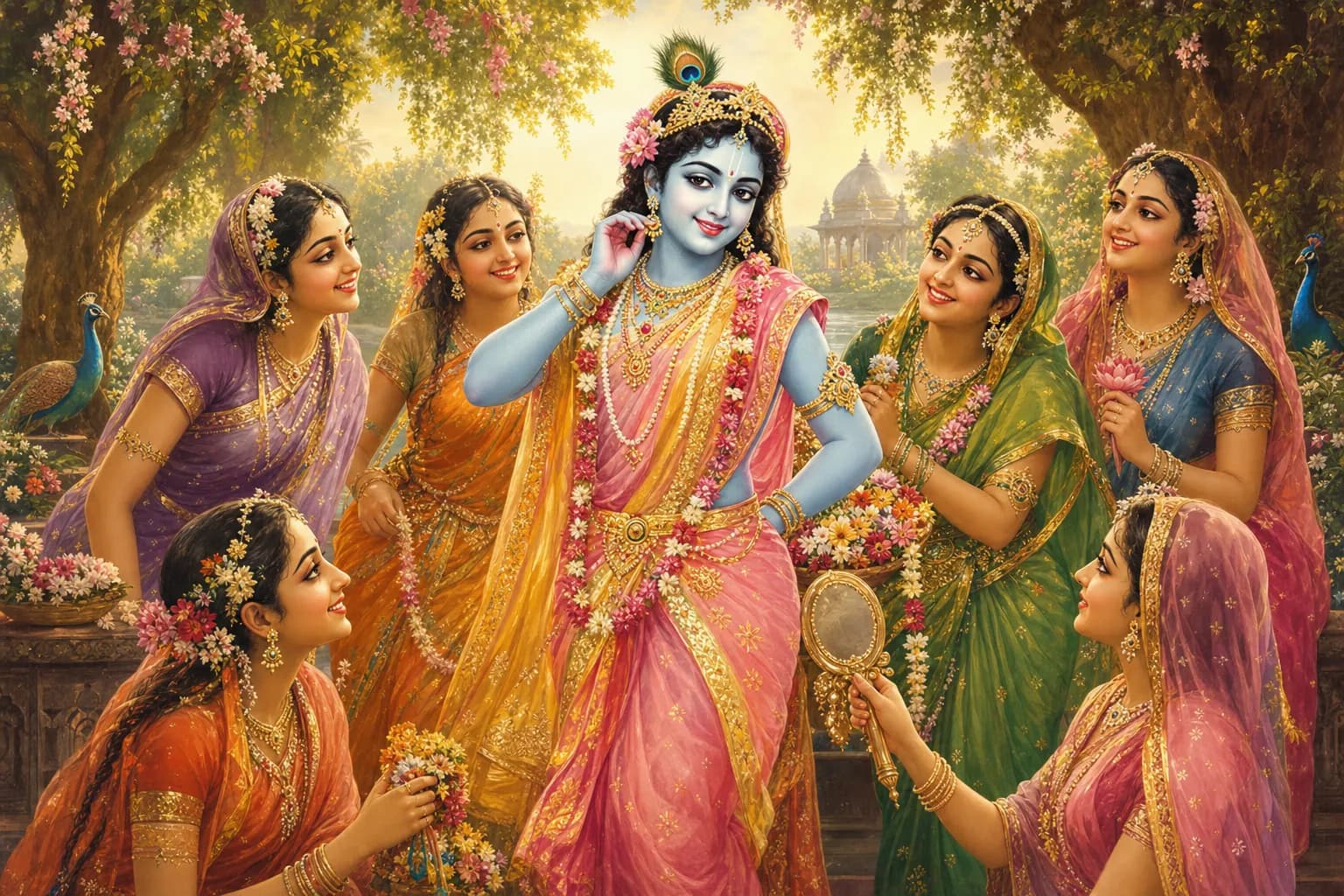
When Krishna Dressed as a Gopi
Why Krishna disguised himself as a gopi to end Radha's maan, where the story comes from, and how it differs from two other gopi tales.
The stories of Radha and Krishna are called lilas, the Sanskrit word for play. Most of Krishna's Vrindavan pastimes, from Putana to the Raas Lila, are told in the tenth canto of the Bhagavata Purana, which holds Radha within them unnamed. She is named and central in the Garga Samhita and the Brahma Vaivarta Purana, and in Jayadeva's Gita Govinda.
That layering surprises almost everyone, and it is the right place to begin. This page lays out what each of the great lilas is, which text carries it, and where to go next.
Key takeaways
- Lila means play. The word is a claim about why Krishna acts, not only about what he does.
- The Bhagavata Purana, Canto 10, holds most of the famous pastimes, each with a chapter you can look up.
- The Bhagavata Purana holds Radha unnamed, and the acharyas read her in the gopi of 10.30.28.
- She is named and central in the Brahma Vaivarta Purana, the Garga Samhita, and Jayadeva's 12th century Gita Govinda.
- Braj still keeps the stories in place and in season, at Barsana, at Govardhan, and on Sharad Purnima.
What does lila mean, and why are these called lilas?
Lila, also spelled leela, is Sanskrit for play or sport. Shankara used the image of a king engaged in a game. The act is deliberate and conscious, and there is no ulterior motive behind it. That is the difference the word is pointing at. Krishna does not lift a hill because he needs to. He lifts it the way a child picks up a mushroom, and the tradition reads the ease itself as the teaching.
So a lila is a story with a claim inside it. Read it as an anecdote and it is charming. Read it as lila and it is saying something about how God relates to the world.
Which stories should you know first?
These are the pastimes people ask about most, with the text that carries each one. Where the story is told in full here, the name links to it.
| The lila | What happens | Where it is told |
|---|---|---|
| Putana | Krishna, still an infant, ends the demoness Kamsa sent to kill him | Bhagavata Purana 10.6 |
| Makhan chori and Damodara | Yashoda catches the butter thief and binds him to a mortar with a rope that will not reach | Bhagavata Purana 10.9 |
| Kaliya daman | Krishna subdues the serpent Kaliya in the Yamuna and then spares him | Bhagavata Purana 10.16 |
| Cheer haran | Krishna takes the young gopis' garments while they bathe | Bhagavata Purana 10.22 |
| Govardhan | Krishna holds the hill on one hand for seven days while Indra's storm breaks over Braj | Bhagavata Purana 10.24 to 10.27, the lifting in 10.25 |
| The Raas Lila | The autumn night dance with the gopis, and the Gopi Gita they sing when he vanishes | Bhagavata Purana 10.29 to 10.33 |
| The birth of Radharani | Vrishabhanu finds a radiant infant, and she opens her eyes only for Krishna | Garga Samhita 1.8, Brahma Vaivarta Purana |
| Krishna dressed as a gopi | Krishna disguises himself to end Radha's maan, her loving sulk | Braj and Gaudiya maan lila rather than the Bhagavata |
| Draupadi and Krishna's queens | Eight queens each tell Draupadi how they came to marry him | Bhagavata Purana 10.83 |
Where do these stories actually come from?
Four bodies of text carry nearly all of it, and they do not say the same things.
| Text | What it gives you | How Radha appears |
|---|---|---|
| Bhagavata Purana, Canto 10 | The childhood lilas, Govardhan, the Raas Lila, Dwarka, the queens | Present unnamed, in the gopi of 10.30.28 |
| Brahma Vaivarta Purana | Radha as Krishna's eternal other half, in her own right | Named |
| Garga Samhita | Radha's birth and the Braj pastimes in devotional detail | Named |
| Gita Govinda, Jayadeva, 12th century | Radha as the named beloved, union and separation as poetry | Named |
Read only the Bhagavata and Radha stays veiled. Read only the Gita Govinda and you get the love without the cosmology. Most devotees hold both. That is why each page here names the text a detail comes from instead of blending them into one smooth story.
Where is Radha in the Bhagavata Purana?
She is there at verse 10.30.28, where the gopis notice that Krishna has left them all and taken one gopi aside, and say she must have worshipped him perfectly. Gaudiya commentators read that gopi as Radha, and hear her name inside aradhita, the word for that perfect worship. On their reading the Bhagavata carries her through the Raas this way, present without her name spoken, concealing what is most intimate rather than leaving it out. Other readers take the verse differently, and that difference is one of the live conversations in the tradition.
Her name and her theology are given in full by the Puranas that name her and by Jayadeva. For the fuller picture, read who Radha is and what their love symbolizes.
How do these stories live on in Braj today?
Braj remembers by geography and by calendar. Barsana is Radha's town, Nandgaon is the village of Nanda Maharaj where Krishna spent his boyhood, Govardhan is the hill itself, and Vrindavan is where the Raas is set. You can walk all of them in a few days. Our temples and Braj pages cover what each place is known for.
The calendar carries the rest. Janmashtami falls on the eighth day of the dark fortnight of Bhadrapada, Radhashtami on the eighth day of the bright fortnight of that same month, and Sharad Purnima, the autumn full moon of Ashwin, is kept as Raas Purnima, the night of the Maha Raas. See festivals for the year.
Where should you start here?
Start with the birth of Radharani if you want the beginning of the story. Read when Krishna dressed as a gopi for the tenderest of the Braj lilas, and when Draupadi met Krishna's queens for the Dwarka side of his life.
From there, questions takes up what the stories leave open, like why Krishna did not marry Radha. Prayers and mantras gives you the words the tradition sings them in, including the Hare Krishna maha mantra. The whole cluster sits under Radha Krishna.
Sources
- Bhagavata Purana 10.6, 10.16, 10.22, 10.30 and 10.83, Vedabase
- Bhagavata Purana 10.9, 10.25, 10.29, 10.31 and 10.33, srimadbhagavatam.org
- Garga Samhita 1.8, Description of Shri Radhika's Birth, Wisdomlib
- Gitagovinda and Jayadeva, Britannica
- Lila (Hinduism), Wikipedia
- Janmashtami and Sursagar, Britannica
Frequently asked questions
What does lila (leela) mean?
Lila is Sanskrit for play or sport. In Vedantic thought it means an act done out of fullness rather than need.
Shankara used the image of a king playing a game: the act is deliberate, and there is no ulterior motive behind it. That is why Krishna's deeds are called lilas and not simply events.
Which book should I read for the complete Radha Krishna story?
The story is held across several books, which is why the question comes up so often.
Start with the Bhagavata Purana, Canto 10, for Krishna's childhood, Govardhan and the Raas Lila. Then read Jayadeva's Gita Govinda for Radha as the named beloved. The Garga Samhita and the Brahma Vaivarta Purana fill in her birth and her place beside him. Braj poets like Surdas carry the rest in Braj Bhasha.
Is Radha mentioned in the Bhagavata Purana or the Bhagavad Gita?
The Bhagavata Purana tells the Vrindavan lilas and holds her within them without speaking her name. Gaudiya commentators read verse 10.30.28, about the one gopi Krishna took aside, as her, and hear her name inside aradhita, the word the gopis use there. Other readers take the verse differently.
The Bhagavad Gita is Krishna's teaching to Arjuna at Kurukshetra, a battlefield dialogue with no Vrindavan narrative in it, so the gopis are outside its subject altogether.
What is the Raas Lila, and where is it in scripture?
The Raas Lila is Krishna's autumn night dance with the gopis of Vrindavan. It is told in the Bhagavata Purana, Canto 10, chapters 29 to 33, the five chapters known as the rasa panchadhyayi.
Chapter 31 is the Gopi Gita, nineteen verses the gopis sing in his absence. Braj keeps the night as Sharad Purnima.
Are the Radha Krishna stories real?
It depends what you are asking. The places are real and you can walk them, from Mathura and Vrindavan to Barsana and Govardhan hill.
The texts are devotional literature rather than dated chronicle, and scholars date the texts, not the events. Devotees hold the lilas to be eternal and not fixed to one point in history. Each page here names the text a detail comes from, so you can weigh it yourself.