
Stories
When Krishna Dressed as a Gopi
Last updated 25 July 2026
The short answer
In the Braj devotional tradition, Krishna dressed as a gopi to end Radha's maan, her loving sulk after she heard he had lingered with a rival gopi. On a sakhi's counsel he disguised himself as a new cowherd girl, was led before Radha, and sang for her until her embrace gave him away and her anger melted. The story lives in Gaudiya maan-lila rather than in the Bhagavata Purana.
Key takeaways
- Krishna disguised himself as a gopi to win back Radha during her maan, her loving jealous sulk, on the advice of her sakhi Vishakha.
- The trigger was news, carried by Radha's pet parrot, that Krishna had delayed their meeting to spend time with a rival gopi named Chandravali.
- The story belongs to the Gaudiya and Braj maan-lila tradition rather than to the Bhagavata Purana, which tells the Raas with Radha present unnamed.
- Braj marks the pastime at Maan Mandir, also called Maan Garh, on a hill in Barsana.
- It is a different episode from Krishna stealing the gopis' clothes (Bhagavata Purana 10.22) and from Shiva taking gopi form as Gopeshwar Mahadev.
Krishna dressed as a gopi to end Radha's maan, her loving sulk after she heard he had spent time with another gopi. Nothing he tried worked, so on a sakhi's advice he came to her disguised as a new cowherd girl and sang for her, and her own embrace gave him away. It is one of the tender stories of Radha Krishna, and it comes down to us through the Braj devotional tradition rather than through the Bhagavata Purana.
Why did Krishna dress as a gopi?
He did it to be forgiven.
Radha was in maan, a jealous, loving anger, and she would not look at him or speak to him. Krishna tried the usual gestures and got nowhere. So he gave up his own form and came to her as someone she would welcome, a new gopi she had never met.
The disguise is the whole point of the story. Krishna, whom the gopis chase, could not get near the one person he wanted, so the Lord of the Raas made himself into an ordinary cowherd girl to sit at Radha's side.
What is Radha's maan, and how did it begin?
Maan is a loving quarrel. In the poetics of Braj it is a recognized mood of deep love, the sulk of someone who feels wronged precisely because they love you. It is not cold anger. It is closeness turned inside out.
Radha's maan began with a message. As the story is told in Braj, her pet parrot brought news that Krishna was late to meet her because he had been with a rival gopi named Chandravali. Radha heard it, and she withdrew.
Krishna came and found her unreachable. He put his head at her feet. He fanned her, held up a mirror, pleaded. She would not soften. He asked her sakhis for help, and they went back and forth between the two until they were worn out.
Then, in the popular telling, the sakhi Vishakha gave him the idea that worked. She dressed him as a gopi, named him Shyama Gopi, and brought him to Radha as a new friend who sang beautifully. Radha, pleased, asked the newcomer to sing. Krishna sang of love until Radha was so moved that she embraced the stranger, and in that touch she knew him. Her maan dissolved into the meeting she had been holding out for all along.
Vishakha and Lalita are two of Radha's ashta-sakhis, the eight principal companions who arrange and protect her meetings with Krishna. In this story they are the ones who make the reunion possible.
Which scripture tells this story?
This one comes from the Gaudiya and Braj tradition, carried in devotional literature and in the living lila rather than in a Puranic verse. Most retellings leave that unsaid.
The Bhagavata Purana, the great scriptural source for Krishna's life, holds Radha within the Raas without speaking her name. In 10.30 one favored gopi slips away with Krishna, and the tradition knows her as Radha. The maan-lila and the gopi disguise are carried by Braj instead.
Radha's maan enters famous literature with Jayadeva's Gita Govinda in the 12th century, a Sanskrit poem built around the love and the lovers' quarrel of Radha and Krishna. The specific story of Krishna disguising himself as a gopi to end that maan comes later still, from Gaudiya and Braj devotional literature and the living lila tradition of Barsana.
That later date leaves the story no less true to the people who tell it. It makes it a different kind of source, and one worth naming plainly.
| Text or tradition | What it gives the story | How to read it |
|---|---|---|
| Bhagavata Purana (c. 9th-10th c.) | The Raas Lila and the gopis' love; the one favored gopi of 10.30, unnamed | Classical scripture. The seed, with her name unspoken and the disguise still to come |
| Gita Govinda, Jayadeva (12th c.) | Radha and Krishna by name, and their maan as a central theme | Devotional poem. The earliest famous telling of Radha's maan |
| Gaudiya and Braj maan-lila | Krishna disguised as a gopi, Vishakha's plan, Chandravali, Maan Mandir | Later devotional literature and living Braj tradition. The source of this exact story |
Is this the story where Krishna steals the gopis' clothes?
No, and this is the most common mix-up. There are three different Braj stories with a gopi at the center, and they get folded into one.
| Story | What happens | Where it comes from |
|---|---|---|
| Krishna dresses as a gopi | Krishna disguises himself as Shyama Gopi to end Radha's maan | Gaudiya and Braj maan-lila tradition |
| Krishna and the gopis' garments | Krishna takes the young gopis' clothes while they bathe in the Yamuna, a lesson in surrender | Bhagavata Purana 10.22 |
| Shiva becomes a gopi | Shiva takes gopi form to enter the Raas Lila, which only gopis may join; Krishna names him Gopeshwar | Braj tradition; the Gopeshwar Mahadev temple, Vrindavan |
Only the first is our story. In the second it is the gopis who lose their clothes, not Krishna who wears theirs. In the third it is Shiva, not Krishna, who becomes a gopi. Krishna wearing a gopi's dress to win back Radha is its own tender episode, and it belongs to the maan-lila.
Where did this happen? Maan Mandir in Barsana
Braj remembers the place.
Radha's maan is set on a hill at Barsana, her village, marked today by Maan Mandir, also called Maan Garh. Pilgrims are shown it as the spot where Radha withdrew in maan and Krishna came to soften her. Opposite it stands Morkuti, where another version of the pastime has Krishna dance before her in the form of a peacock rather than a gopi. The peacock is never far from Krishna, which is also why he wears a peacock feather.
The two tellings, gopi and peacock, are not a contradiction to sort out. They are the way Braj holds a memory, in more than one shape at once.
What the story means
Under the costume, the story is about how far love will go to be reunited.
Radha's maan is not a flaw. It is the measure of how completely she loves, so completely that a rumor of Chandravali can wound her. And Krishna's disguise is not a trick. It is the Lord setting down everything that makes him Krishna, the flute, the crown, the form the whole world adores, just to sit close to her again.
In Gaudiya devotion Radha is the soul's love for God, and Krishna is God's answer to it. Read that way, the disguise says something plain. The divine will take any form, even a borrowed one, to reach the heart that is turned away.
For more of these pastimes, see the birth of Radharani and the rest of the Stories of Radha and Krishna.
Frequently asked questions
Why did Krishna dress as a gopi?
To pacify Radha's maan, her loving anger. After every other attempt failed, Krishna took a sakhi's advice, disguised himself as a new gopi, and approached Radha in that form until her own embrace revealed him and dissolved her sulk.
Which scripture tells the story of Krishna dressing as a gopi?
This episode comes from Gaudiya and Braj devotional literature and the living maan-lila tradition centered on Barsana, rather than from a classical Purana. The Bhagavata Purana tells the Raas with Radha present unnamed, and the lovers' quarrel becomes famous in Sanskrit with Jayadeva's Gita Govinda in the 12th century.
What is Radha's maan, and what is maan lila?
Maan is a loving, jealous sulk between two people who love each other deeply. In Braj poetics it is a recognized mood of divine love, not petty anger. Maan lila is the set of pastimes in which Radha withdraws in maan and Krishna works to win her back.
Is this the same story as Krishna stealing the gopis' clothes?
No. That is a separate episode, the vastra-harana or cheer-haran, told in the Bhagavata Purana 10.22, where Krishna takes the young gopis' garments while they bathe in the Yamuna. Dressing as a gopi to pacify Radha's maan is a different pastime from a different source.
Is Krishna dressing as a gopi the same as Shiva becoming Gopeshwar Mahadev?
No, though the two are often confused. In the Gopeshwar story it is Shiva, not Krishna, who takes gopi form, so he can enter the Raas Lila, which only gopis may join. Krishna then names him Gopeshwar. He is worshipped as Gopeshwar Mahadev in Vrindavan.
Where did Krishna dress as a gopi, and what is Maan Mandir in Barsana?
Braj tradition places Radha's maan on a hill at Barsana, marked today by Maan Mandir, also called Maan Garh. It is remembered as the spot where Radha withdrew in maan and Krishna came to soothe her, opposite Morkuti, where another telling has him dance in peacock form.
Sources
Continue reading
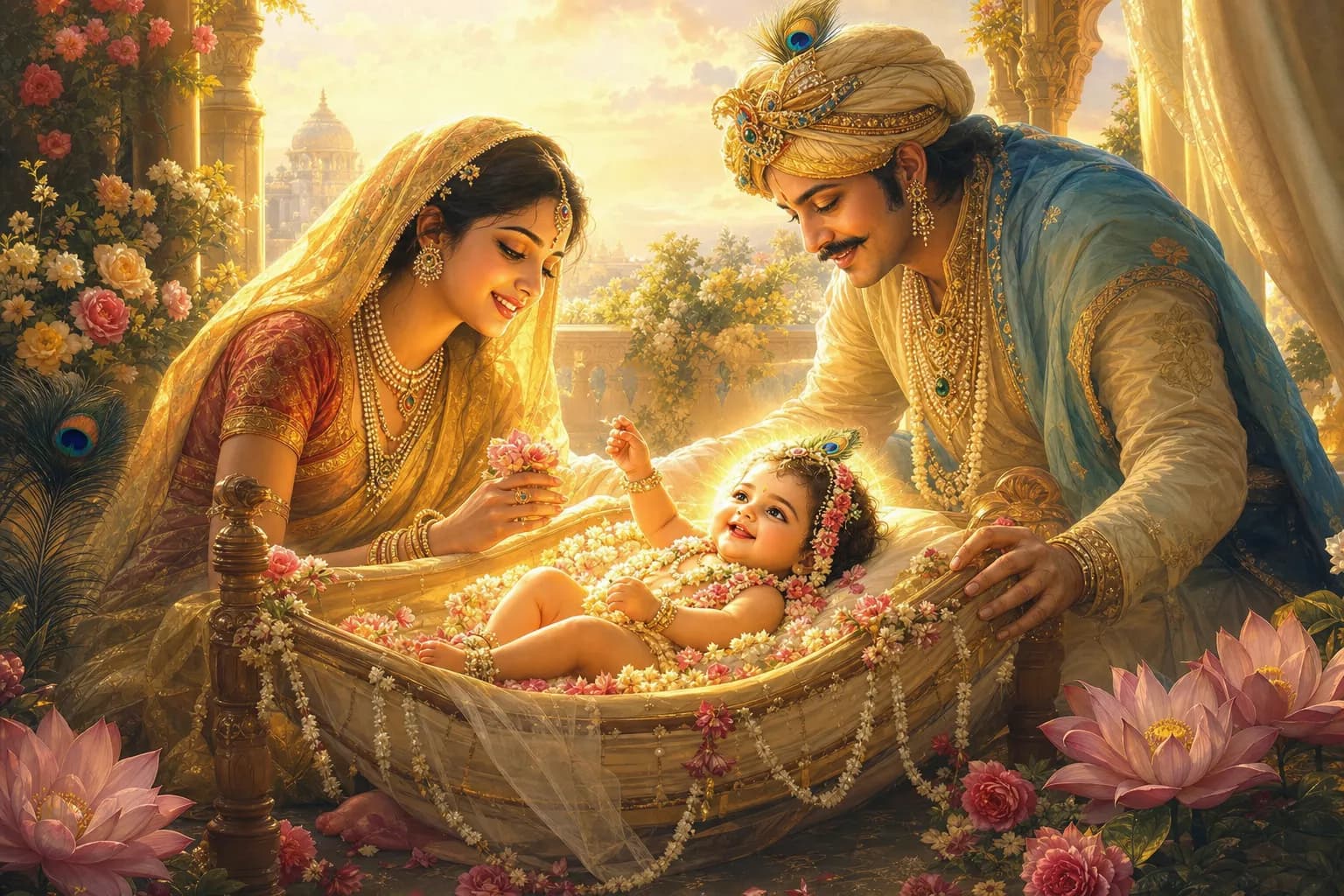
The Birth of Srimati Radharani
How Srimati Radharani was born, told scripture by scripture: the Garga Samhita, the Brahma Vaivarta Purana, her parents, the lotus, and Radhashtami.
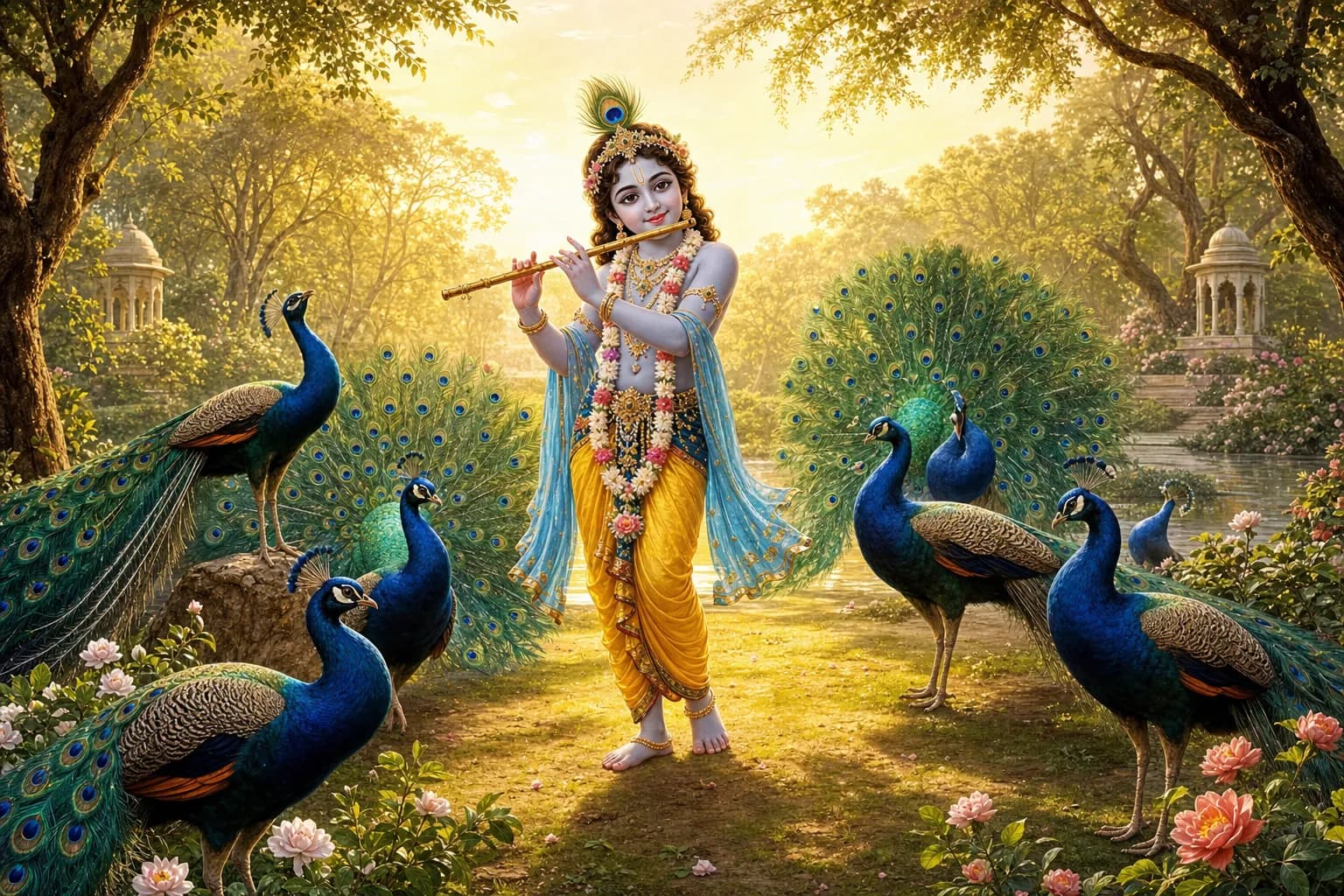
Why does Krishna wear a peacock feather?
Scripture, the Braj legend of the dancing peacocks, and what the feather really means. Sourced, tradition by tradition.
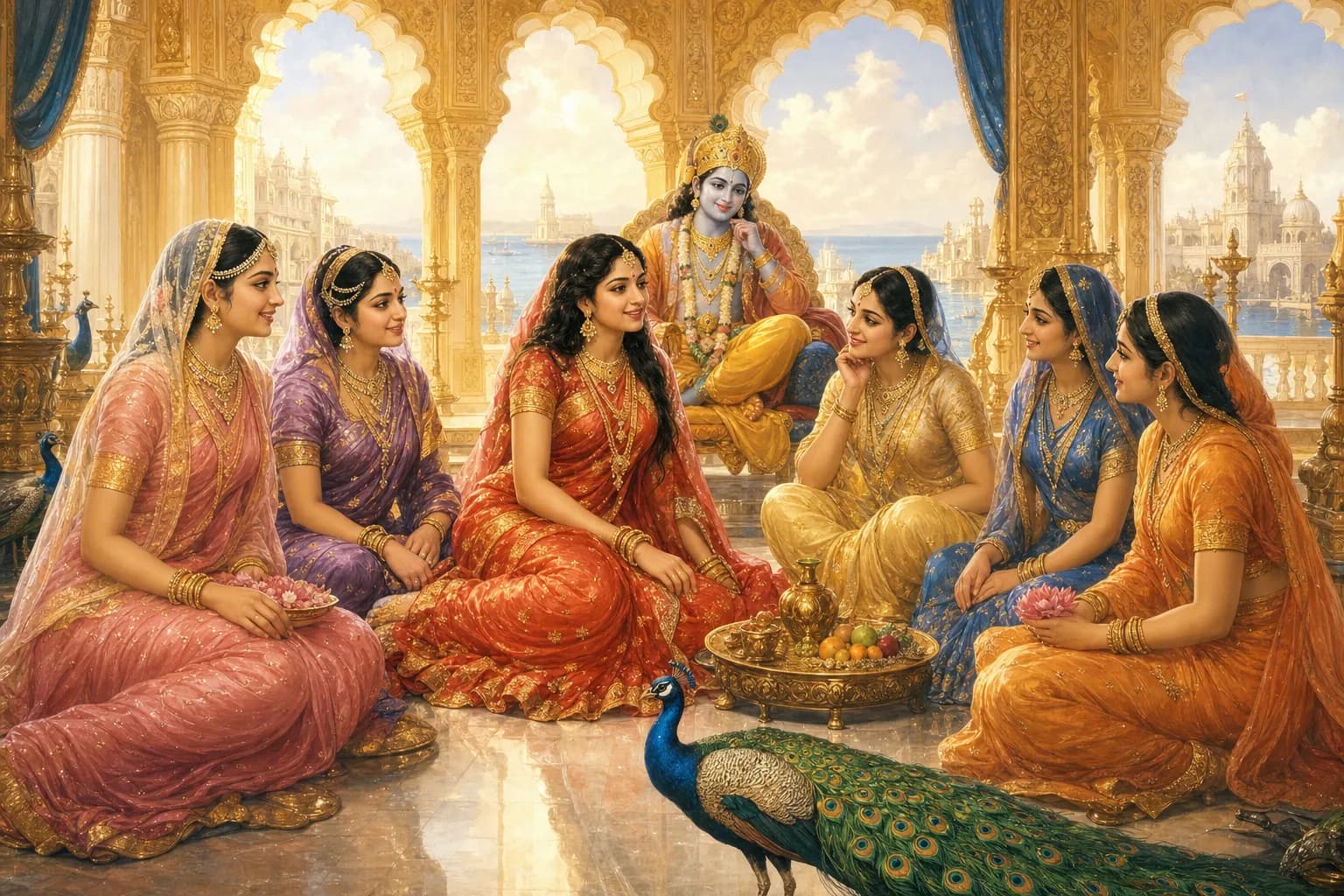
When Draupadi Met Krishna's Queens
How Draupadi asked each of Krishna's eight queens the way she married him, told in Bhagavata Purana Canto 10, Chapter 83.