
Radha Krishna
Who is Radha?
Last updated 25 July 2026
The short answer
Radha is the beloved of Krishna and the foremost of the gopis of Vrindavan, worshipped as his eternal consort and the personification of pure, selfless love (bhakti). Most traditions see her as Krishna's own inner energy in female form, so the two are one being in two bodies. The Bhagavata Purana speaks of her without naming her, at 10.30.28, and she is central to later texts like the Gita Govinda and the Brahma Vaivarta Purana.
Key takeaways
- Radha is Krishna's beloved and the greatest of the Vrindavan gopis, worshipped as the ideal of pure devotional love.
- The Bhagavata Purana conceals her at 10.30.28, where the word aradhita holds her name; her first major named portrait is Jayadeva's Gita Govinda (12th century).
- Most Vaishnava schools treat Radha as Krishna's own internal energy (hladini shakti), not a separate or lesser deity.
- Her name comes from the Sanskrit root radh, meaning to worship or to perfect, so Radha means the perfect worshipper.
- Traditions differ on her marriage and human life, and this page sets out what each text and sampradaya actually says.
Radha is the beloved of Krishna and the foremost of the gopis of Vrindavan. Vaishnava traditions worship her as Krishna's eternal consort and the living form of pure, selfless love. Most schools hold that she is Krishna's own inner energy in female form, so the two are one being in two bodies. The Bhagavata Purana speaks of her without naming her, at 10.30.28, and she stands at the center of later texts like the Gita Govinda and the Brahma Vaivarta Purana, of the whole Radha Krishna tradition, and of their love story.
If you grew up hearing "Radha Krishna" as one phrase, that instinct is right. In devotion they are almost never separated.
Who is Radha to Krishna?
Radha is Krishna's dearest devotee and his eternal beloved. Among the gopis (the cowherd women of Vrindavan whose love for Krishna is the model of bhakti), she is the greatest, the one whose love surpasses all others.
The relationship is not read as ordinary romance. It is read as the union of the soul with God. Radha is the soul in perfect longing, Krishna is the divine that longing reaches. That is why devotees place her name first and say Radhe Radhe before they say Krishna.
Their bond is eternal, set in the spiritual abode of Goloka before it plays out on earth in Vrindavan. It does not begin with a meeting and does not end with a parting.
Is Radha mentioned in the Bhagavata Purana?
She is there, veiled rather than named, and that surprises many people, because the Bhagavata Purana is the great scripture of Krishna's life. The acharyas read the veiling as concealment: what is most intimate is guarded rather than displayed.
In the raas lila, the Bhagavata Purana describes Krishna slipping away with one favoured gopi. The verse uses the word aradhita, "she who has worshipped him perfectly":
anayaradhito nunam bhagavan harir ishvarah
"Certainly this gopi has perfectly worshipped the all-powerful Lord Hari."
Bhagavata Purana 10.30.28
Commentators across traditions read that veiled word as Radha herself. Her full, named portrait comes into view later. The poet Jayadeva makes her the heroine of the Gita Govinda in the 12th century, and the Brahma Vaivarta Purana develops her as Krishna's eternal consort in Goloka. Earlier still, the Prakrit anthology Gatha Saptasati (around the 1st to 2nd century) carries one of the oldest surviving mentions of her name.
Where Radha appears, text by text
| Text | Approx. date | What it says about Radha | Type of source |
|---|---|---|---|
| Bhagavata Purana | c. 9th-10th century | Present but veiled; the favoured gopi of 10.30.28, read by commentators as Radha | Scripture (implicit) |
| Gatha Saptasati (Hala) | c. 1st-2nd century | Among the earliest surviving mentions of Radha by name | Early Prakrit poetry |
| Gita Govinda (Jayadeva) | 12th century | Radha as the central heroine of Krishna's love | Devotional poetry |
| Brahma Vaivarta Purana | later Purana | Radha as Krishna's eternal shakti and consort in Goloka | Later scripture |
| Garga Samhita | later text | Radha's marriage, her thousand names (Radha-sahasranama) | Later devotional scripture |
What does the name Radha mean?
Radha comes from the Sanskrit root radh, which means to worship, to accomplish, or to bring to perfection. So the name itself means the one who worships perfectly, the perfect devotee.
This is not a small point. The name carries the whole theology. Radha is worship in a person. Where Krishna is the object of all devotion, Radha is devotion itself, made complete.
How does each tradition understand Radha?
Radha's exact status shifts between the Vaishnava schools. The difference is a real one, so here is what each school actually teaches.
| Tradition | Founder / key figure | Who Radha is in this school |
|---|---|---|
| Nimbarka Sampradaya | Nimbarka (c. 12th-13th century) | Among the earliest to worship Radha and Krishna together as the supreme divine couple; Radha is the eternal consort, worship centers on the pair |
| Gaudiya Vaishnavism | Chaitanya Mahaprabhu (16th century) | Radha is Krishna's hladini shakti, his own pleasure potency; the two are one, and Chaitanya is understood as Radha and Krishna combined (Chaitanya Charitamrita, Adi-lila 1.5) |
| Pushtimarg (Vallabha) | Vallabhacharya (16th century) | Radha revered as the Swamini (queen) of Krishna, worthy of devotion; worship centers on the child-Krishna form Shrinathji, so she is honoured but less central than in Gaudiya thought |
| Brahma Vaivarta tradition | the Purana itself | Radha as Krishna's primal shakti in Goloka, linked to Lakshmi, descending to earth with him |
The through-line is that every major school holds Radha in the highest place. Where they differ is how far they go: consort, or Krishna's own energy, or the source goddess from whom all others come.
Were Radha and Krishna married?
Two Puranas say yes. The Garga Samhita and the Brahma Vaivarta Purana both describe a wedding in the Bhandirvan grove with Brahma himself kindling the fire, and Brahma tells them first that they are already husband and wife and that the ceremony only makes it visible in the way of this world. The Nimbarka tradition holds them eternally wed, so for that school there was never a moment when they were not.
Gaudiya Vaishnavism reads it the other way. Their love in Vrindavan stands deliberately outside marriage, and is the model of prem, love that asks nothing back, precisely because nothing protects it. A wedding would have made it smaller.
What every school agrees on is the part that matters. Their union has no beginning, and no ceremony either made it or could. The full text-by-text treatment is here.
Is Radha an incarnation of Lakshmi?
It depends on who you ask. The Brahma Vaivarta Purana links Radha to Lakshmi and describes her descending to earth alongside Krishna, born to Vrishabhanu and Kirtida in Barsana. In that frame Radha is the Lakshmi to Krishna's Vishnu.
Gaudiya and Nimbarka theology goes further. There, Radha is not an expansion of Lakshmi at all. She is Krishna's own source energy, which makes her the origin that other goddesses come from, not one of them. Both views live in the tradition, and the difference is a real theological one.
Why is Radha worshipped as so powerful?
Because in bhakti the highest power is love, and Radha is love in its perfect form.
Devotees say Krishna cannot be won by wealth, ritual, or force, only by pure devotion. Radha is that devotion made complete, so her love is said to hold sway over Krishna himself. That is the sense in which Radharani is called more powerful than the Lord: not above him, but the one thing that moves him.
It is why her name comes first. Radha Krishna. Radhe Radhe. The devotee reaches Krishna through Radha, because she is the way devotion is supposed to feel. If that is the thread you want to follow, read what their love symbolizes.
Frequently asked questions
Are Radha and Krishna the same person?
In most Vaishnava theology, yes in essence. Radha is Krishna's own internal pleasure potency (hladini shakti) taking female form, so the two are described as one soul in two bodies. They are worshipped as a single divine reality, Radha Krishna, not as two separate gods.
Is Radha mentioned in the Bhagavata Purana?
She is there, veiled rather than named. The Bhagavata Purana (10.30.28) describes one favoured gopi Krishna took aside during the raas, using the word aradhita (worshipped), which many commentators read as Radha herself, concealed inside the verse. Her named, developed portrait comes into full view later, in Jayadeva's Gita Govinda and the Brahma Vaivarta Purana.
Were Radha and Krishna married?
The Garga Samhita and the Brahma Vaivarta Purana describe a wedding at Bhandirvan with Brahma himself officiating, and the Nimbarka tradition holds them eternally wed in the divine realm.
Gaudiya Vaishnavism reads it the other way, that their love stands outside marriage and is greater for it. Every school agrees on the thing that matters: their union is eternal, and no ceremony either made it or could.
Is Radha an incarnation of Lakshmi?
It depends on the tradition. The Brahma Vaivarta Purana links Radha to Lakshmi and describes her descent alongside Krishna.
Gaudiya and Nimbarka schools go further, treating Radha as Krishna's own source energy rather than an expansion of Lakshmi, which makes her the origin of all other goddesses, not a derivative of one.
Why is Radha considered so powerful?
Because in bhakti theology Radha embodies the highest love, and that love is said to control Krishna himself.
Devotees hold that Krishna is won by pure devotion, and Radha is its perfect form, so her name is often chanted before his (Radha Krishna, Radhe Radhe). Her power is the power of devotion, not conquest.
Did Radha and Krishna ever marry?
It varies by scripture. The Gaudiya and Garga Samhita tradition describes a gandharva marriage officiated by Brahma. The Bhagavata Purana records no marriage.
In Vrindavan lila, their love is deliberately kept beyond marriage as the ideal of selfless union. See why Krishna did not marry Radha for the full scripture-by-scripture view.
Sources
- Bhagavata Purana 10.30.28 (the anaya-aradhita verse)
- Jayadeva, Gita Govinda (12th century)
- Brahma Vaivarta Purana, Krishna Janma Khanda
- Chaitanya Charitamrita, Adi-lila 1.5 (Radha as hladini shakti)
- Garga Samhita (Radha's marriage and Radha-sahasranama)
- Nimbarka Sampradaya (Radha-Krishna worship, Dvaitadvaita)
Continue reading
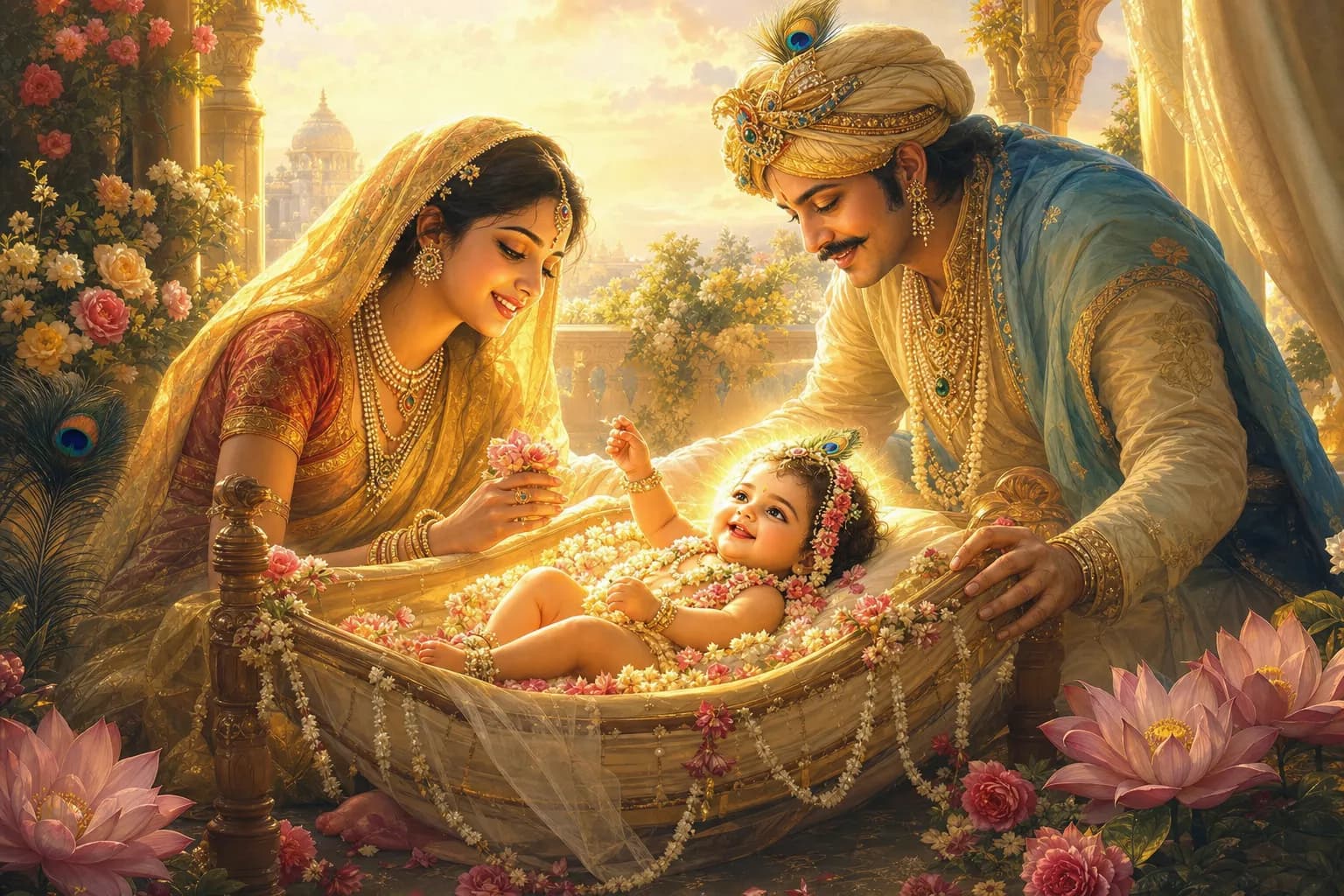
The Birth of Srimati Radharani
How Srimati Radharani was born, told scripture by scripture: the Garga Samhita, the Brahma Vaivarta Purana, her parents, the lotus, and Radhashtami.
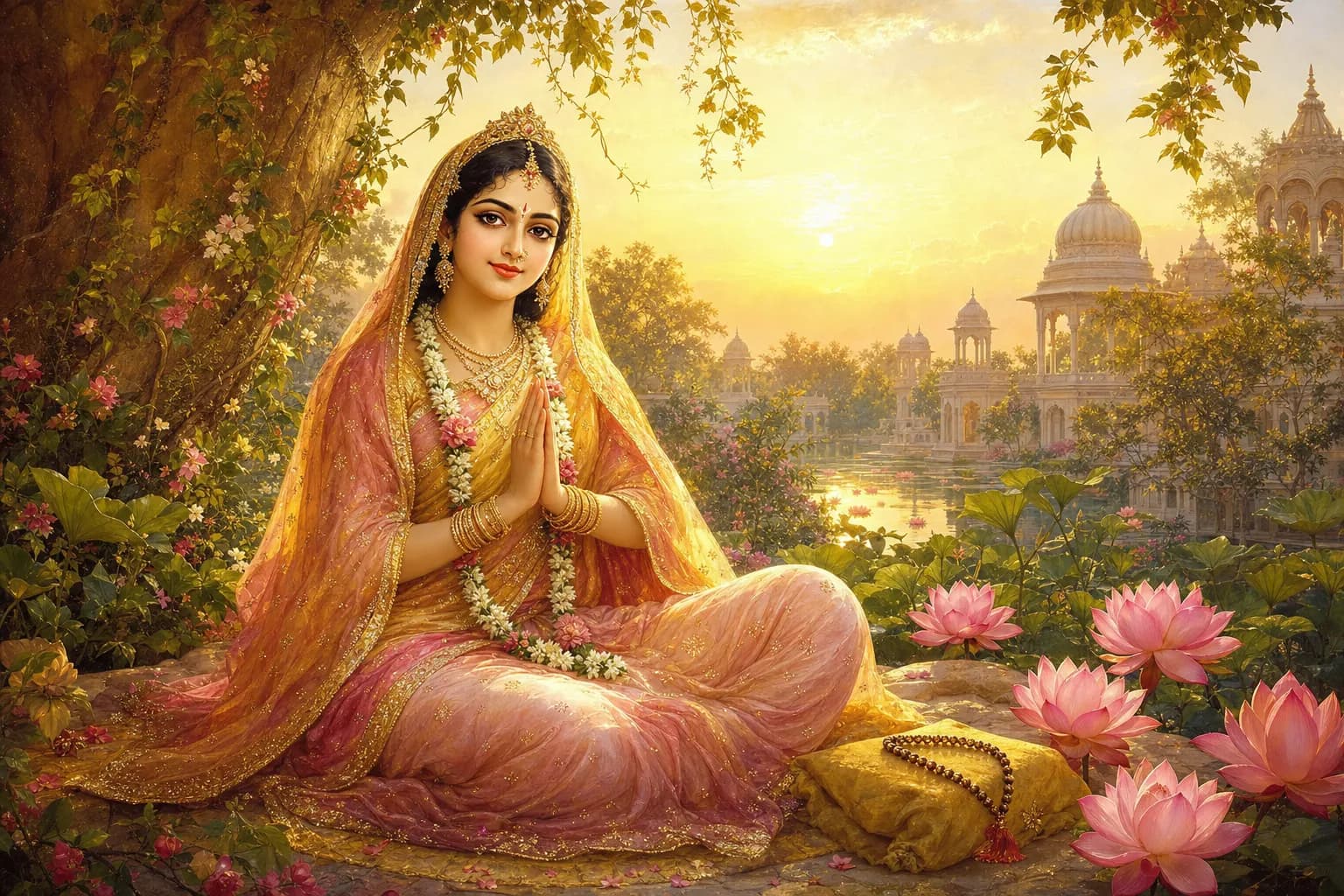
Radha Sahasranama: The 1008 Names of Radha Rani
The Radha Sahasranama, the thousand names of Srimati Radharani: where it comes from, why devotees chant it, and the full sung name list.