
Questions
Why does Krishna wear a peacock feather?
Last updated 25 July 2026
The short answer
Krishna wears a peacock feather because it belongs to his eternal Vrindavan form as a cowherd, described in scripture such as the Bhagavata Purana (10.21.5) and the Brahma Samhita (5.30). The best loved reason is a Braj legend: peacocks danced to his flute, and their king gifted a feather in gratitude, which Krishna wore ever after.
Key takeaways
- Scripture describes the feather as part of Krishna's form, but does not give a reason for it.
- The Bhagavata Purana 10.21.5 calls it barhapida and the Brahma Samhita 5.30 calls it barha-avatamsam.
- The popular why is a Braj legend: peacocks danced to his flute and gifted him a feather.
- Common meanings (beauty, humility, Radha's love) are devotional interpretation, not scripture.
- The idea that peacocks are celibate is a folk belief, and it is biologically false.
Krishna wears a peacock feather because it belongs to his form. In his eternal life as a cowherd boy in Vrindavan, the feather is simply how he is described and how he is drawn. Scripture confirms he wears it. The reason he wears it comes from a beloved Braj legend, and the meanings layered on top of it come from tradition. Those are three different things, and most pages blur them into one. This page keeps them apart, with sources.
Where does scripture actually say Krishna wears a peacock feather?
Two well known texts describe the feather directly, using the Sanskrit word barha, a peacock's tail feather.
In the Bhagavata Purana 10.21.5, the gopis watch Krishna walk into the forest and describe his form. He wears barhapida, a crest of peacock feathers, and moves like the finest of dancers. It is a picture, not an explanation.
The Brahma Samhita 5.30, the Govindam prayer known by its refrain govindam adi-purusham tam aham bhajami, worships him as barha-avatamsam, one whose head ornament is a peacock feather. This verse is chanted daily in the Hare Krishna tradition, and it fixes the feather as part of who Govinda is.
So the feather is canonical iconography. What neither verse gives you is a reason. For that, Braj tells a story.
| Text | Reference | What it says | Type |
|---|---|---|---|
| Bhagavata Purana | 10.21.5 | The gopis describe Krishna entering the forest wearing barhapida, a peacock-feather crest | Explicit scripture |
| Brahma Samhita | 5.30 (Govindam prayer) | Worships Govinda as barha-avatamsam, whose head ornament is a peacock feather | Explicit scripture |
Why does Krishna wear a peacock feather on his head?
The story most people mean when they ask this question is a Braj legend, retold across devotional sources rather than tied to a single verse.
One afternoon near Govardhan Hill, Krishna played his flute. The peacocks heard it and could not stay still. They opened their tails and danced, and some were so overwhelmed they fainted. Krishna, whom scripture calls nata-vara, the best of dancers, was pleased and danced with them.
When it was over, the king of the peacocks came forward and offered his own feathers as dakshina, a gift of gratitude for the joy Krishna had given. Krishna accepted, picked up a feather, and set it in his hair. He has worn one ever since.
This is devotional tradition, the kind of Braj lila that carries a truth without a chapter and verse. It is the honest answer to why, as long as you do not dress it up as scripture.
What does the peacock feather symbolize?
Once the feather is on his head, tradition reads meaning into it. These readings are interpretation, and they vary, so here they are with their labels rather than presented as fact.
| Explanation | What it is said to mean | Where it comes from |
|---|---|---|
| Peacocks danced to his flute and gifted a feather | His gratitude and his bond with Braj's creatures | Devotional legend, no single verse |
| Part of his beautiful cowherd form | The playful sweetness of the Vrindavan Krishna | Scriptural iconography (BP 10.21.5) |
| Triumph over ego and pride | The peacock is vain yet surrenders its finest feather | Later devotional interpretation |
| A sign of Radha's love | That Radha is always present on his head | Later devotional interpretation |
| Purity, because peacocks are celibate | Love without desire | Modern folk belief (see below) |
The last one needs care. A popular claim says peacocks are lifelong celibates who never mate, so the feather stands for pure love. It is widely repeated in India, but it is biologically false. Peacocks mate like other birds. It is a folk belief, charming but not a fact, and not scripture either.
Does the peacock feather represent Radha?
Some traditions say yes, that the feather carries Radha's presence and keeps her always on Krishna's head. It is a tender idea and you will hear it often.
It is also interpretation, not a scriptural statement. No verse assigns the feather to Radha. If someone tells you the feather is Radha, they are sharing a devotional reading, and a lovely one, but not a line from a text. You can read more about the couple on the Radha Krishna hub.
Is the peacock feather unique to Krishna?
Not entirely. In Hindu iconography the peacock belongs to more than one deity. Kartikeya, also called Murugan, rides a peacock as his mount, and Saraswati is often shown with one.
What is distinctly Krishna's is the single feather worn in the hair, tied to his Vrindavan boyhood and the flute. Vishnu, whom Krishna comes from, is not usually shown wearing it. That is why the feather reads as a Braj and Krishna emblem, and why you rarely see a Krishna murti carved without it.
For more on how he is pictured, see why Krishna is shown with blue skin and the playful stories of his Vrindavan years, like the time Krishna dressed as a gopi. You can browse all of these in Questions and Stories.
Frequently asked questions
What does the peacock feather mean in Hinduism?
In Hindu iconography the peacock feather signals beauty, auspiciousness, and a link to the divine. It is the mount of Kartikeya and Saraswati, and Krishna's crest.
On Krishna specifically, tradition reads it as a mark of his playful cowherd form and his bond with the creatures of Braj. Scripture shows him wearing it but does not assign it a fixed meaning.
Do other gods wear peacock feathers, or is it unique to Krishna?
It is not unique to Krishna. Kartikeya (Murugan) rides a peacock, and Saraswati is often shown with one.
But the single peacock feather worn in the hair is Krishna's signature, tied to his Vrindavan childhood. Vishnu, Krishna's source, is not usually shown wearing one, which is why the feather reads as a Krishna and Braj emblem rather than a Vishnu one.
Is a peacock feather lucky, and can I keep one at home?
In popular Hindu belief a peacock feather is auspicious and is often kept at home or on a Krishna altar, near books, or in a cash box for good fortune.
This is folk and Vastu custom, not a scriptural instruction. It is a devotional gesture, so treat it as one: keep it clean and respectfully placed rather than as a guaranteed charm.
What is Krishna's favourite bird?
The peacock. It is the bird most tied to Krishna in art and story because of the feather he wears and the Braj legend of the peacocks who danced to his flute.
Vrindavan and the Govardhan area were, and still are, home to peacocks, so the association is geographic as much as symbolic.
Does the peacock feather symbolize Radha?
This is a devotional interpretation, not a scriptural statement. Some traditions read the feather as carrying Radha's presence on Krishna's head, a sign that she is always with him.
It is a beautiful idea and widely repeated, but you will not find a verse that says it. It sits with later devotional reading rather than doctrine.
Which scripture says Krishna wears a peacock feather?
The Bhagavata Purana 10.21.5 describes Krishna entering the Vrindavan forest wearing barhapida, a peacock-feather crest. The Brahma Samhita 5.30, the famous Govindam prayer, worships him as barha-avatamsam, one whose head ornament is a peacock feather. Both establish the feather as part of his form; neither explains why he wears it.
Sources
Continue reading
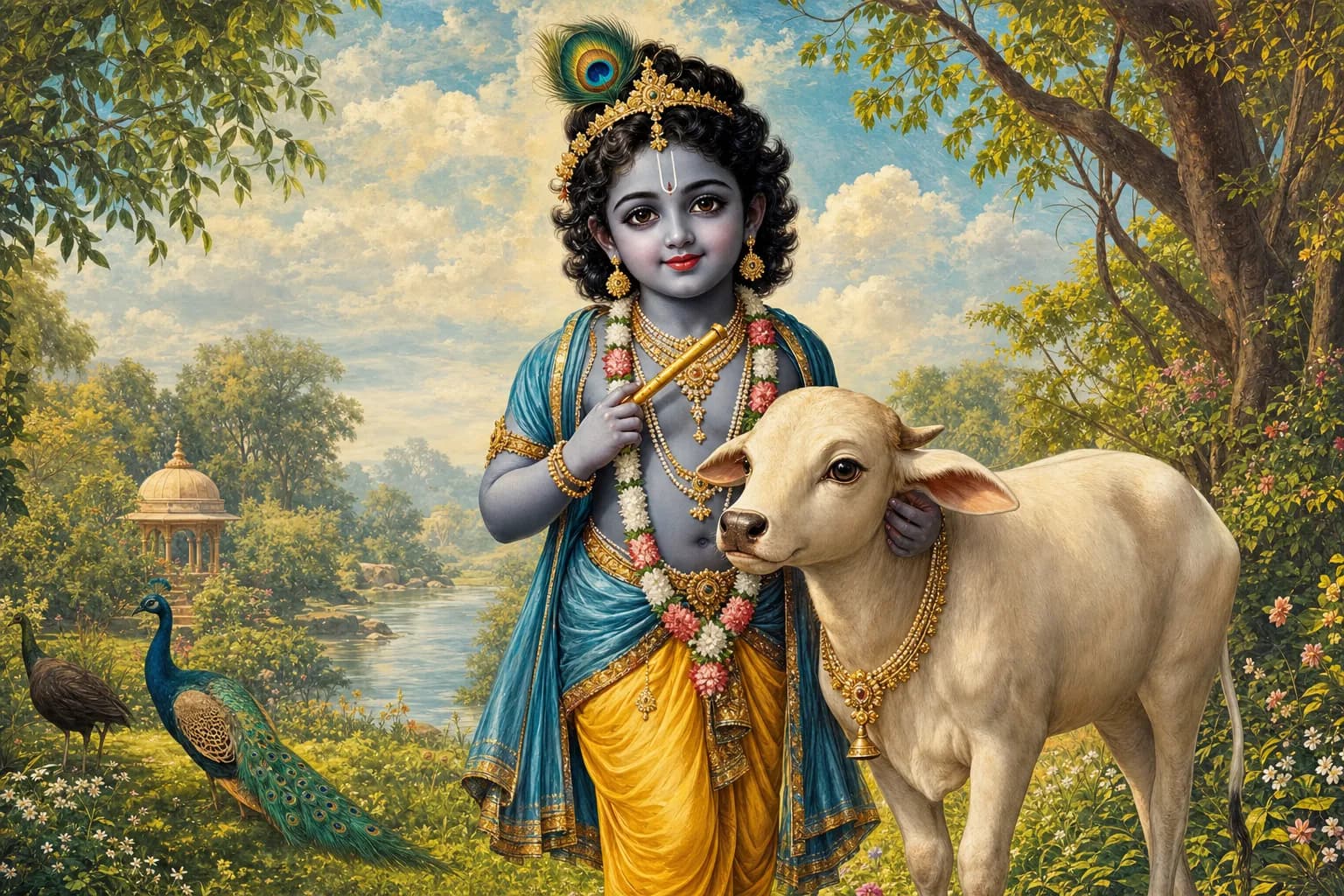
Why is Krishna blue?
Krishna is not literally blue. Scripture calls his complexion shyama, the dark blue-black of a rain cloud. Here is what the texts actually say.
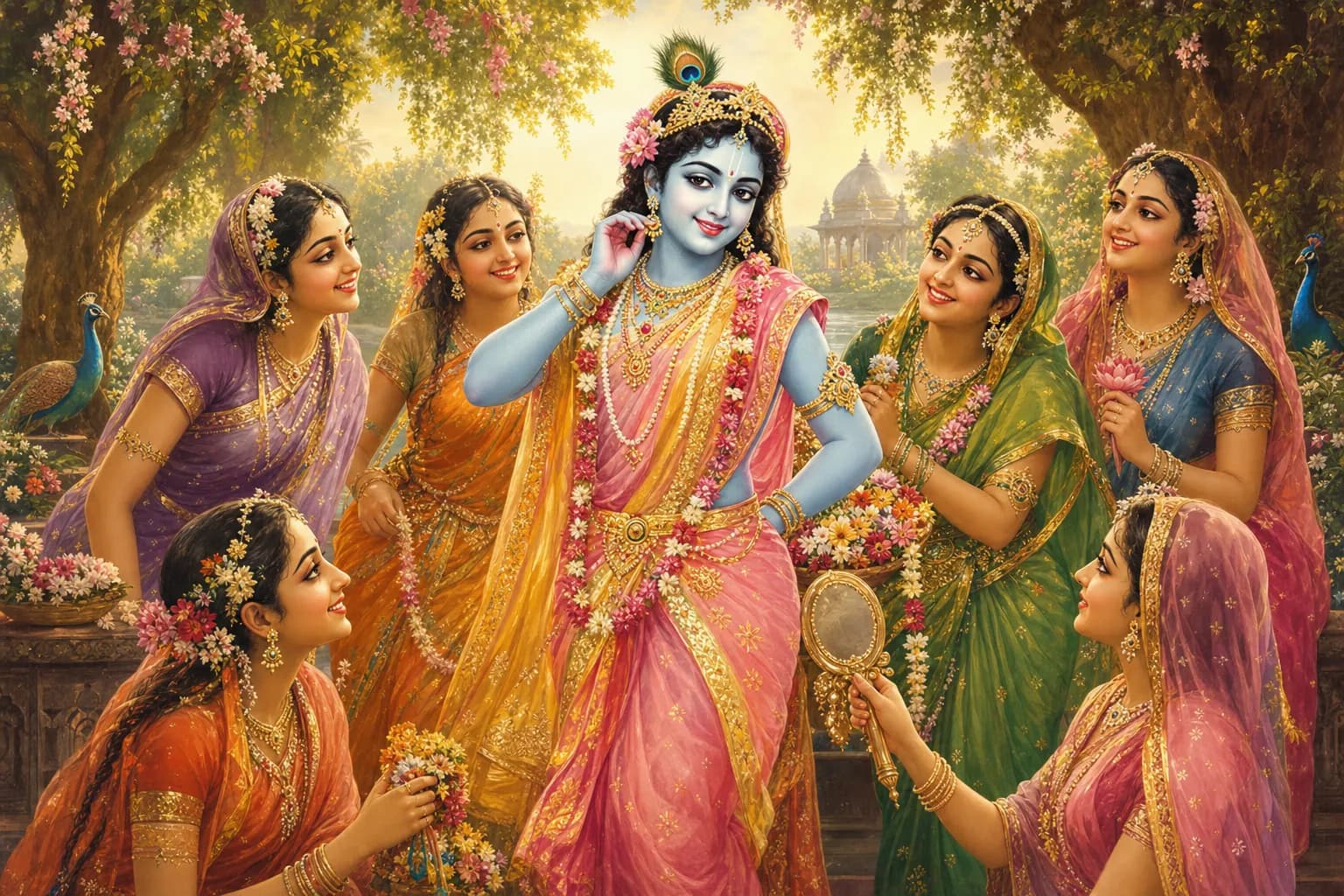
When Krishna Dressed as a Gopi
Why Krishna disguised himself as a gopi to end Radha's maan, where the story comes from, and how it differs from two other gopi tales.