
Questions
Why is Krishna blue?
Last updated 25 July 2026
The short answer
Krishna is not literally blue. Hindu scripture describes his complexion as shyama, the dark blue-black of a monsoon rain cloud, and his name itself means dark. Painters render that cloud-dark hue as blue because blue also stands for the infinite, the sky, the ocean, the endless cosmos. So the blue you see is devotional art, not a claim that his skin was blue.
Key takeaways
- The name Krishna comes from the Sanskrit root krish, meaning dark or black. It is also glossed as all-attractive.
- Scripture calls his complexion shyama or megha-shyama, the dark blue-black of a rain-heavy cloud. Brahma Samhita 5.30 compares him to a dark cloud (asita-ambuda).
- No scripture says his skin was literally blue. Blue is an artistic convention for a complexion the texts call dark.
- Blue also carries meaning: the boundless sky, ocean and cosmos. That is why Vishnu, Rama and Krishna are all painted blue.
- The Putana and Kaliya poison stories are popular retellings, not scripture. The Bhagavata Purana calls Krishna dark from the day he was named.
Krishna is not literally blue. Hindu scripture describes his complexion as shyama, the dark blue-black of a monsoon rain cloud, and his name itself means dark. Painters render that cloud-dark hue as blue because blue also stands for the infinite, the sky, the ocean, the endless cosmos. The blue you see on a poster is devotional art, not a claim that his skin was blue.
That one distinction, between what the texts say and what artists paint, clears up almost every version of this question. Here is how it holds up scripture by scripture.
Is Krishna blue or black?
He is dark. The word the texts reach for is shyama, and shyama means dark with a blue-black cast, the color of a sky heavy with rain.
The old Sanskrit lexicon Amarakosha even lists shyama as meaning both green and krishna, that is, dark or dark-blue. So the vocabulary itself blurs black and blue on purpose. When someone asks whether Krishna is black or blue, the scriptural answer is that both words are pointing at the same rain-cloud hue.
His name settles it. Krishna comes from the Sanskrit root krish, which means dark or black. The Gaudiya tradition adds a second reading from the Mahabharata: krish for attraction and na for bliss, giving the beloved gloss all-attractive. Both meanings live in the name at once. The color is real, and so is the charm.
Does any scripture actually say Krishna had blue skin?
No. There is no verse anywhere that calls his skin literally blue. What the texts give you is dark, described with the most beautiful cloud imagery in Sanskrit.
Brahma Samhita 5.30 praises Govinda as asita-ambuda-sundara, beautiful with the hue of a dark rain cloud, in the same breath as the flute and the peacock feather. The folk poets and bhajan singers call him ghana-shyam, as dark as monsoon clouds. Across all of it, the picture is a storm cloud, not a clear blue sky.
So literal blue is not in the scripture. It arrives later, in the hands of painters.
Then why do artists paint him blue?
Two reasons, and they work together.
First, the practical one. A rain cloud is dark, and a dark cloud reads to the eye as blue-black. When you translate megha-shyama, cloud-dark, onto a wall or a canvas, blue is the natural pigment. The blue is a visual shorthand for shyama, not a departure from it.
Second, the symbolic one. Blue is the color of everything vast and boundless, the sky above, the ocean, the depth of the cosmos at night. Giving Krishna that color says he is limitless, the way the sky is limitless. It is the same instinct that makes us call the far reaches of space blue when they are really dark and endless.
So the blue does two jobs at once. It renders a dark complexion, and it whispers that this dark form has no edges.
Why is Krishna sometimes shown blue and sometimes dark or almost black?
Because the texts describe change, and artists take liberties on top of it.
Bhagavata Purana 10.8.13 has the sage Garga tell Nanda that this child assumed white, red and yellow forms in previous ages, and now has taken a dark one. The dark form is the one for our age, but the verse itself puts several complexions on record. That alone tells you the color was never meant as a fixed skin tone.
On top of that, painters simply differ. A Nathdwara artist may keep him a deep, literal dark. A calendar-print studio may reach for a bright, symbolic blue. You are seeing two honest readings of the same shyama, one leaning to the color, one to the meaning.
Here is what the main sources actually say, side by side.
| Source | What it says about his complexion | Type of source |
|---|---|---|
| Brahma Samhita 5.30 | Beautiful with the hue of asita-ambuda, a dark rain cloud | Scripture (honored across Gaudiya Vaishnavism) |
| Bhagavata Purana 10.8.13 | White, red and yellow in past ages, now a dark (krishna) form | Scripture |
| Amarakosha | shyama means green or krishna, that is, dark or dark-blue | Classical Sanskrit lexicon |
| Valmiki Ramayana | Hanuman calls Rama shyama-varna, dark | Scripture (the same convention, applied to Rama) |
| Bhajan and folk poetry | ghana-shyam, dark as monsoon clouds | Later devotional literature |
| "Poison turned him blue" | Putana's milk or Kaliya's venom left him blue | Modern retelling and folk explanation, not scripture |
Why are Vishnu, Rama and Krishna all shown with blue skin?
Blue is the family color of the boundless. Vishnu is described as all-pervading, present everywhere the way the sky and the ocean seem to be everywhere. Painters give him their color, and the forms counted within Vishnu inherit it.
Rama is a clear example. In Valmiki's Ramayana, Hanuman describes Rama as shyama-varna, dark, the very word used for Krishna. Bengali tradition took the dark-green reading of shyama and long painted Rama green, as dark as fresh durva grass, before the more common blue took over. Same word, two palettes.
So when you see Radha Krishna, Vishnu and Rama all in blue, you are looking at one shared idea rendered three times: the divine as something dark, deep and without limit.
What about the stories that poison turned Krishna blue?
You will find these all over the internet. One says the demoness Putana's poisoned milk turned the baby blue. Another says the venom of the serpent Kaliya did it. They are memorable, and they are not scripture.
The Bhagavata Purana already calls Krishna dark on the day the sage Garga names him, long before the Kaliya episode. A color he was born with cannot have been caused by a snake he subdued as a boy. These poison tales are later folk explanations that try to give a physical cause for a hue the scriptures treat as his eternal nature. They are worth enjoying as stories, not citing as the reason.
Is the blue a body at all, or something deeper?
The tradition itself hints that the color is not ordinary matter. In Bhagavad Gita 7.25, Krishna says he is not manifest to everyone, veiled by his own yogamaya. His full form, the texts say, is seen clearly by his devotees, not by casual observers.
Read that way, the dark-blue is less a pigment and more a pointer. It marks a form that is infinite and self-luminous, shown to us in the one color that already means the infinite. The painter's blue and the scripture's shyama meet exactly there.
If this is the kind of question you like to chase, the same care sits behind why Krishna wears a peacock feather and the story of when Krishna dressed as a gopi. You can browse the rest under Questions and Stories.
Frequently asked questions
Is Krishna blue or black?
Scripture describes Krishna as shyama, a dark complexion the poets compare to a blue-black monsoon cloud. So the honest answer is dark, with a blue-black cast. Black and blue are two ways of naming the same cloud-dark hue, and neither literally means his skin was sky-blue.
If Krishna's name means the dark one, why is he shown with blue skin?
Because artists paint the meaning, not a photograph. The name Krishna means dark, and the poets sharpen that to megha-shyama, dark like a rain cloud.
A rain cloud reads as blue-black, so painters render the dark hue as blue. The blue is a visual translation of shyama, not a contradiction of it.
Does any scripture actually say Krishna had blue skin?
No text says his skin was literally blue. The scriptures call him shyama and megha-shyama, dark like a cloud, and Brahma Samhita 5.30 likens him to a dark rain cloud (asita-ambuda). Literal blue is a convention of later devotional art, not a scriptural description.
Why is Krishna sometimes shown blue and sometimes dark or almost black?
Both are faithful to the texts, which call him dark. Bhagavata Purana 10.8.13 even says he took white, red and yellow forms in earlier ages before this dark one.
Beyond that, artists differ. Some paint the literal dark, some choose the symbolic blue of the infinite, so you see both across regions and eras.
Why are Vishnu, Rama and Krishna all shown with blue skin?
Blue stands for the boundless. Vishnu is all-pervading like the sky and the ocean, so painters give him their color. Krishna and Rama are counted among his forms, so they share the convention. Valmiki's Ramayana calls Rama shyama-varna, dark, exactly as the texts call Krishna dark.
Why do TV serials and modern posters show Krishna as fair or white?
That is a modern aesthetic choice, not a scriptural one. The texts are consistent that Krishna is dark. Lightening his skin follows contemporary tastes and casting, and it moves away from what the scriptures actually say about his complexion.
Sources
Continue reading
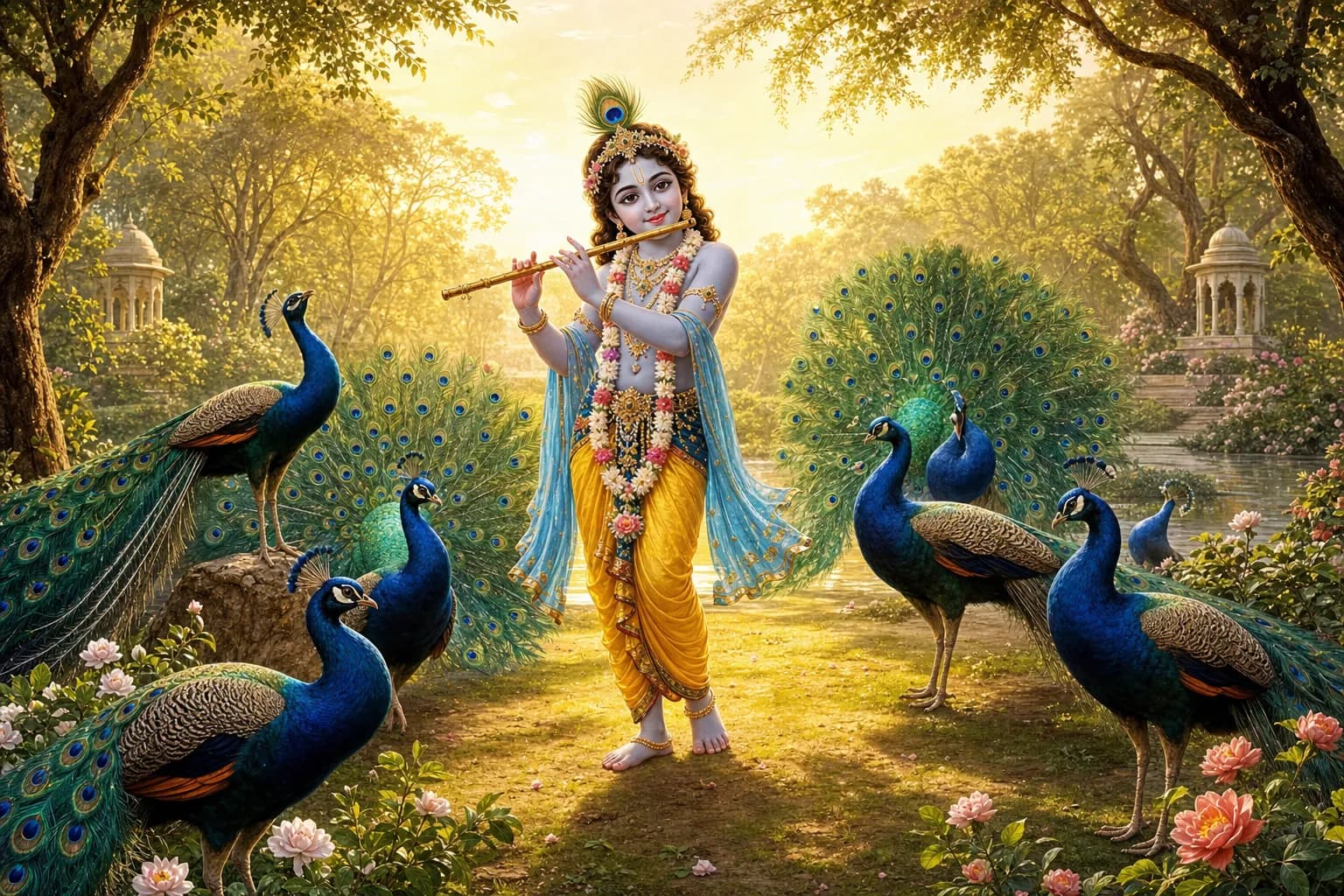
Why does Krishna wear a peacock feather?
Scripture, the Braj legend of the dancing peacocks, and what the feather really means. Sourced, tradition by tradition.
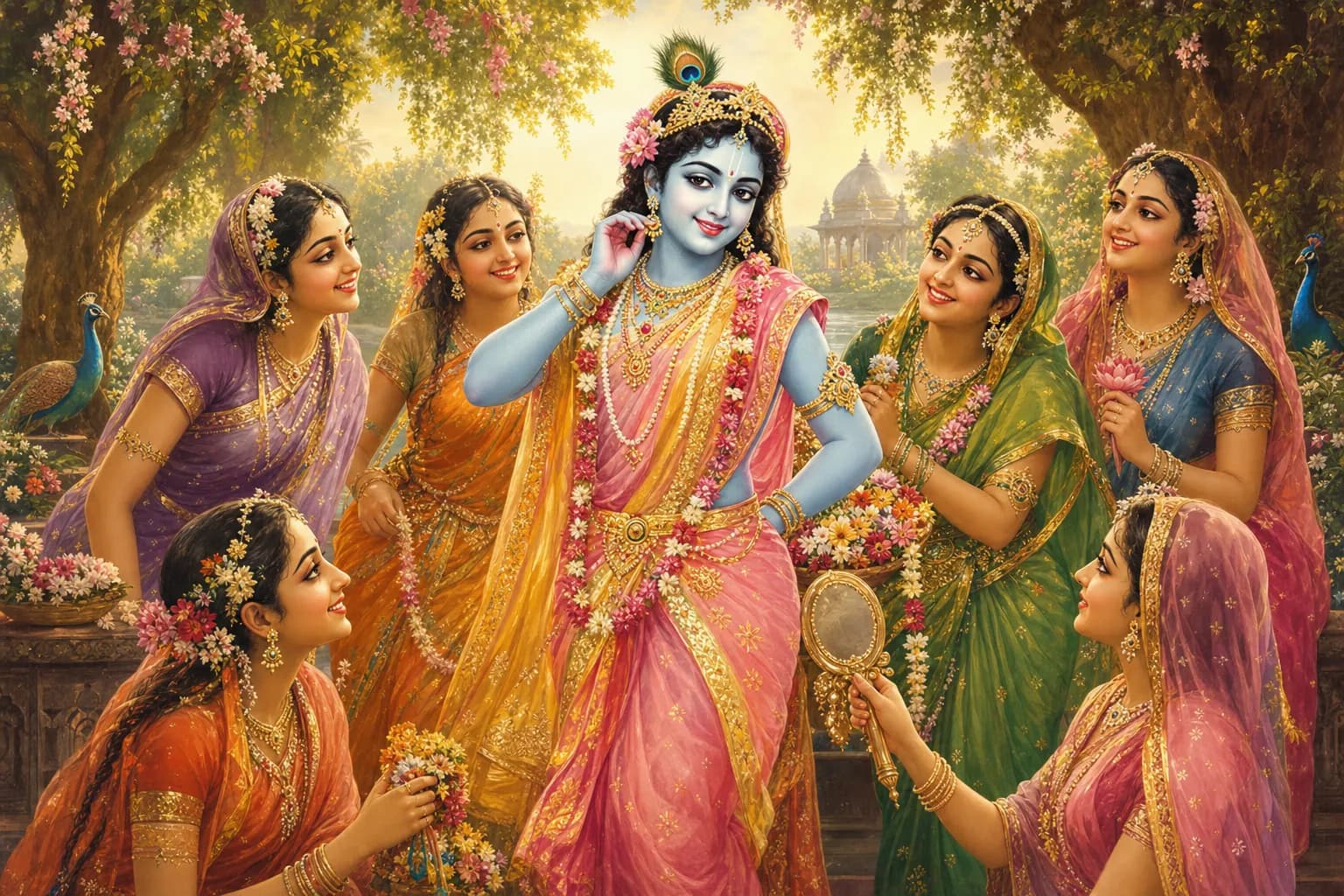
When Krishna Dressed as a Gopi
Why Krishna disguised himself as a gopi to end Radha's maan, where the story comes from, and how it differs from two other gopi tales.