
Festivals
Nandotsav
Last updated 26 July 2026
The short answer
Nandotsav is the celebration Nanda Baba held in Gokul the morning after Krishna was born, and Braj keeps it the day after Janmashtami. Bhagavata Purana 10.5 narrates it: the cowherds throwing curd and butter over one another, the gopis sprinkling turmeric on the child, and Nanda giving away cows and clothes to everyone who came. In 2026 it falls on Saturday 5 September.
When Nandotsav falls
Next: Saturday, 5 September 2026
Key takeaways
- Nandotsav is the day after Janmashtami, when Nanda Baba celebrated the birth of his son in Gokul.
- In 2026 it falls on Saturday 5 September, and both the general and Vaishnava reckonings agree.
- Bhagavata Purana 10.5 narrates it: turmeric sprinkled on the child, curd and butter thrown in joy, and Nanda giving away everything.
- Where Janmashtami is a vigil kept at midnight, Nandotsav is daylight, drums and giving. The fast ends that morning.
- The bhava of the day is vatsalya, the love of a parent for God as their own child.
The night of Janmashtami is kept quietly. Krishna is born at midnight in a prison at Mathura, the guards asleep, Vasudeva carrying him across a flooded river in the dark. Nobody in Gokul knows yet.
Nandotsav is the morning after, when they do. The child is in Nanda Baba's house, the whole of Vraja hears about it, and the celebration that follows is one of the most open-hearted days in the Braj year. Where Janmashtami is a vigil, Nandotsav is drums in daylight.
When Nandotsav falls
| Year | Date |
|---|---|
| 2026 | Saturday 5 September |
| 2027 | Thursday 26 August |
Both the general reckoning and the Vaishnava calendar agree in both years, so there is no split to navigate.
One correction worth making plainly, because it is circulating widely. ISKCON does not keep Janmashtami on 5 September 2026. ISKCON and the Vaishnava calendar keep Janmashtami on Friday 4 September, the same day as everyone else this year, and Nandotsav on Saturday 5 September. Pages that give 5 September as an "ISKCON Janmashtami" have mistaken Nandotsav for the birth day itself.
The other reason the morning matters: the parana, the time to break the Janmashtami fast, falls on Nandotsav morning. The fast ends exactly as the celebration begins.
What the Bhagavata Purana describes
The whole of it is in Canto 10, chapter 5, and the chapter is worth reading straight through on the day. Nanda, overwhelmed with joy, bathes and dresses, calls brahmanas learned in the Vedas, and has the jata-karma, the birth ceremony, performed for his son.
Then the giving begins. He gives cows in charity to the brahmanas, decorated with cloth and jewels, and mountains of grain. Vraja itself is dressed: festoons and flags, gateways built of flower garlands and mango leaves, every courtyard swept and washed. The cows and bulls and calves are smeared with turmeric and oil, their heads set with peacock feathers, garlanded and covered in cloth.
The cowherd men arrive in their best, carrying gifts in their hands. The gopis, hearing that Yashoda has a son, dress and hurry over with presents, flowers falling from their hair into the street as they go. And then the two verses that the whole day is built on.
"Offering blessings to the newborn child, Kṛṣṇa, the wives and daughters of the cowherd men said, 'May You become the King of Vraja and long maintain all its inhabitants.' They sprinkled a mixture of turmeric powder, oil and water upon the birthless Supreme Lord and offered their prayers."
Bhagavata Purana 10.5.12
"In gladness, the cowherd men enjoyed the great festival by splashing one another's bodies with a mixture of curd, condensed milk, butter and water. They threw butter on one another and smeared it on one another's bodies."
Bhagavata Purana 10.5.14
That verse is why Braj still throws curd and butter and turmeric on Nandotsav. It is not a later custom laid over the text. It is the text.
The chapter closes with Nanda giving clothes, ornaments and cows to the cowherd men, and charity to the reciters and singers and to men of every other profession, satisfying everyone's desires. From that time, it says, Nanda's Vraja became the place of the pastimes of the goddess of fortune.
Why this day is giving rather than fasting
The two days are opposite in shape, and deliberately so.
| Janmashtami | Nandotsav | |
|---|---|---|
| Where | Kansa's prison, Mathura | Nanda's open courtyard, Gokul |
| When | Midnight | Daylight |
| How | In secret, in vigil, fasting | In public, with drums, feasting |
| What you do | Wait | Give |
A birth in a prison has to be hidden. A birth in Nanda's house can be shouted about. Chapter 5 is a chapter of giving from beginning to end, and the day copies it.
Vatsalya, the love that makes God a child
The bhava of Nandotsav is vatsalya, loving God as your own son or daughter. It is one of the five primary relationships in Vaishnava devotion, and Nanda and Yashoda are its highest example. As Swami Mukundananda puts it, in vatsalya bhava the devotee takes the role of a parent and God accepts the position of a dependent child.
The Bhagavata does not treat this as a lesser love. When Parikshit asks what Nanda and Yashoda could possibly have done to deserve it, the answer is startling:
"Neither Lord Brahmā, nor Lord Śiva, nor even the goddess of fortune, who is always the better half of the Supreme Lord, can obtain from the Supreme Personality of Godhead, the deliverer from this material world, such mercy as received by mother Yaśodā."
Bhagavata Purana 10.9.20
This same bhava has a home on Radha's side of Braj. Kirti Mandir at Barsana, built by Jagadguru Shri Kripalu Ji Maharaj, is dedicated to Kirti Maiya, Radha's mother, with Radha enshrined as a child in her lap. It is the only temple of its kind, and it honours exactly what Nandotsav honours: the love a mother has for her child as its own full path to God.
How Braj keeps it
Gokul carries the day. The child Krishna is brought out from Nand Bhavan and Nand Kila in a dola, a palanquin, and carried through the lanes of the bazaar to the Ras Chabutra near Nand Chowk, with shehnai playing and the people of the town showering flowers on it as it passes. Badhai songs are sung. The festivities run from early morning and stretch across three days.
Nandgaon keeps it at Nand Bhavan on Nandishwar hill, and does something lovely: the communities of Nandgaon and Barsana come together for it, in their best clothes and jewellery. There is group singing and episodes from Krishna's life are enacted, among them Dahi Handi, Mall Yudh, Bans Badhai and Bhanda Leela, and the two villages exchange sweets and gifts. At midnight the deity is bathed in panchamrit inside the sanctum, with only the priests present.
At Shri Radha Vallabh in Vrindavan, the temple's Samaji musicians begin singing badhai from before mangala aarti. The deity is bathed in the five substances and then in Yamuna water. The whole temple is dressed in yellow, with yellow curtains over the sanctum and banana leaves and kalash set as auspicious signs. Dhaniya barfi, mingi barfi, almond and pistachio barfi and rabri are made for the day, and panchamrit is given at darshan.
At ISKCON temples the day carries a second meaning: Srila Prabhupada appeared on Nandotsav in 1896, so it is also his Vyasa Puja.
The song of the day
One badhai is sung everywhere, and it is the sound of Nandotsav:
Nand ke anand bhayo, jai Kanhaiya Lal ki
"Joy has broken out in Nanda's house. Glory to Nanda's boy."
It is answered with the jaikara Hathi ghoda palki, jai Kanhaiya Lal ki. It is a traditional Braj badhai with no single author, and once you have heard a courtyard full of people singing it you will not forget it.
Keeping Nandotsav at home
Nothing here is difficult, and none of it needs a temple.
- Break the Janmashtami fast at the parana time in the morning.
- Bathe your Laddu Gopal in panchamrit, the five substances, and dress him in fresh clothes.
- Sing badhai. Nand ke anand bhayo is the one.
- Make sweets and butter and share them with whoever is near.
- Give something away. This is the part that matters most, because it is what Nanda did. Sweets, fruit, clothes, toys, coins. The chapter is a chapter of giving, and the day is a copy of it.
Where this sits in the Radha Krishna year
Nandotsav follows Janmashtami by a day, and Radhashtami comes a fortnight later. Before them, Jhulan Yatra swings through Shravana, and Sharad Purnima closes the season in October. For the whole cycle, see the festivals of Radha Krishna.
Frequently asked questions
Why is Nandotsav celebrated?
Because the night Krishna was born was kept in secret in a prison at Mathura, and the morning after, in Gokul, Nanda Baba could finally celebrate openly that a son had come to his house.
Bhagavata Purana 10.5 describes what he did: he called the brahmanas, had the birth rites performed, decorated the whole of Vraja, and gave away cows, grain, clothes and ornaments to everyone who came.
What do you do on Nandotsav?
Break the Janmashtami fast in the morning, bathe your Laddu Gopal in panchamrit and dress him in fresh clothes, and sing badhai, the songs that congratulate Nanda Baba.
Then give something away. The whole of Bhagavata Purana 10.5 is a chapter about giving, and Braj keeps the day by distributing sweets, fruit, clothes and coins.
When is Nandotsav in 2026?
Saturday 5 September 2026, the day after Janmashtami. Both the general reckoning and the Vaishnava calendar agree on it this year.
In 2027 it falls on Thursday 26 August.
Is ISKCON Janmashtami on 5 September 2026?
No. ISKCON and the Vaishnava calendar keep Janmashtami on Friday 4 September 2026, the same day as the general reckoning, and Nandotsav on Saturday 5 September.
Pages that give 5 September as an ISKCON Janmashtami date have confused Nandotsav with Janmashtami itself. The two reckonings agree on the birth day in 2026.
What is the difference between Nandotsav and Dahi Handi?
They fall on the same day and share a root, but they are different customs. Nandotsav is the Braj celebration of the birth in Nanda's house. Dahi Handi, kept most famously in Maharashtra, remembers Krishna's butter stealing with the pot hung high and the human pyramid.
Both go back to the same joy in the same chapter, where the cowherds throw curd and butter over one another. [Janmashtami](/festivals/janmashtami) covers Dahi Handi in full.
What is vatsalya bhava?
Loving God as your own child. It is one of the five primary relationships in Vaishnava devotion, and Nanda and Yashoda are its greatest example.
In this bhava the devotee protects and feeds and worries over the Lord rather than only worshipping him, and the tradition holds it as an extraordinary mercy rather than a lesser form of love.
Sources
- Nandotsava 2026 date, Drik Panchang ISKCON calendar
- Vaishnava calendar 2026 to 2027, ISKCON Bangalore
- Bhagavata Purana 10.5, the birth celebration in Vraja
- Bhagavata Purana 10.5, translated by G. V. Tagare
- Bhagavata Purana 10.9.20, the mercy Yashoda received
- Nandotsav at Nand Bhavan, Nandgaon, Vrindavan Today
- Nandotsav in Gokul, Amar Ujala
- Janmashtami and Nandotsav at Shri Radha Vallabh temple
- The five bhavas, Swami Mukundananda, JKYog
Continue reading
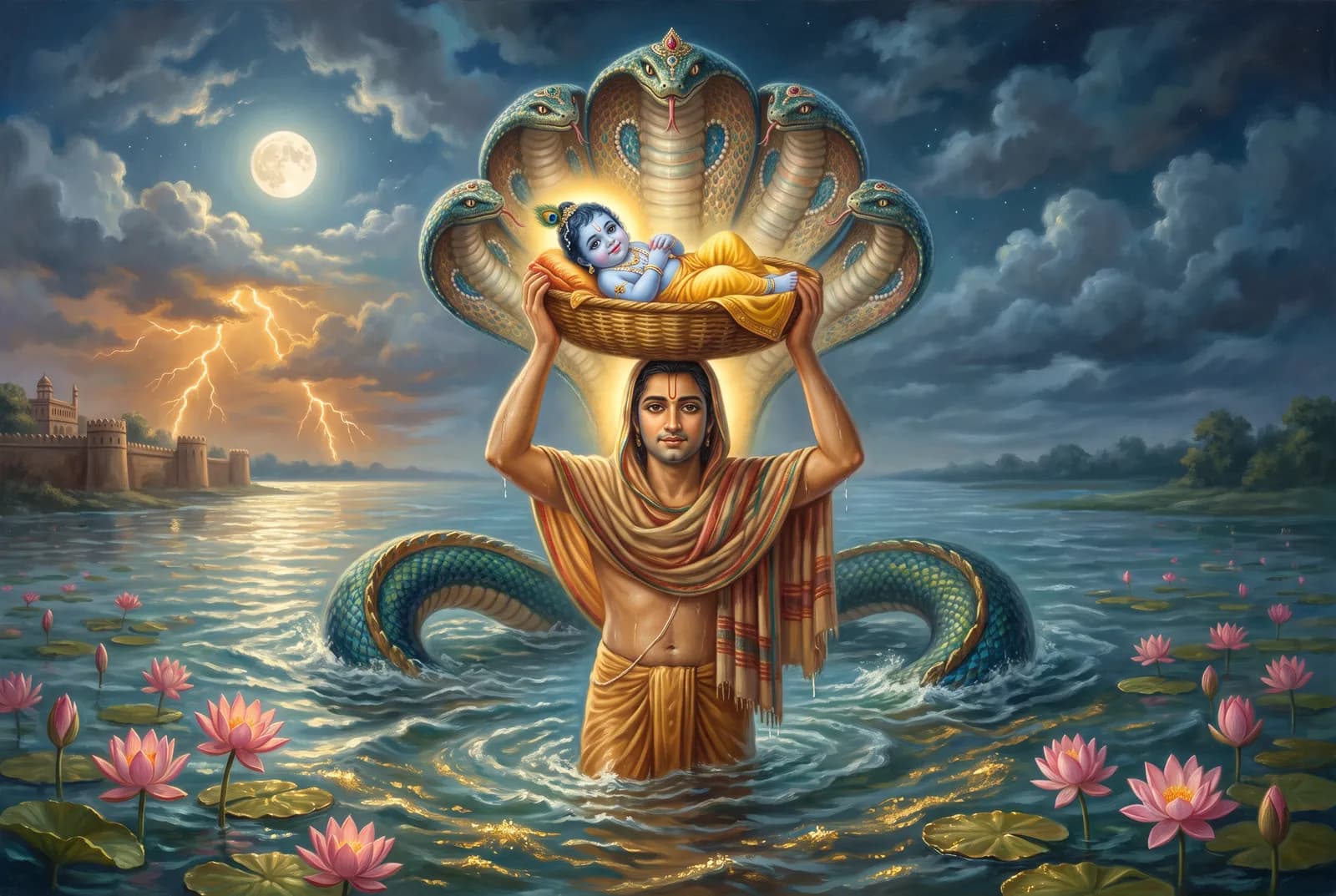
Krishna Janmashtami
Krishna Janmashtami explained: the Bhagavata account of the birth, why it is kept at midnight, the tithi, the fast, Dahi Handi and Braj.
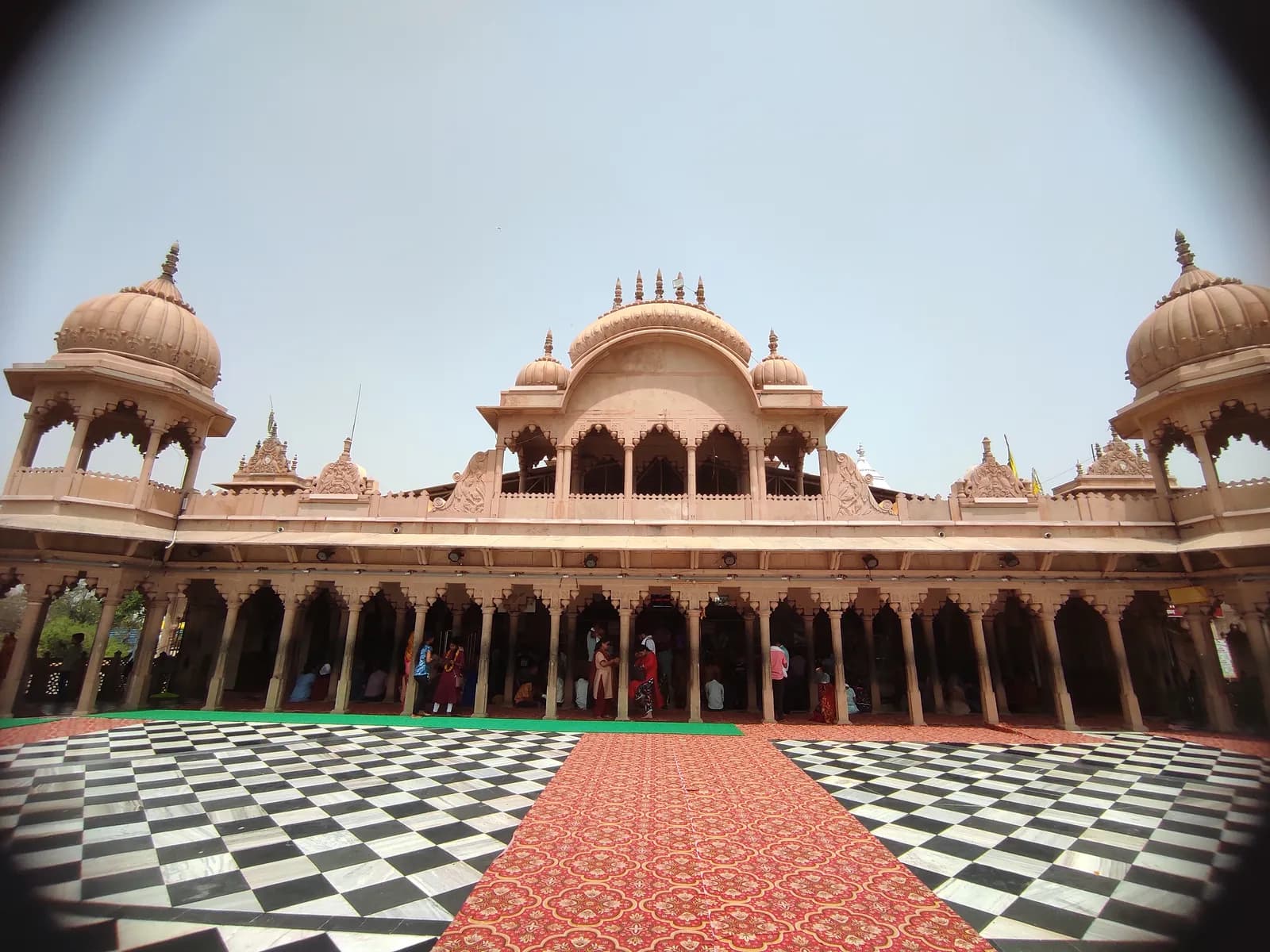
Barsana
Barsana, Radha's town in Braj: the Shriji temple on Bhanugarh hill, the Raval birthplace question, Lathmar Holi, Radhashtami, and how to visit.
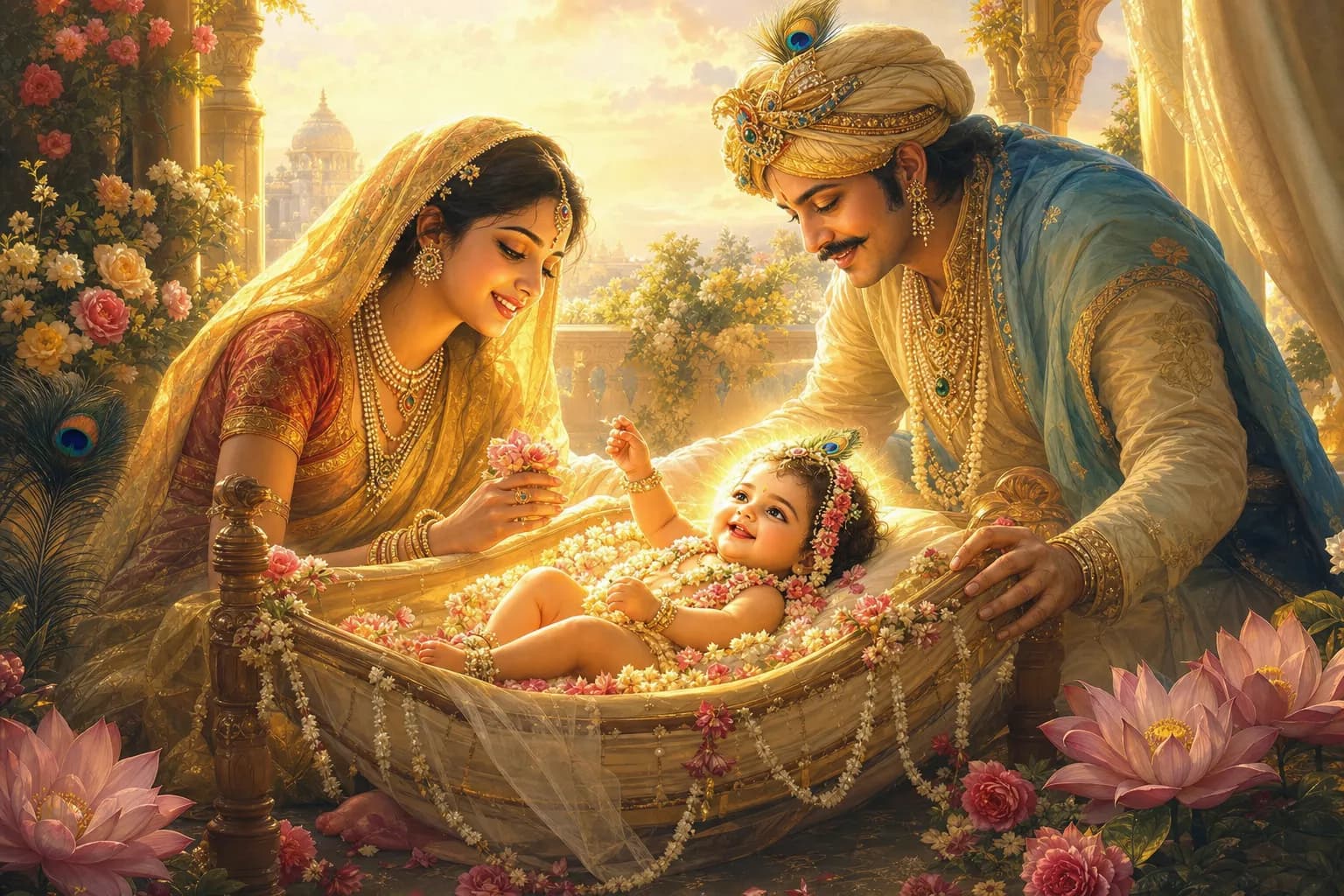
The Birth of Srimati Radharani
How Srimati Radharani was born, told scripture by scripture: the Garga Samhita, the Brahma Vaivarta Purana, her parents, the lotus, and Radhashtami.