
Festivals
Krishna Janmashtami
Last updated 25 July 2026
The short answer
Krishna Janmashtami marks the birth of Krishna on the eighth lunar day of the dark fortnight of Bhadrapada, which falls in August or September. The Bhagavata Purana places that birth in the dead of night, in Kansa's prison at Mathura, so the festival is kept awake until midnight with fasting, kirtan, jhankis and an abhishek of the infant Krishna.
When Krishna Janmashtami falls
Next: Friday, 4 September 2026
Key takeaways
- The tithi is Bhadrapada krishna paksha ashtami in the north Indian purnimanta calendar. The same day is called Shravana krishna ashtami in Maharashtra, Gujarat and the south. It is one day under two names.
- Bhagavata Purana 10.3.8 says Vishnu appeared from Devaki nishithe tama-udbhute, late at night when the darkness was dense. That single word is why the whole festival waits for midnight.
- Bhagavata Purana 10.3.1 to 10.3.5 sets the scene with the constellation Rohini risen and every star peaceful. Rohini is why the Vaishnava and smarta reckonings sometimes split across two days.
- In 2026 Janmashtami is Friday 4 September, and both reckonings agree. In 2025 they did not, and the festival ran over 15 and 16 August.
- Dahi Handi and Nandotsav come the next day. Braj keeps Nandotsav on Bhadrapada navami at Gokul and Nandgaon, and Maharashtra keeps Dahi Handi with human pyramids and a pot of gopalkala.
Krishna Janmashtami marks the birth of Krishna on the eighth lunar day of the dark fortnight of Bhadrapada, which falls in August or September. The Bhagavata Purana places that birth in the dead of night, in Kansa's prison at Mathura. So the festival is kept awake until midnight, with fasting through the day, kirtan through the evening, and an abhishek of the infant Krishna at the stroke of the hour.
Almost every question people ask about the day comes back to that midnight. Why the vigil, why the fast runs so long, why one family in a street keeps it a day before another. Here is the whole thing, from the verses outward.
What does the Bhagavata Purana say about Krishna's birth?
The account sits in the third chapter of the tenth canto, titled the birth of Lord Krishna. It opens with the sky rather than with the child.
Bhagavata Purana 10.3.1 to 10.3.5 describes the hour: the constellation Rohini risen, none of the constellations fierce, the rivers running clear, the wind carrying fragrance, and the minds of good people at ease for the first time under Kansa. Kinnaras and Gandharvas sing. Only after five verses of that setting does the text come to the birth itself.
Then 10.3.8, the verse the entire festival hangs on:
nishithe tama-udbhute jayamane janardane devakyam deva-rupinyam vishnuh sarva-guha-shayah avirasid yatha prachyam dishindur iva pushkalah
"At the dead of night, when the darkness was dense, Vishnu appeared from Devaki, like the full moon rising in the east."
Bhagavata Purana 10.3.8
The child appears first in four-armed Vishnu form, with conch, disc, club and lotus, which is how Vasudeva and Devaki understand who their son is (10.3.9-10). At their prayer he takes the form of an ordinary infant (10.3.46). Vasudeva then carries him out of the prison to Gokula, and at that same moment Yogamaya is born as the daughter of Nanda's wife (10.3.47). The exchange in the night, the river, the sleeping guards: all of it is this chapter.
Two chapters later, Nanda holds the birth ceremony in Vraja (10.5). That celebration is the origin of Nandotsav, which Braj still keeps the day after Janmashtami.
Why is Janmashtami celebrated at midnight?
Because of one word in 10.3.8. Nishitha means the deep-night watch, the period around the midpoint between sunset and sunrise, and the verse uses it as the hour of the appearance.
That is why panchangs publish a nishita puja muhurat for Janmashtami rather than a morning one, and why it is a narrow window, usually about forty-five minutes. In 2026 the nishita window for Delhi runs from roughly 11:57 pm on 4 September to 12:43 am on 5 September. It shifts by city, because it is calculated from local sunset and sunrise, not from a clock.
The rest of the night's shape follows from it. The fast is not broken at sunset because the reason to fast has not arrived yet. The vigil, jagarana, exists so that no one sleeps through the moment. The abhishek is done on the infant form, not the adult, because what is being marked is a birth.
What is the tithi, and why does the date move?
The tithi is ashtami, the eighth lunar day, in krishna paksha, the waning fortnight. In the purnimanta calendar used across north India that fortnight belongs to Bhadrapada. In the amanta calendar used in Maharashtra, Gujarat, Karnataka, Kerala, Tamil Nadu, Andhra Pradesh, Assam and Bengal, the very same fortnight belongs to Shravana.
So a Delhi panchang says Bhadrapada krishna ashtami and a Pune panchang says Shravana krishna ashtami, and they are pointing at the same night. Only the month naming differs, not the day.
The Gregorian date moves because the Hindu calendar is lunisolar. Twelve lunar months run about eleven days short of a solar year, so a festival drifts earlier each year until an extra month, adhika masa, is inserted and it jumps forward again. Janmashtami swings across a window from early August to early September. It was 26 August in 2024, 16 August in 2025, 4 September in 2026, and 25 August in 2027.
A tithi also begins and ends at a clock time rather than at midnight, which is the second reason the calendar looks odd. In 2026 ashtami begins at 02:25 on 4 September and ends at 00:13 on 5 September, so it covers one midnight and misses the next.
Why do smarta and Vaishnava households sometimes keep it a day apart?
They apply different tests to the same tithi.
| Smarta reckoning | Vaishnava reckoning | |
|---|---|---|
| What decides the day | Ashtami tithi present at nishita, the Hindu midnight | Ashtami joined by Rohini nakshatra, the star named at Bhagavata Purana 10.3.1-5 |
| Followed by | Most households across India | ISKCON, Gaudiya, and most Vaishnava temples |
| Fast broken | After the midnight puja or the next morning, per local custom | Next morning after sunrise, once both ashtami and Rohini have ended |
| 2025 | 15 August | 16 August |
| 2026 | 4 September | 4 September |
| 2027 | 25 August | 25 August |
Most years the two tests give the same answer and nobody notices. In 2025 they did not. Ashtami began at 11:49 pm on 15 August, and Rohini nakshatra did not begin until 17 August, so the smarta rule pointed at 15 August and the Vaishnava rule at 16 August. The Government of India gazetted holiday list took 16 August, and titled the entry Janmashtami (Vaishnava).
Kerala adds a third path. There the day is Ashtami Rohini, fixed by the solar month of Chingam together with Rohini nakshatra, so it can fall a day or two away from the rest of the country and occasionally further.
None of this is a dispute. Each tradition is honouring a different half of the same verse, the tithi or the star.
How is Janmashtami observed?
The day has a fixed arc almost everywhere, whatever the local name.
The fast. Most people drop grains and lentils and eat phalahar: fruit, milk, curd, nuts, potato, sabudana, and singhara or kuttu flour in place of wheat. Dhaniya panjiri, ground coriander seed with ghee and sugar, is the north Indian Janmashtami prasad precisely because it contains no grain. Nirjala, going without water, is a personal choice and is never expected.
The jhanki. Households and temples build tableaux of scenes from Krishna's life, the prison, the crossing of the Yamuna, Gokul, the butter pots. A cradle is set up for the infant and rocked. In Tamil Nadu women press tiny footprints in wet rice flour from the threshold to the altar, so the child is welcomed all the way in.
The night. Kirtan, bhajans and readings from the tenth canto carry the evening. The Hare Krishna maha mantra is the one chanted most widely. Rasa lila troupes perform in Braj, and Manipur keeps night-long kirtan at the Shree Shree Govindajee temple in Imphal.
Midnight. The abhishek is done at the nishita window with panchamrit, then the deity is dressed, the aarti is sung and the conch is blown. Makhan mishri, kheer, peda and fruit are offered.
The next day. Parana breaks the fast once ashtami and Rohini have passed, and the celebration turns outward into Nandotsav and Dahi Handi.
What is Dahi Handi, and what is Nandotsav?
Both belong to the day after, and both are the joy of Vraja rather than the solemnity of the prison.
Nandotsav is Nanda Baba's own celebration of the birth, kept on Bhadrapada navami at Gokul and Nandgaon. Sweets and gifts are given away, exactly as 10.5 describes Nanda giving to everyone present whatever they asked. The line sung all day is Nand ke anand bhayo, jai Kanhaiya Lal ki.
Dahi Handi, also called Gopalkala, is Maharashtra's version of the same joy. A clay pot is slung thirty or forty feet above a street, and teams called govinda pathaks build a human pyramid to reach it. The pot holds gopalkala, curd mixed with poha, coconut and sugar.
It is a re-enactment of a specific verse. At Bhagavata Purana 10.8.30 the gopis complain to Yashoda that when the milk and curd are hung too high, Krishna and Balarama pile up planks and turn the grinding mortar upside down to climb to it. The pyramid in a Mumbai street is that scene, staged once a year at scale. Kerala keeps the same idea as Uriyadi, where a pot of butter, seedai and murukku is hung and struck at.
How do Mathura, Vrindavan and Dwarka keep it?
Braj is where the day is largest, and each town keeps a different piece of it.
Mathura keeps the birth. At Shri Krishna Janma Bhoomi, the site held to be Kansa's prison, the night runs on abhishek, jhankis, rasa lila and kirtan straight through to the midnight hour, with pilgrims arriving from across the country. Dwarkadhish temple in the old city keeps its own crowded programme.
Vrindavan keeps the darshan. Its most distinctive custom belongs to Banke Bihari, where mangala aarti is not performed on ordinary days at all, because Bihari ji is understood to wake late. Once a year, on Janmashtami, the mangala aarti is held, at about two in the morning, and hundreds of thousands of devotees come for it. Entry has to be limited. ISKCON Vrindavan runs its own maha abhishek and all-night kirtan a short distance away.
Gokul and Nandgaon keep the aftermath, so their peak is Nandotsav the following day rather than the midnight itself.
Dwarka keeps Krishna the king rather than the child. At the Dwarkadhish temple in Gujarat the night ends in a midnight aarti, and the state calls the festival Satam Atham.
| Region | Local name | What is distinctive |
|---|---|---|
| Braj (Mathura, Vrindavan, Gokul, Nandgaon) | Janmashtami, Shri Krishna Jayanti | Midnight abhishek at the Janma Bhoomi, jhankis and rasa lila, the once-a-year mangala aarti at Banke Bihari, Nandotsav the next day |
| Maharashtra | Gokulashtami | Dahi Handi the following day, govinda pathaks and human pyramids, a pot of gopalkala |
| Gujarat | Satam Atham | Two linked days, with the largest gathering at Dwarkadhish temple in Dwarka |
| Kerala | Ashtami Rohini | Reckoned by the solar month and Rohini nakshatra, Uriyadi pot-breaking, processions of children dressed as Krishna |
| Tamil Nadu | Gokulashtami, Sri Krishna Jayanti | Kolam and tiny rice-flour footprints from the doorway to the altar, seedai and murukku offered |
| Manipur | Krishna Janma | Night-long kirtan at the Shree Shree Govindajee temple, Imphal, children costumed as Krishna and Radha |
| Nepal | Krishnashtami | Queues through the night at the Krishna Mandir in Patan, built by Siddhi Narsingh Malla |
Where does Janmashtami sit in the Radha Krishna year?
Fifteen days before Radhashtami. Janmashtami is the eighth day of the waning fortnight and Radhashtami the eighth of the waxing fortnight of the same lunar month, so Radha's appearance always follows Krishna's by a fortnight, every year. Barsana is to Radhashtami what Mathura is to Janmashtami.
The two days also differ in character. Janmashtami is kept at midnight and is a gazetted holiday across India. Radhashtami is usually kept at midday and is a Braj and Vaishnava observance rather than a national one, because the sampradayas differ on Radha's theological position. Who Radha is works through that carefully, and the birth of Srimati Radharani sets out what each text actually says about her appearance.
For everything else in the year, the festivals hub has the full calendar with the tithi for each. If you arrived with a doubt rather than a date, questions answers the common ones with sources, including why Krishna is shown blue and why Krishna did not marry Radha.
Frequently asked questions
Why is Janmashtami celebrated on two different days some years?
Because the two reckonings weigh different things. The smarta rule looks for ashtami tithi at nishita, the Hindu midnight. The Vaishnava rule waits for the day when ashtami is joined by Rohini nakshatra, the star named in the Bhagavata account.
In most years those land on the same date. In 2025 they did not, so smarta households kept it on 15 August and Vaishnava temples on 16 August. Both are keeping the same birth, by different rules.
Was Krishna really born at midnight?
The Bhagavata Purana says so in as many words. Verse 10.3.8 reads nishithe tama-udbhute jayamane janardane, at the dead of night, when the darkness was dense, on the appearance of Janardana. Nishitha is the deep-night watch around the midpoint between sunset and sunrise.
That is why panchangs publish a nishita puja window each year and why devotees stay awake for it rather than doing the puja at a convenient hour.
What can you eat during a Janmashtami fast?
Most households drop grains and lentils for the day and eat phalahar instead: fruit, milk, curd, nuts, potato, sabudana, and flours made from singhara or kuttu rather than wheat.
Dhaniya panjiri, made from ground coriander seed, is the classic north Indian Janmashtami prasad because it uses no grain at all. Nirjala, going without water, is optional and is not expected of anyone.
When should the Janmashtami fast be broken?
Parana is done the next morning after sunrise, once both ashtami tithi and Rohini nakshatra have ended. If they run past sunrise, the fast is broken later in the day, when either one ends. If neither has ended by sunset or even by nishita, the wait continues until they do.
Your local panchang prints the exact parana time for your city, and it moves by a few hours from place to place.
I have never fasted before. How should I start?
Start gently. Take fruit, milk and water through the day, do the puja at the nishita window, and break the fast at the parana time your panchang gives. Sit for some part of the night with kirtan or the tenth canto rather than treating the day as an endurance test.
Anyone unwell, pregnant, elderly or on medication takes food and medicine normally. The vrat is a way of keeping attention on Krishna, not a rule that overrides health.
What is the difference between Dahi Handi and Janmashtami?
Janmashtami is the birth itself, kept at midnight with fasting and puja. Dahi Handi is the celebration on the following day, strongest in Maharashtra, where teams called govinda pathaks build human pyramids to reach a clay pot slung high above the street. The pot holds gopalkala, a mix of curd, poha, coconut and sugar.
It re-enacts a scene the Bhagavata Purana describes at 10.8.30, where Krishna and Balarama pile up planks to reach curd hung out of their reach.
What should I do on Janmashtami at home?
Clean and decorate a small altar, set out a cradle for the infant Krishna, and keep a light fast through the day. Do the abhishek and puja at the nishita window near midnight, offer makhan mishri, panchamrit and fruit, and sing.
Reading from the tenth canto of the Bhagavata Purana, especially chapters 3 to 5, gives the night its shape. Many households draw small footprints from the doorway inward, so the child is welcomed all the way in.
Sources
- Bhagavata Purana 10.3.1-5, the auspicious moment and the constellation Rohini
- Bhagavata Purana 10.3.7-8, nishithe tama-udbhute, the appearance in the dense darkness of night
- Bhagavata Purana 10.3.47, Vasudeva carries the newborn out of the delivery room to Gokula
- Bhagavata Purana 10.5, Nanda Maharaja performs the birth ceremony
- Bhagavata Purana 10.8.30, curd hung out of reach and the planks piled up to reach it
- Krishna Janmashtami dates, tithi and nishita puja timings, Drik Panchang
- ISKCON Janmashtami dates and parana rule, Drik Panchang
- List of Gazetted Holidays 2026, Government of India
- Krishna Janmashtami, District Mathura, Government of Uttar Pradesh
- Shri Krishna Janmashtami at Shri Banke Bihari Mandir, Vrindavan (official temple site)
- Nandotsava, kept the day after Janmashtami on Bhadrapada krishna navami
- Uriyadi, the pot-breaking game on Ashtami Rohini, Kerala Tourism
- Amanta and purnimanta lunar month reckoning, Drik Panchang
- Janmashtami, Encyclopaedia Britannica
- Shree Shree Govindajee Temple, Imphal, Incredible India (Ministry of Tourism)
Continue reading
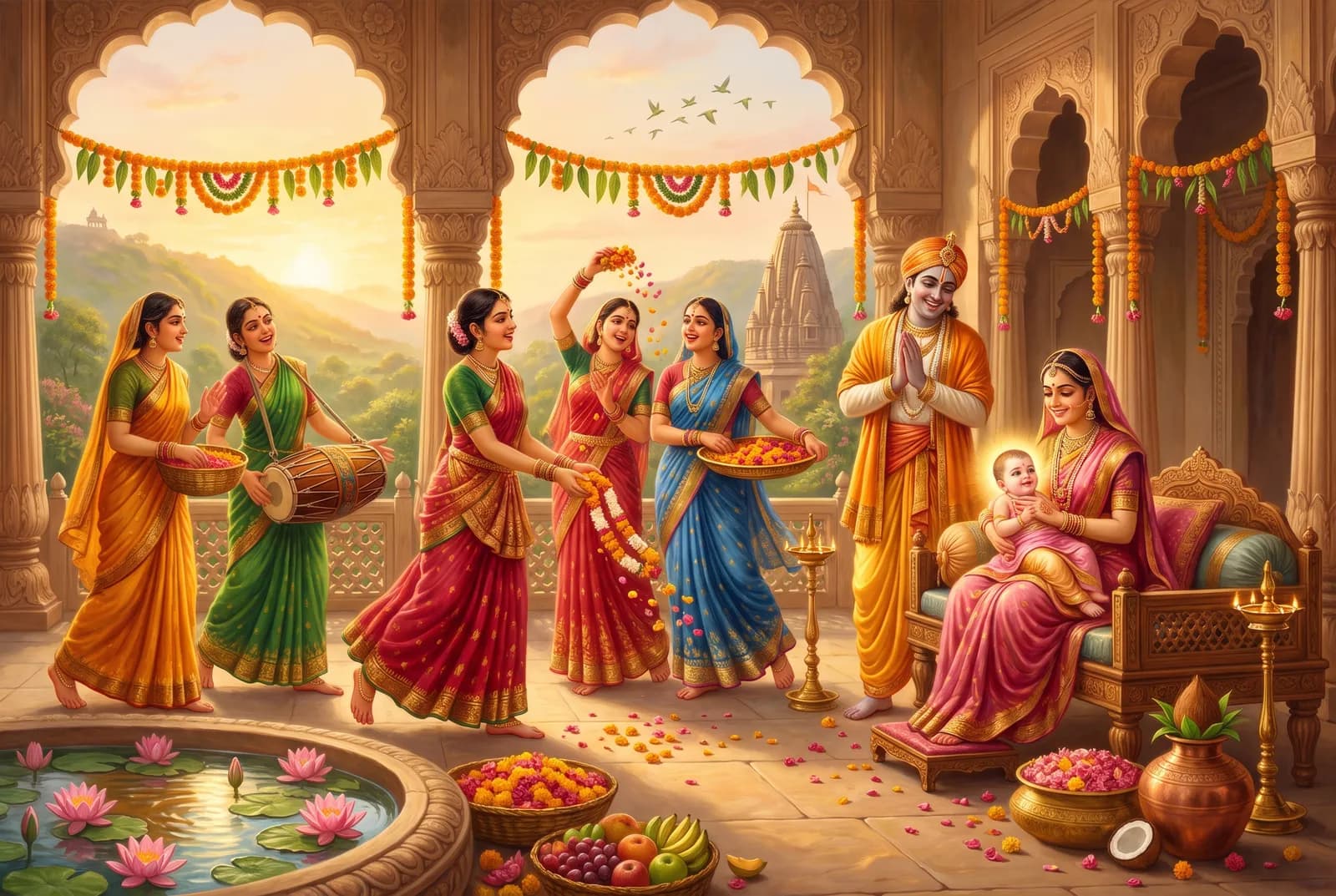
Radhashtami
Radhashtami is Radharani's appearance day, Bhadrapada shukla ashtami. The 2026 date, what scripture records, and how Barsana keeps it.
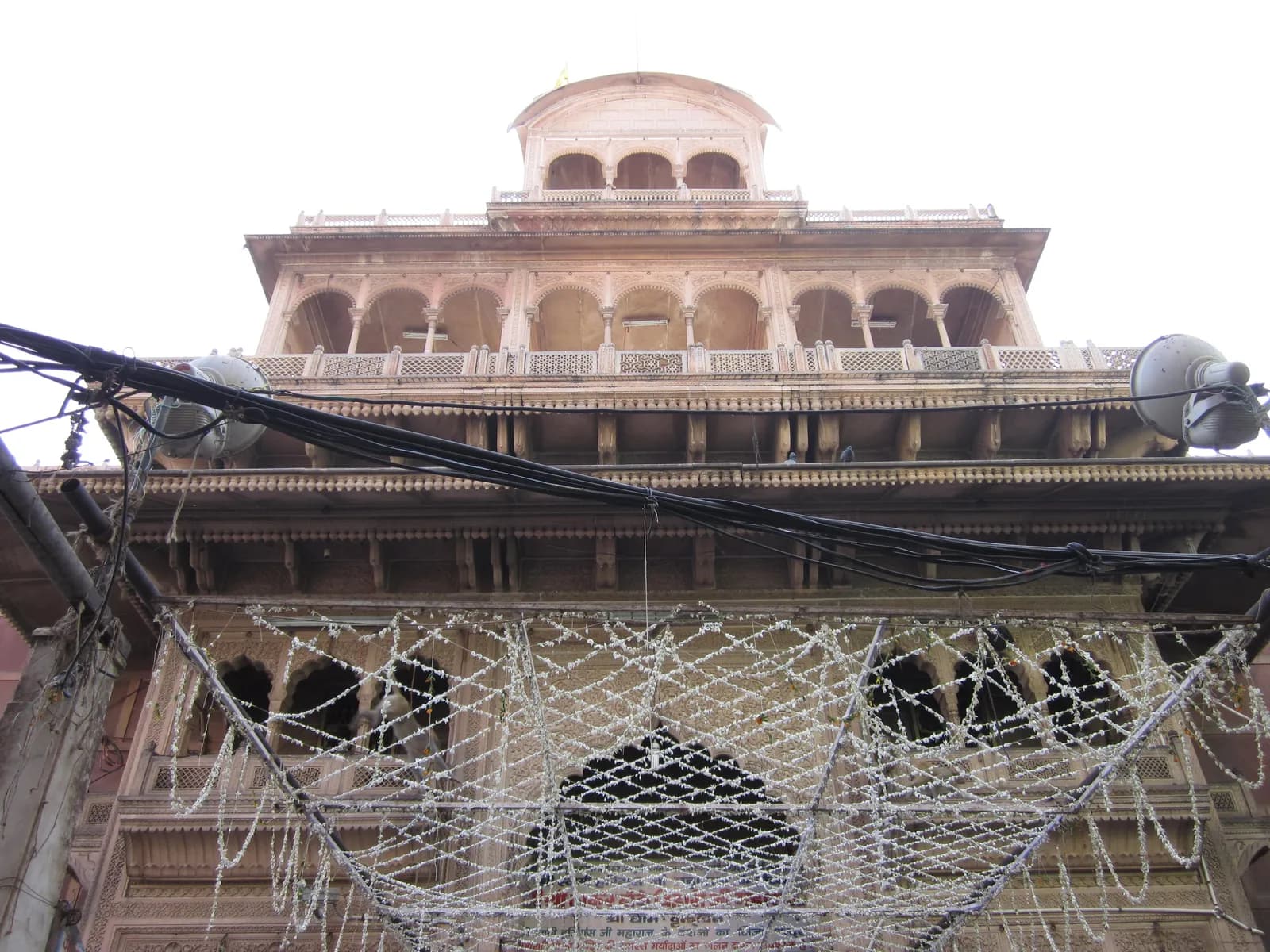
Banke Bihari Temple, Vrindavan
Banke Bihari Temple, Vrindavan: the deity Swami Haridas found at Nidhivan, why the curtain keeps closing, plus timings, festivals and how to plan a visit.
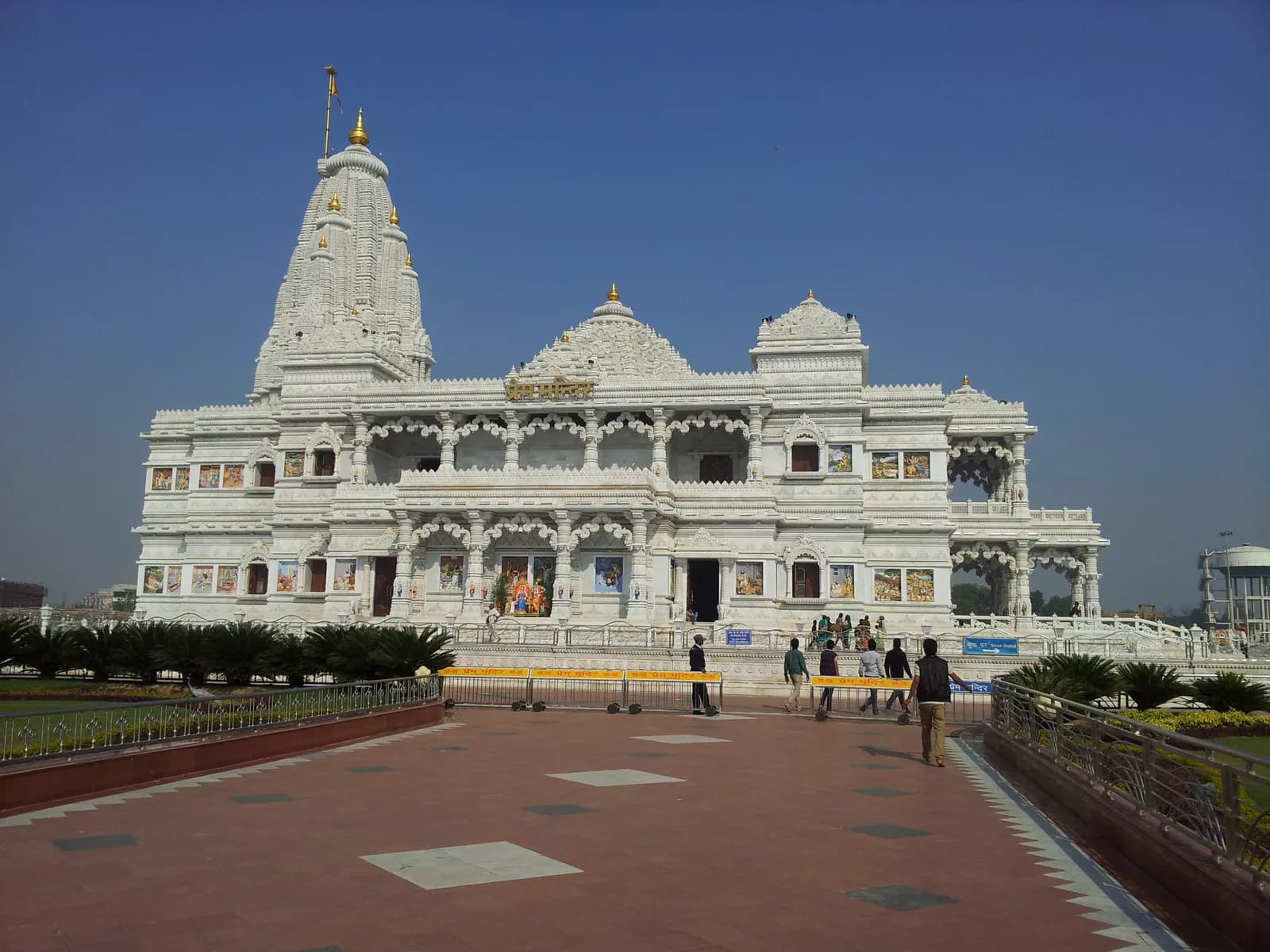
Vrindavan
Vrindavan, the town of Krishna's childhood: its temples, the Yamuna ghats, the 10 km parikrama, when to go, and what first-time visitors get wrong.