
Festivals
Holi
Last updated 26 July 2026
The short answer
Holi is kept over two days at the end of Phalguna. On the full moon night a bonfire is lit, called Holika Dahan, remembering the boy Prahlada who came through fire unharmed because he would not stop chanting the name of God. The next morning is Rangwali Holi, the day of colours, which Braj keeps as the Holi of Radha and Krishna. In 2027 the bonfire is Sunday 21 March and the colours Monday 22 March.
When Holi falls
Next: Sunday, 21 March 2027
Key takeaways
- Holika Dahan falls on Phalguna purnima and Rangwali Holi on the morning after.
- In 2027 that is Sunday 21 March and Monday 22 March, with the Holika Dahan muhurat from 6:33 to 8:55 PM. In 2028 it is Friday 10 and Saturday 11 March.
- Narada Purana, Purva-bhaga chapter 124, names Holika and ties the fire to Phalguna Purnima. The Bhagavata Purana tells Prahlada's rescue at 7.5.43 to 45 without naming her.
- Garga Samhita 4.12 is the earliest text placing Radha and Krishna at a Holi, which is why Braj plays it for forty days.
- The colour is the devotional heart of the day: Krishna coloured Radha, and Braj has been colouring each other ever since.
- Prem Ras Madira gives its whole eighteenth chapter, Hori Madhuri, to Holi padas, which is what this lineage sings on the day.
Holi is two days, and they are not the same festival wearing one name.
The first is a fire on the night of the Phalguna full moon, lit for a boy who walked through fire chanting a name and came out unharmed. The second is the morning after, when the whole country throws colour at each other, and which Braj keeps as the Holi of Radha and Krishna.
When Holi falls
| Day | 2027 | 2028 |
|---|---|---|
| Holika Dahan | Sunday 21 March | Friday 10 March |
| Rangwali Holi | Monday 22 March | Saturday 11 March |
Holika Dahan is Phalguna purnima and Rangwali Holi the morning after. The bonfire muhurat in 2027 runs from 6:33 to 8:55 PM. The general and Vaishnava reckonings agree on both days in both years. The muhurat is a local clock time and it shifts with the Bhadra window, so take it from a panchang pinned to your own city in the weeks before rather than from a national figure.
Why is a fire lit the night before?
For Prahlada, and for what kept him.
He was a boy who would not stop chanting the name of Vishnu, and his father, the king Hiranyakashipu, tried everything to make him stop. The Bhagavata Purana runs through the attempts in a single unbroken list: elephants, serpents, spells, a fall from a hilltop, illusion. Fire is one item in it, no larger than the rest:
"...by administering poison, by starving him, by exposing him to severe cold, winds, fire and water..."
Bhagavata Purana 7.5.43 to 45
None of it worked. That is the whole point of the passage: nothing at all could touch a boy who was chanting the holy name.
The day and the name come from elsewhere. The Narada Purana, in the Purva-bhaga, chapter 124, gives Holika her name, ties her to Prahlada, and sets the observance on Phalguna Purnima, the full moon of Phalguna. It also offers more than one way of reading the fire: as Holika, as the burning of the old year at its end, and as the burning of Kama, desire. Braj takes all three and does not choose.
The Vishnu Purana, at 1.18, tells it a third way. A woman of fire is sent against Prahlada and is not named, and the fire turns back on the ones who sent her while the boy stands untouched, chanting.
So when the fire is lit on the full moon night, what is being remembered is not a burning. It is a boy who was not burned, and the name that held him.
On the night itself: wood and dried cow dung cakes are stacked in the days before, often around a pole. At the muhurat the fire is lit, families circle it three or seven times with water, kumkum and roli, and offer new grain, chickpeas and coconut into it. The roasted grain is taken home. Ash from the fire is worn on the forehead the next morning.
Why is Holi celebrated with colours?
Because of Krishna's face, and a thing Yashoda said to him.
Braj tells it simply. The boy was dark. Radha was fair. He came to his mother troubled about it, and she told him to stop worrying and go colour Radha's face any shade he pleased. He went and did exactly that, and Braj has not stopped since.
The earliest text that places the two of them at a Holi is the Garga Samhita, in its fourth khanda, chapter twelve, where Krishna comes into the groves to play colour with Radha and the sakhis:
"He has come to Your forest."
Garga Samhita 4.12.7
That single line carries a lot. He is from the other side of Braj. He has arrived where he was not asked. And out of it grew the whole exchange between the two villages that becomes Lathmar Holi.
What the colour means, in the end, is that on this one day the distance goes. Gulal covers the face; nobody can tell who is rich and who is poor, who is young and who is old, who is from which house. That levelling is not a modern gloss on the festival. It is exactly what a grove full of colour did to Krishna and the gopis, and it is why the day feels the way it does.
What our own lineage sings on Holi
There is a whole book of Holi in this lineage. Prem Ras Madira, the collection of devotional padas by Jagadguru Shri Kripalu Ji Maharaj, gives its eighteenth chapter, Hori Madhuri, entirely to this festival, and those padas are sung every spring wherever his followers keep it.
The best known of them begins by calling a friend out to play:
lāl saṅg, kheliy hil mil phāg. chalu rī sakhī!
"O Sakhi! Play Holi with Shyamasundara with the sentiment of love."
Jagadguru Shri Kripalu Ji Maharaj, Prem Ras Madira, Hori Madhuri
And then it turns every part of the play into something interior:
keśar ghora bhāv kī gorī! pichkārī anurāg.
"Mix the saffron colour of your devotional sentiments, and using the pichkari of attachment for Him, play Holi with Him."
Jagadguru Shri Kripalu Ji Maharaj, Prem Ras Madira, Hori Madhuri
The saffron is bhava. The pichkari is anurag. Nothing in the picture is dropped and nothing is left merely literal, which is the whole method of these padas.
In his Holi discourse Maharaj Ji puts the same thing as a statement about where God is. Prahlada's father demanded to know whether God was in a pillar, and the answer that came out of it is the one the festival exists to carry:
"In reality, Holi is meant to remind us that God is present everywhere."
Jagadguru Shri Kripalu Ji Maharaj
Swami Mukundananda puts the practical end of it in one line: the path of divine love is a nitya-utsav, an eternal celebration. Sing Krishna's glories, dance, think of him, and rejoice in his service. Holi is one day; that is meant to be every day.
Jagadguru Kripalu Parishat keeps the festival with a Holi Sadhana Shivir at Shri Kripalu Dham, Mangarh, running for ten days or more, with the colour played on the grounds of Bhakti Mandir.
How Braj keeps Holi
Not for two days. For about forty.
Braj starts at Vasant Panchami, when the Holi pole goes up and the samaj gayan begins, and does not stop until the full moon. Each town takes its own day.
| Where | What happens |
|---|---|
| Barsana | Laddu Holi, then Lathmar Holi, the women with lathis and the men behind shields |
| Nandgaon | Lathmar Holi in reverse, the day after Barsana |
| Banke Bihari, Vrindavan | Phoolon wali Holi, the Holi of flowers, on Rangbhari Ekadashi |
| Dwarkadhish, Mathura | A huge temple Holi with pichkaris of coloured water |
| Dauji, near Baldeo | Huranga, the day after Rangwali Holi, the last Holi of the season |
If you are going, Vrindavan and Barsana have the practical detail for each.
Playing it well
Holi is one of the few days in the year when nobody in a street is a stranger, and it stays that way if a few things are kept.
Use natural colour. Gulal from flowers, turmeric, sandalwood and beetroot. Chemical colour is hard on skin and worse on eyes, and it does not smell like Holi.
Oil first. Coconut or mustard oil in the hair and on the skin, and the colour comes off in one wash instead of four.
Colour the willing. Ask, or read the face. Keep it away from eyes. Keep water out of it around elders, small children, and anyone dressed for the temple.
Take it easy on the thandai. The bhang version is traditional and it is also strong, and it is not what a first Holi in Braj should be spent on.
Where this sits in the Radha Krishna year
Holi closes the bright half of the Braj year. It opens at Vasant Panchami in Magha and builds through Lathmar Holi at Barsana and Nandgaon to the full moon of Phalguna.
The other end of the year belongs to the monsoon and the autumn: Jhulan Yatra in Shravana, Janmashtami and Radhashtami in Bhadrapada, Sharad Purnima in Ashwin. For the whole cycle, see the festivals of Radha Krishna.
Frequently asked questions
Why is Holi celebrated with colours?
Braj gives the reason, and it is a story about Krishna's own face. He was dark and Radha was fair, and he complained to Yashoda about it. She told him to go and colour Radha's face whatever shade he liked.
He did, and the whole of Braj has been colouring each other ever since. The gulal is not decoration on top of the festival. It is the festival.
When is Holi in 2027?
Holika Dahan is on Sunday 21 March 2027, on Phalguna purnima, with the bonfire muhurat from 6:33 to 8:55 PM. Rangwali Holi, the day of colours, is Monday 22 March.
In 2028 the two days are Friday 10 and Saturday 11 March. Both reckonings agree in both years. Check a panchang for your own city closer to the day, because the muhurat is a local clock time.
What is the story behind Holika Dahan?
A boy named Prahlada would not stop chanting the name of Vishnu, and his father, the king Hiranyakashipu, tried every way to stop him. One attempt was fire. Prahlada walked through it and came out unharmed, because the name he was chanting protected him.
The bonfire on the eve of Holi is that fire. What is remembered in it is not the burning but the boy who was not burned.
Which scripture names Holika?
The Narada Purana does, in the Purva-bhaga, chapter 124, where the day is set on Phalguna Purnima and the fire is given its name.
The Bhagavata Purana tells the same rescue at 7.5.43 to 45, listing fire among the things Prahlada came through, without naming her. The Vishnu Purana, at 1.18, has an unnamed woman of fire sent against him who turns back on the ones who sent her.
What is the difference between Holika Dahan and Rangwali Holi?
They are the two halves of one festival. Holika Dahan is the bonfire on the night of the full moon, lit at a muhurat given by the panchang, with parikrama around the fire and grain offered into it.
Rangwali Holi, also called Dhulandi, is the next morning, and it is the one with the colour, the water, the sweets and the music.
Why is Braj Holi famous?
Because Braj keeps it for about forty days rather than two, and because this is the land the Holi of Radha and Krishna is set in. It starts at Vasant Panchami and runs to the full moon.
Along the way it takes in Lathmar Holi at Barsana and Nandgaon, the Holi of flowers at Banke Bihari in Vrindavan, and the temple Holi at Dwarkadhish in Mathura, before the full moon night arrives.
What is Phoolon wali Holi and where is it played?
It is the Holi of flowers, played with petals instead of powder, and it is kept at the Banke Bihari temple in Vrindavan on Rangbhari Ekadashi, in the bright fortnight of Phalguna.
The doors open, the priests shower the crowd with flowers from the altar for a short and famous span of minutes, and it is over. Get there early.
What does Holi mean spiritually?
That God is everywhere, and that love is what colours a life. Kripalu Ji Maharaj teaches Holi as the festival of divine omnipresence, kept because Prahlada's faith was answered from a pillar nobody expected.
The Hori Madhuri padas of Prem Ras Madira take it further and turn every part of the play inward: the saffron is your devotional sentiment, the pichkari is your attachment to him.
How should you play Holi safely?
Use natural gulal made from flowers, turmeric and sandalwood rather than chemical colour, which is hard on skin and eyes. Oil your hair and skin beforehand and it washes out far more easily.
Colour only people who want to be coloured, keep it away from faces and eyes unless they are willing, and keep water out of it around elders, children and anyone in temple dress.
Sources
- Holika Dahan date and muhurat, Drik Panchang
- Rangwali Holi date and tithi, Drik Panchang
- Vaishnava calendar, ISKCON Bangalore
- Narada Purana, Purva-bhaga Part 4, translated by G. V. Tagare (Motilal Banarsidass)
- Bhagavata Purana 7.5, Prahlada Maharaja, the Saintly Son of Hiranyakasipu
- Vishnu Purana Book 1 Chapter 18, translated by H. H. Wilson
- Garga Samhita, Ashvamedha Khanda, with English translation
- Holi
- The true spiritual significance of Holi, a discourse by Jagadguru Shri Kripalu Ji Maharaj
- Holi, the festival of colours and love, with Hori Madhuri padas in translation, Jagadguru Kripalu Parishat
- Hori Madhuri, the 18th chapter of Prem Ras Madira, JKP Literature
- Lal sang kheliy hil mil phag, with transliteration and translation, JKYog India
- Holi Sadhana Shivir at Kripalu Dham, Mangarh, Jagadguru Kripalu Parishat
Continue reading
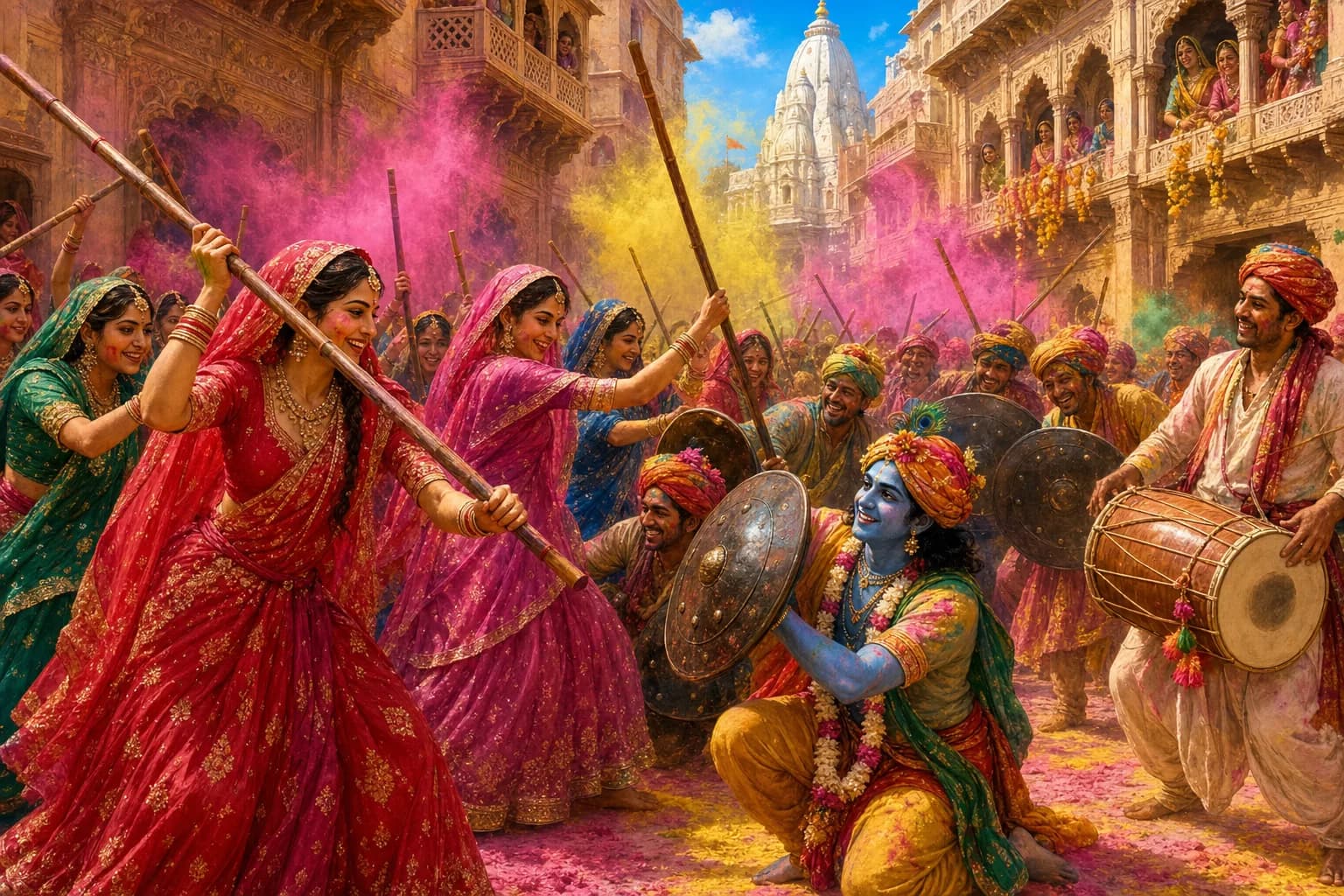
Lathmar Holi
Lathmar Holi at Barsana and Nandgaon: the 2027 and 2028 dates, the Garga Samhita passage the play grows out of, what actually happens on the day, and how to go without getting in the way.
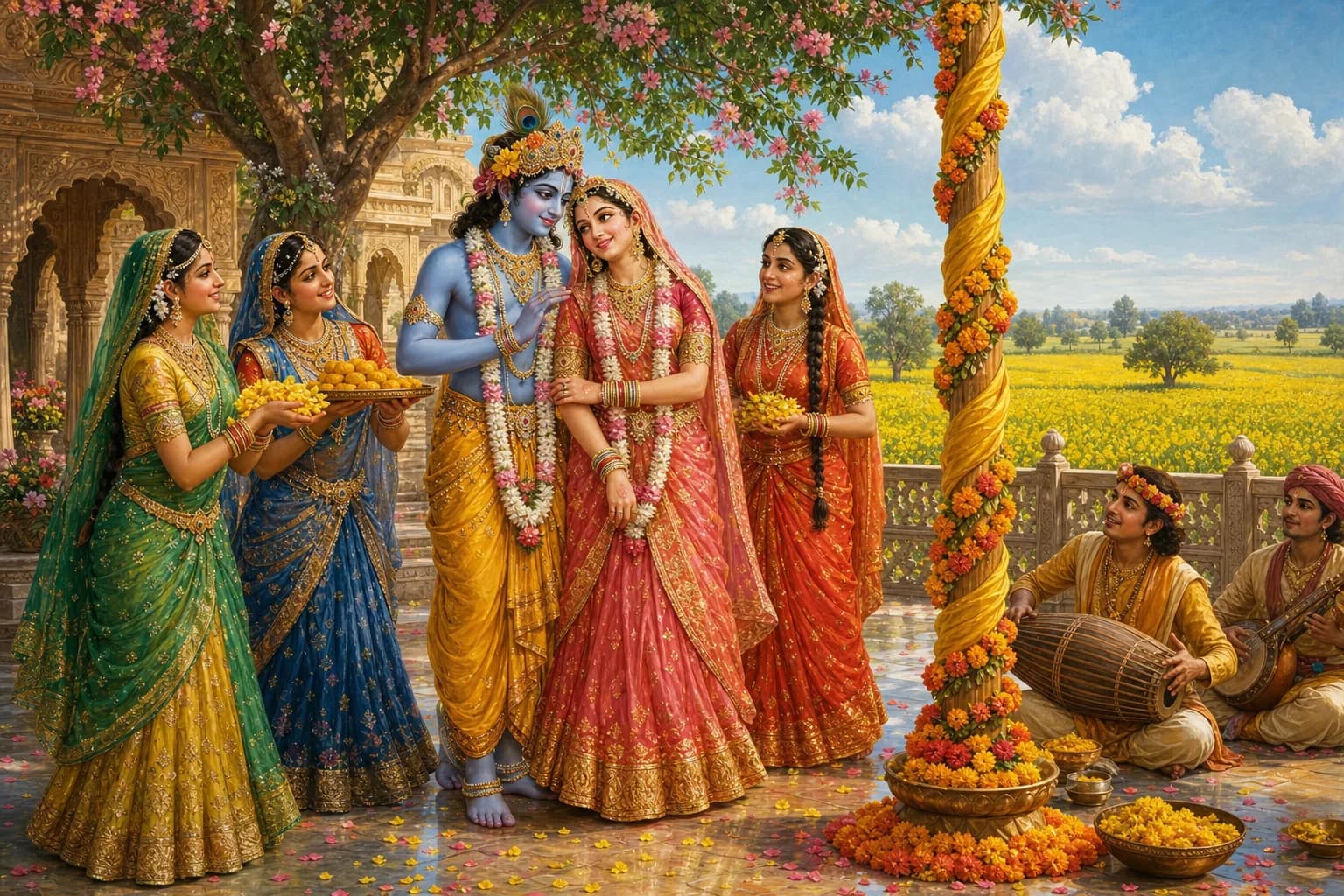
Vasant Panchami
Vasant Panchami, the first day of spring and the day Braj begins its forty days of Holi. The 2027 and 2028 dates, why the day is yellow, and what happens at Barsana, Nandgaon and Vrindavan.
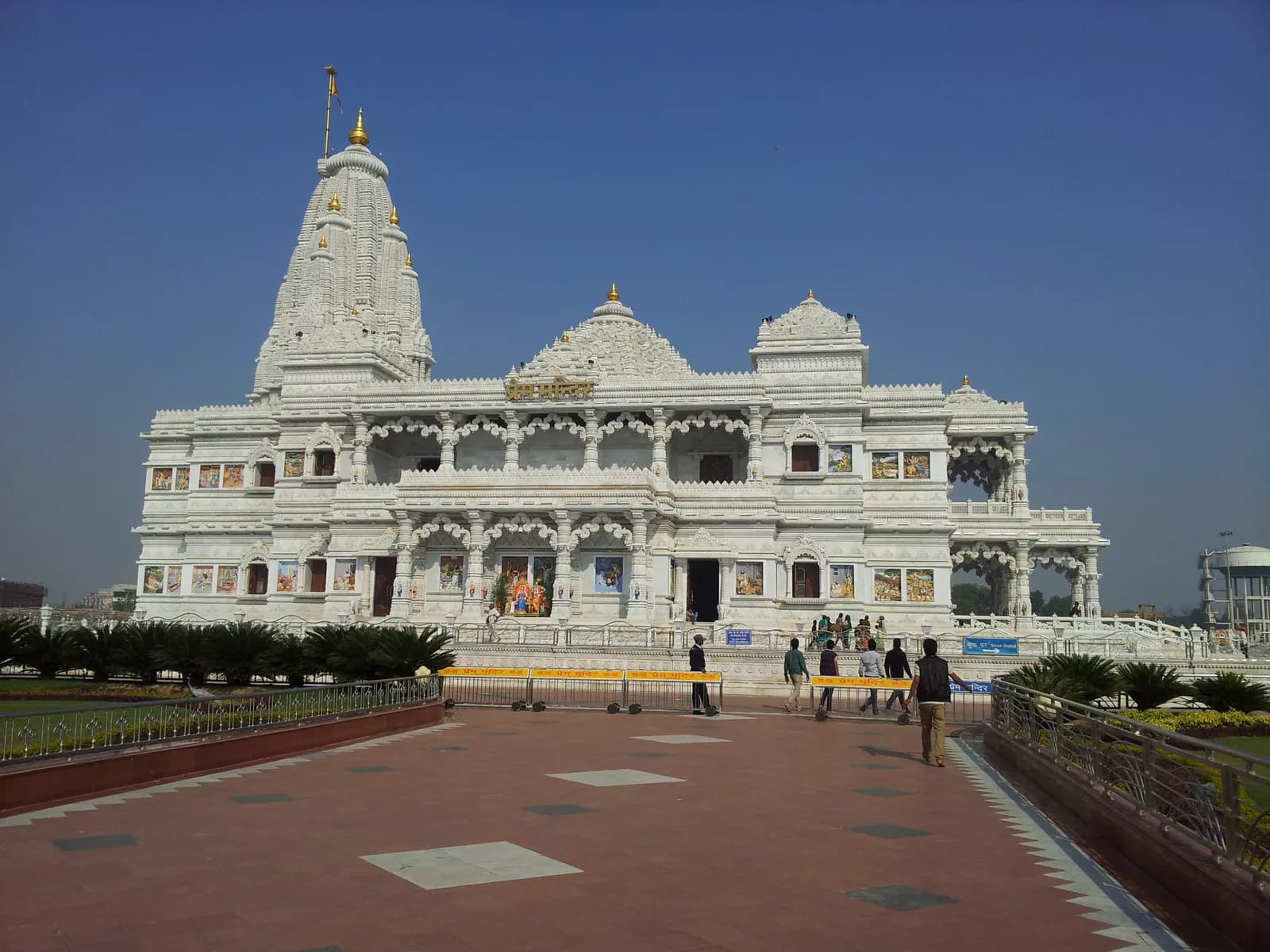
Vrindavan
Vrindavan, the town of Krishna's childhood: its temples, the Yamuna ghats, the 10 km parikrama, when to go, and what first-time visitors get wrong.