
Temples
Vrindavan
Last updated 25 July 2026
The short answer
Vrindavan is a temple town on the west bank of the Yamuna in Mathura district, Uttar Pradesh, about 15 km north of Mathura. Hindus hold it to be where Krishna spent his childhood and youth with Radha and the gopis. Roughly 5,500 temples stand in it, from 16th century Goswami shrines to modern marble complexes, and pilgrims walk a 10 km circuit around the whole town.
Key takeaways
- Mathura is where Krishna was born. Vrindavan, about 15 km north, is where he grew up. They are two different towns and most pilgrims see both.
- The name comes from vrinda, holy basil, and vana, grove. It was forest before it was a town, and the Bhagavata Purana moves Nanda's cowherds here in Canto 10, chapter 11.
- The town was lost and rebuilt. Chaitanya Mahaprabhu came looking for the sites in 1515 and sent the Six Goswamis to recover them; Hit Harivansh and Swami Haridas settled here in the same century.
- Banke Bihari is the busiest temple, Radha Raman and Radha Vallabh the most historically loaded, Nidhivan the strangest, Prem Mandir and the ISKCON temple the most modern.
- The Vrindavan parikrama is about 10 km and takes two to three hours on foot. Govardhan's is 21 km and the Braj 84 kos yatra runs roughly 252 km.
- October to March is the comfortable season. Almost every temple shuts for a few hours around midday.
Vrindavan is a temple town on the west bank of the Yamuna in Mathura district, Uttar Pradesh, about 15 km north of Mathura. Hindus hold it to be where Krishna spent his childhood and youth with Radha and the gopis. Roughly 5,500 temples stand in it, from 16th century Goswami shrines to modern marble complexes, and pilgrims walk a 10 km circuit around the whole town.
It is small. The 2011 census counted just over 63,000 residents, and you can cross the old quarter on foot in twenty minutes. What it holds is out of all proportion to its size, which is why a first visit can feel overwhelming. This page is the ground map: what is here, what each place is for, and what to do about the crowds. For the wider region, start at temples and Braj.
What is Vrindavan famous for?
For being the setting of almost every Krishna story people love.
The name is literal. Vrindavan comes from vrinda, holy basil, and vana, grove. This was forest before it was a town, and the tradition still calls it a van rather than a city. In the Bhagavata Purana, Nanda and the cowherds abandon Gokul and move the whole settlement here in Canto 10, chapter 11, after a run of attacks on the infant Krishna. Everything that follows, the cows, the flute, the butter, the gopis, happens on this ground.
The peak of it is the raas, the circle dance told across Bhagavata Purana 10.29 to 10.33. Radha is never named in that text, and the tradition that names her builds on later sources, which who Radha is works through carefully.
The other half of Vrindavan's fame is what it lost. In Bhagavata Purana 10.39, Akrura drives Krishna and Balarama away to Mathura, and Vrindavan never gets him back. Chapter 47, the Song of the Bee, has Uddhava returning to a town of women who will not be consoled. This is the place of both the meeting and the separation, and Braj devotion leans harder on the second.
Every conversation in the town starts with "Radhe Radhe". Not hello, not namaste. Her name.
Where is Vrindavan, and how is it different from Mathura?
They are two different towns 15 km apart, and confusing them is the single most common mistake visitors make.
| Mathura | Vrindavan | |
|---|---|---|
| What happened here | Krishna was born in Kansa's prison | Krishna grew up, played the flute, and met Radha |
| Feel | A working district headquarters with a temple core | A dense temple town of narrow lanes |
| The main sites | Krishna Janmabhoomi, Dwarkadhish temple, Vishram Ghat | Banke Bihari, the Goswami temples, Nidhivan, Prem Mandir, Keshi Ghat |
| Getting there | Mathura Junction is the railhead for both | 15 km north of Mathura, about 30 minutes by road |
| How long you need | Half a day | A full day at minimum, two days comfortably |
Almost everyone arrives through Mathura Junction, then takes an auto, taxi or shared tempo north. Vrindavan had its own station on a branch line from Mathura, opened in 1889, but it closed in 2023 and the track has been lifted, so the junction is now the only realistic rail option. By road from Delhi it is a three to three and a half hour run on the Yamuna Expressway. The nearest airport of any size is Agra, and most people simply drive.
Why did Vrindavan have to be rediscovered?
Because for a long stretch nobody could say for certain where anything was. The forest had swallowed the sites, and the local memory of which grove was which had thinned.
Chaitanya Mahaprabhu came to Vrindavan in 1515 for exactly that reason, to find the lost places. He did not stay. He sent others, the scholars remembered as the Six Goswamis, with a standing brief: locate the sites, install deities, write the books, establish the worship. Almost every historic temple in the town traces to that project or to the patrons who funded it.
He was not alone in that century. Vallabhacharya had already been coming and staying for months at a time, and Vrindavan shaped his Pushtimarg. Hit Harivansh founded the Radha Vallabha Sampradaya here in 1535, a school that worships Radha first and Krishna as hers. Swami Haridas, the dhrupad musician, did his bhajan in the grove now called Nidhivan, and the deity of Banke Bihari is said to have appeared to him there.
Four distinct lineages put down roots in the same small town within a few decades, and their temples still keep four different styles of worship a few lanes apart. Vrindavan is not one tradition. It is several, standing very close together.
Which temples should you actually visit?
There are about 5,500. These are the ones that carry the town.
| Temple | What it is | Known for |
|---|---|---|
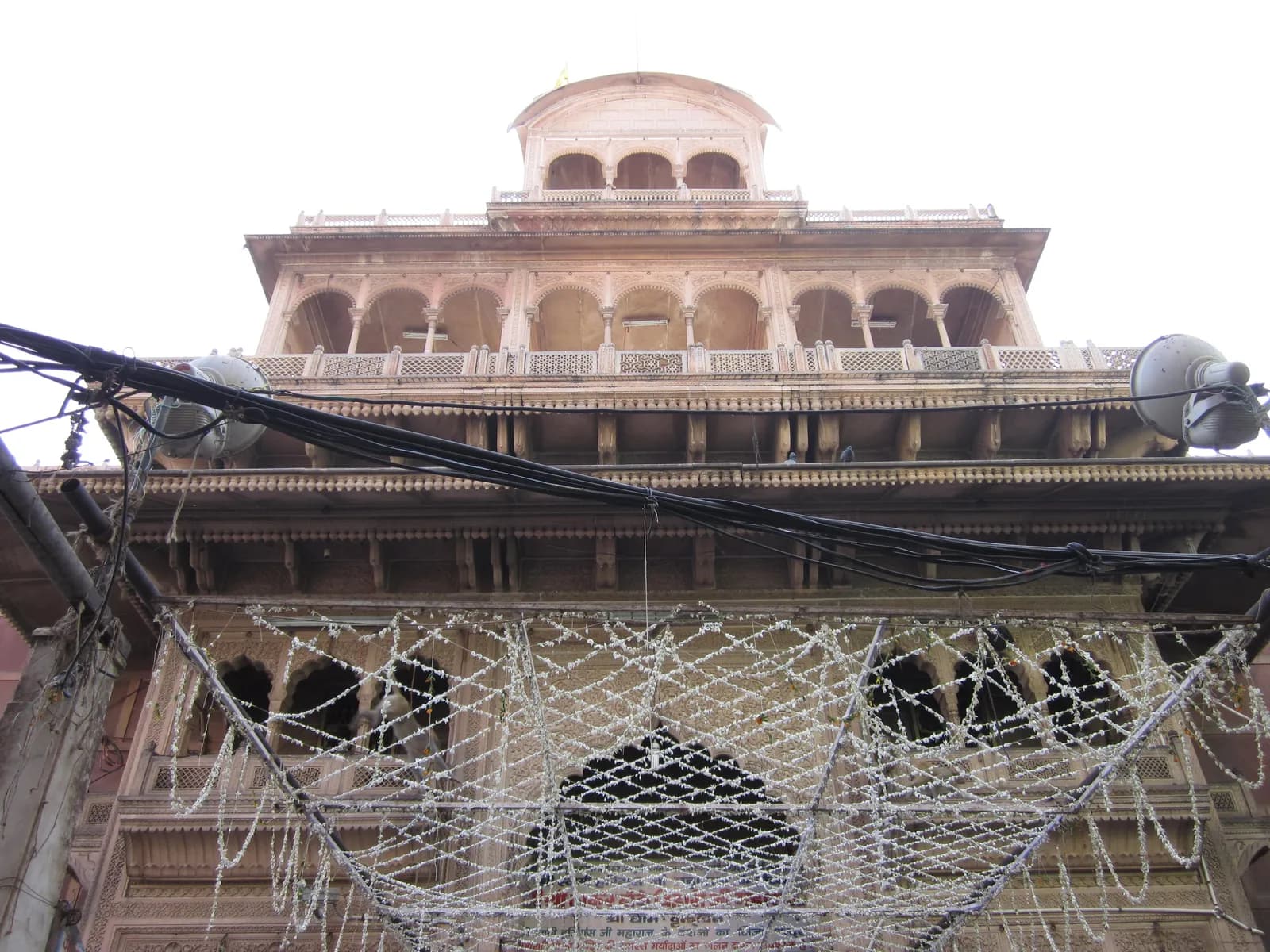
| Banke Bihari | The busiest temple in Vrindavan; deity brought from Nidhivan, present building around 1864 | The curtain drawn across the deity every few minutes; no bells anywhere; the flute held only on Sharad Purnima |
| Radha Raman | Established by Gopala Bhatta Goswami, 1542 | The deity self-manifested from a shaligram shila. There is no separate Radha murti, only her crown beside him |
| Radha Vallabh | Seat of the Radha Vallabha Sampradaya; the old temple completed 1585 | Radha is present as a crown on the seat, not an image. Her name is sung before his, always |
| Nidhivan | A grove, not a built temple | The bhajan place of Swami Haridas, where Banke Bihari appeared. Locked and barricaded after dark |
| Prem Mandir | Built by Jagadguru Shri Kripalu Ji Maharaj, inaugurated February 2012 | White marble carved with the lilas across about 55 acres. Lit up and musical in the evening |
| Krishna Balaram Mandir (ISKCON) | Deities installed by Srila Prabhupada in 1975, in Raman Reti | Prabhupada's white marble samadhi adjoins it; the best organised darshan in town for foreign visitors |
Two more reward the detour. Radha Damodar and Madan Mohan sit in the old quarter and hold the Goswami samadhis, so they are where the 16th century is thickest. On the outskirts, the Vrindavan Chandrodaya Mandir is still under construction and is planned as the tallest religious monument in the world.
If you only have one morning, give it to Banke Bihari and go early. That temple is now run by a Supreme Court appointed committee, which scrapped VIP and paid queue-jumping access and extended the public darshan windows. Anyone offering to sell you special darshan is selling something they do not have.
Prem Mandir, the temple of divine love
The white marble temple on the southern edge of town, and the one at the head of this page, was built by Jagadguru Shri Kripalu Ji Maharaj, in whose lineage this site is kept. He laid its foundation stone on 14 January 2001, the anniversary of the day the Kashi Vidvat Parishat gave him the title of Jagadguru, and it took about twelve years and a thousand artisans to finish. Shri Radha Krishna and Shri Sita Ram are enshrined inside, and the Jhulan, Govardhan, Raas and Kaliya lilas stand carved life sized in the grounds.
Its name comes from a couplet he wrote: the Vedas declare the supremacy of divine love, and that love is so powerful that even Krishna remains under its control. Go in the evening, when the marble is lit and the fountains run.
What is the mystery of Nidhivan?
Nidhivan is a walled grove of short tulsi trees whose trunks twist downward and grow in pairs. The town's belief is that they are the gopis, and that they take their own form at night.
Inside the grove stands the Rang Mahal. Each evening the priests lay out a bed, ornaments, water, neem twigs for cleaning the teeth, and betel leaf and sweets. Then the gates are locked from outside and the whole grove is barricaded. In the morning the bed looks slept in, the twigs used, the sweets partly eaten. Nobody stays inside. The houses that overlook the grove keep their upper floors shut after dark.
The belief is that Radha and Krishna come back here for the raas every night, and that a person who watches does not come away with their sight, speech or mind intact.
No scripture records any of this. There is no verse, no chapter, no Purana that describes the nightly return to Nidhivan. It is living tradition of Vrindavan itself, held with total conviction by people who have kept the grove for generations. That is a different kind of claim from a scriptural one, and it is worth being clear about which is which, because the two get blurred constantly online.
What is left of the Yamuna at Vrindavan?
Less than the paintings suggest, and more than the complaints do.
Keshi Ghat is the main one, a run of sandstone steps and old facades below the Madan Mohan temple. It is named for the horse demon Keshi, killed by Krishna in Bhagavata Purana 10.37, after which he bathed here. Chir Ghat, a little west, is where the gopis' clothes were taken while they bathed, the episode retold in the day Krishna dressed as a gopi. An evening aarti is done on the steps and boats work the stretch in front.
Be realistic about the water. The Yamuna reaches Braj carrying most of Delhi's load, the channel has shifted away from parts of the old bank, and cleanup schemes have run for decades without fixing it. People still bathe. Many visitors touch the water and leave it there. Go at sunrise or for the evening aarti, when the ghat is at its best.
How long is the Vrindavan parikrama?
About 10 km, and two to three hours if you walk it.
A parikrama is a circumambulation, a walk around something holy keeping it on your right. In Braj it counts for more than any single darshan. The Vrindavan circuit runs around the whole town on the Parikrama Marg, passes close to the ISKCON temple, and is walked most heavily on Ekadashi. Many people do it barefoot. E-rickshaws run the loop in under an hour for anyone who cannot.
| Circuit | Distance | Time on foot |
|---|---|---|
| Vrindavan parikrama | about 10 km | 2 to 3 hours |
| Govardhan parikrama | 21 km | 5 to 7 hours |
| Braj 84 kos yatra | roughly 252 km | Days to weeks, with village halts |
None of them require a booking, a guide or a fee. They require time and feet you are willing to punish.
When should you go, and what lands in Vrindavan?
October to March. Days are pleasant, evenings are cool, and the biggest festivals sit inside that window or just outside it. May and June are brutal; the monsoon is green but heavy going in the lanes.
| Festival | When | What Vrindavan does |
|---|---|---|
| Holi | Feb to Mar, over several weeks | The whole Braj season, opening at Vasant Panchami, with Lathmar Holi at Barsana next, then colour through Vrindavan and Mathura |
| Jhulan Yatra | Shravana, Jul to Aug | Radha and Krishna on decorated swings through the monsoon |
| Janmashtami | Bhadrapada, Aug to Sep | Krishna's birth kept at midnight; the town does not sleep |
| Radhashtami | 15 days later | Radha's appearance day; Barsana is bigger, Vrindavan is fuller |
| Sharad Purnima | Ashwin full moon, Sep to Oct | The raas night. Banke Bihari holds the flute this one day of the year |
| Kartik | Oct to Nov | The most auspicious month here. Lamps on the ghats, parikramas every day |
Whatever you pick, plan around the midday shutdown. Almost every temple in Vrindavan opens early, closes for a few hours around noon while the deities are bathed, fed and rested, then reopens in the late afternoon until the evening aarti. First-timers lose an entire day to this. Temples in the morning, ghats and gardens and prasad in the afternoon, aarti at dusk. The full year is laid out in festivals.
What nobody tells you before you go
The town is holy. It is also crowded, and it has learned to work visitors.
Monkeys take spectacles and phones on purpose, especially around Banke Bihari and Nidhivan, and they trade them back for fruit or juice that someone conveniently sells nearby. Keep glasses in a case and phones out of sight. Do not chase.
Autos will quote several times the fare, so fix the price before you sit. Temples ask visitors to dress modestly. Banke Bihari on a festival day is very full, so go at opening, or choose the days on either side if you are with elderly parents or small children.
None of this is the point of Vrindavan. It is simply what a living pilgrimage town asks of you, and the town gives back far more.
Where to go next
Read the story the town is built on: the birth of Radharani, which explains why nearby Barsana matters as much as Vrindavan, and the rest of the stories. Take the honest questions with you, including why Krishna did not marry Radha.
Then plan the darshan itself at Banke Bihari, and carry a prayer for the parikrama path. The Hare Krishna maha mantra is the one you will hear most, and the Radha Sahasranama is the one Vrindavan sings on her day. If you are starting at the beginning, the front door is Radha Krishna.
Photographs
Frequently asked questions
What is Vrindavan famous for?
For being the place where Krishna is said to have spent his childhood and youth, and for the temples built on that memory.
Around 5,500 temples stand in the town, including the 16th century shrines founded by the Six Goswamis, Banke Bihari, Nidhivan, and modern complexes like Prem Mandir and the ISKCON Krishna Balaram Mandir. It is also known for its ghats on the Yamuna, its 10 km parikrama, and for Holi, which Braj plays harder and longer than anywhere else in India.
Should I visit Mathura or Vrindavan first?
Most people start at Mathura, because Krishna's story starts there. Mathura holds the Krishna Janmabhoomi complex and Dwarkadhish temple, and it is where you arrive if you come by train.
Vrindavan, 15 km further north, is where he grew up, and it holds far more temples, so it deserves the longer half of your time. The two are 30 minutes apart by road and both fit into a single day if you are willing to move fast.
Is two days enough for Vrindavan?
Two days is enough to see the town properly and not feel rushed. Day one covers Banke Bihari early, Radha Raman, Radha Vallabh and Nidhivan in the old lanes, then Keshi Ghat at sunset. Day two covers Prem Mandir, the ISKCON temple, Seva Kunj, and the parikrama if you want to walk it.
One day is enough only for the headline temples, and you will spend much of it queueing.
How long is the Vrindavan parikrama?
About 10 km around the town, which takes two to three hours at a walking pace and roughly 45 minutes to an hour by e-rickshaw. It is walked most heavily on Ekadashi.
Do not confuse it with the Govardhan parikrama, which is 21 km around the hill and takes five to seven hours, or the Braj 84 kos yatra, which covers roughly 252 km over several days.
Has anyone stayed in Nidhivan at night?
Nidhivan is barricaded and locked after the evening aarti, and nobody stays inside. The belief held in Vrindavan is that Radha and Krishna return there each night for the raas, and that anyone who witnesses it does not come away whole. The priests lay out a bed, water, neem twigs and betel in the Rang Mahal each evening and find them used the next morning.
There is no scriptural verse behind any of this. It is the town's living belief, and it is treated with complete seriousness.
Which month is less crowded in Vrindavan?
The quietest stretch is roughly late November through January, once Kartik has ended and before the Holi season builds. December weekends still fill up.
Avoid Janmashtami, Radhashtami, the whole Kartik month, and the Braj Holi weeks if crowds are what you are trying to escape, and avoid May and June if heat is. Weekdays are consistently easier than weekends at every temple.
Why do monkeys in Vrindavan take spectacles and phones?
Because it works. The macaques around Banke Bihari, Nidhivan and the parikrama route have learned that a snatched pair of glasses or a phone gets traded back for fruit or juice, and locals sell the exchange item on the spot.
Keep spectacles in a case, phones in a zipped bag, and nothing shiny in an open hand. If something is taken, do not chase or shout; hand over the fruit and it is usually dropped.
Sources
- Vrindavan (location, population, about 5,500 temples, etymology from vrinda and vana), Wikipedia
- Vrindavan, Britannica (town on the west bank of the Yamuna, just north of Mathura)
- Mathura-Vrindavan, Uttar Pradesh Tourism (Vrindavan 15 km from Mathura)
- Bhagavata Purana 10.11, The Childhood Pastimes of Krishna (the cowherds move from Gokul to Vrindavan)
- Bhagavata Purana 10.29, Krishna and the Gopis Meet for the Rasa Dance
- Bhagavata Purana 10.37, The Killing of the Demons Kesi and Vyoma
- Bhagavata Purana 10.39, Akrura's Vision (Krishna and Balarama leave Vrindavan for Mathura)
- Bhagavata Purana 10.47, The Song of the Bee (Uddhava carries Krishna's message back to the gopis)
- Vrindavan at a Glance, Vrindavan Research Institute (Chaitanya Mahaprabhu in Vrindavan, 1515)
- Radha Vallabha Sampradaya, founded 1535 at Vrindavan by Hit Harivansh (1502-1552), Wikipedia
- Radha Vallabh Temple, Vrindavan (completed 1585, built by Sundardas Bhatnagar), Wikipedia
- Radha Raman Temple, Vrindavan (shaligram deity established by Gopala Bhatta Goswami)
- Banke Bihari Temple (deity from Nidhivan, present temple around 1864, no bells, curtain drawn)
- Shri Banke Bihari Mandir, official temple site (Swami Haridas and the appearance of Bihariji)
- Nidhivan, Vrindavan (paired tulsi, Rang Mahal, barricaded at night), Wikipedia
- Prem Mandir, established and inaugurated by Jagadguru Shri Kripalu Ji Maharaj in February 2012, official site
- ISKCON Vrindavan, Krishna Balaram deities installed by Srila Prabhupada in 1975
- Vrindavan Chandrodaya Mandir (under construction, planned as the tallest religious monument), Wikipedia
- Parikrama Marg, Vrindavan (10 km, two to three hours), Braj Ras
- Vrindavan railway station (opened 1889, closed 2023, Mathura-Vrindavan line), Wikipedia
- Banke Bihari darshan hours extended and VIP passes stopped, The Indian Express
Continue reading
Banke Bihari Temple, Vrindavan
Banke Bihari Temple, Vrindavan: the deity Swami Haridas found at Nidhivan, why the curtain keeps closing, plus timings, festivals and how to plan a visit.
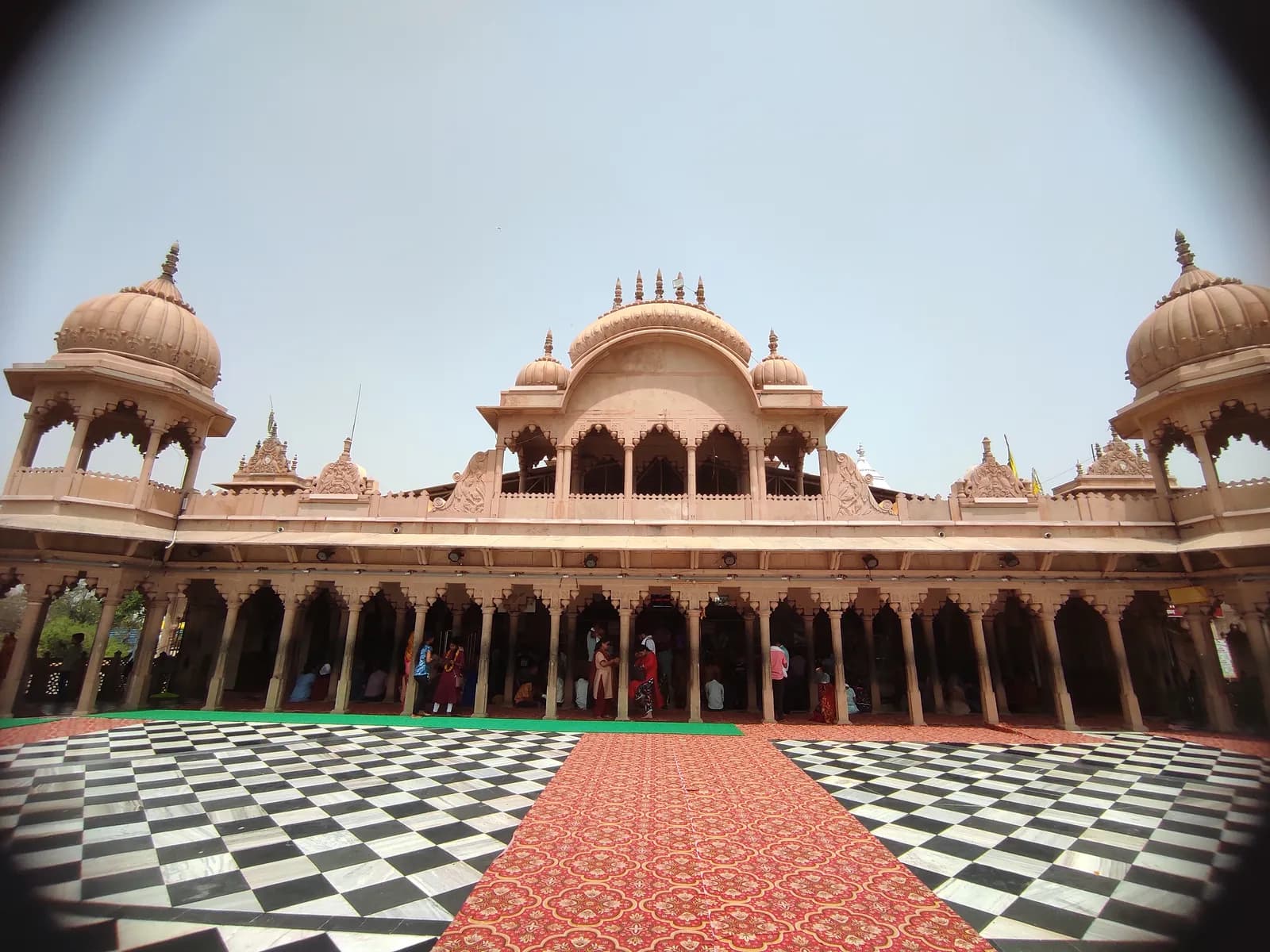
Barsana
Barsana, Radha's town in Braj: the Shriji temple on Bhanugarh hill, the Raval birthplace question, Lathmar Holi, Radhashtami, and how to visit.
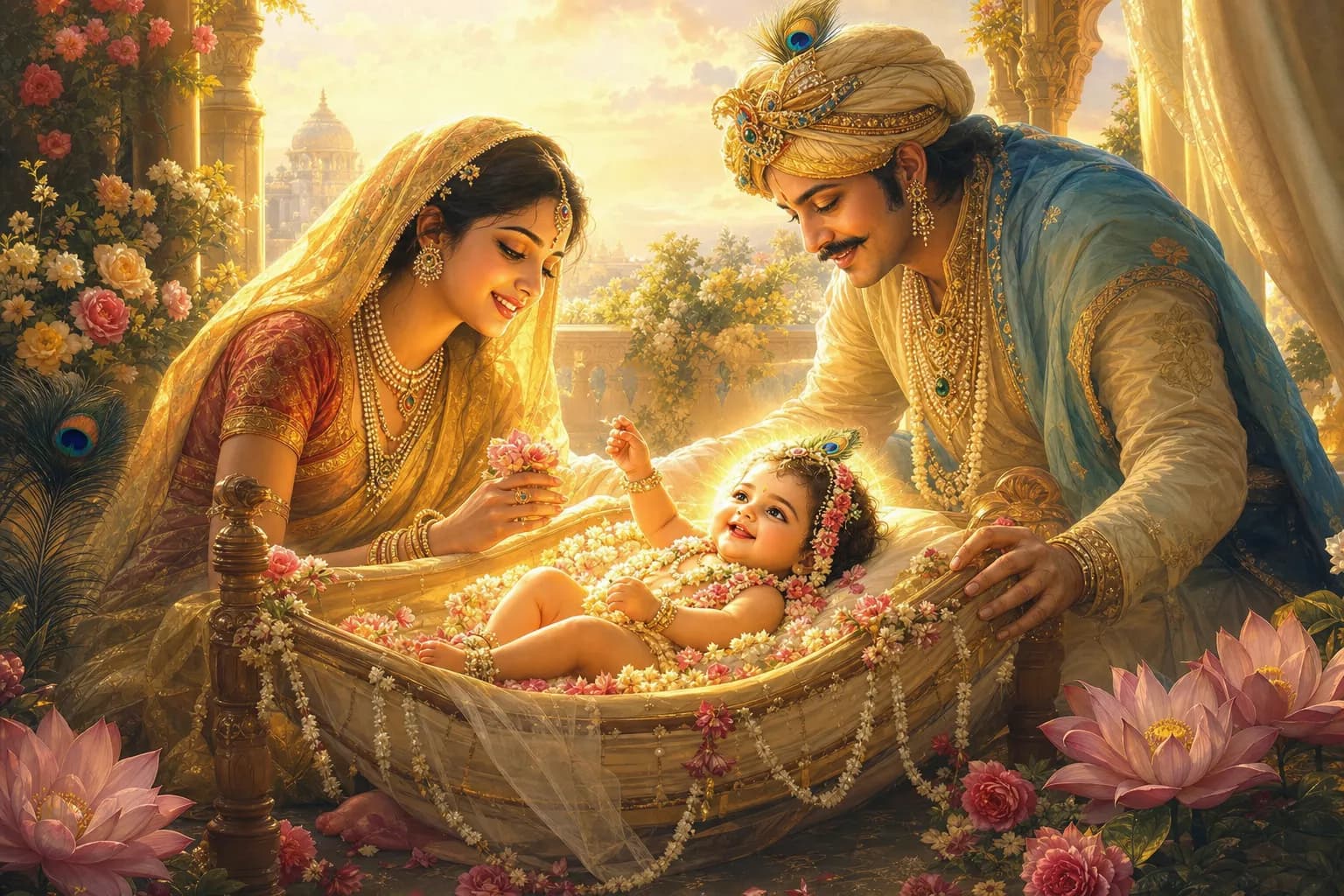
The Birth of Srimati Radharani
How Srimati Radharani was born, told scripture by scripture: the Garga Samhita, the Brahma Vaivarta Purana, her parents, the lotus, and Radhashtami.