
Temples
Banke Bihari Temple, Vrindavan
Last updated 25 July 2026
The short answer
Banke Bihari Temple in Vrindavan houses Thakur Shri Banke Bihari Ji, the deity Swami Haridas received at Nidhivan in the sixteenth century and worshipped as the combined form of Radha and Krishna. The present building was raised in 1862. A curtain closes the darshan every few minutes, no bells are rung inside, and there is no daily morning aarti.
Key takeaways
- The deity appeared to Swami Haridas at Nidhivan and is worshipped as Shyama and Shyam, Radha and Krishna, joined in one form. The present temple was built in 1862.
- Darshan is never continuous. A curtain closes across the deity every few minutes, and the temple explains it by the pull of Bihariji's gaze.
- No bells or conches are rung here, and there is no daily mangala aarti. The temple keeps mangala aarti for Janmashtami alone.
- Timings move with the season. The temple publishes a summer schedule opening at 7:45 AM and a winter schedule opening at 8:45 AM.
- Entry is free and the temple runs no VIP darshan. Phones, leather items and umbrellas are not allowed inside.
Banke Bihari Temple in Vrindavan houses Thakur Shri Banke Bihari Ji, the deity Swami Haridas received at Nidhivan in the sixteenth century and worshipped as the combined form of Radha and Krishna. The present building was raised in 1862. A curtain closes the darshan every few minutes, no bells are rung inside, and there is no daily morning aarti.
It is the busiest temple in Vrindavan and the one first-time visitors get wrong most often. The doors open late, they shut in the middle of the day, your phone stays outside, and the darshan you queued an hour for lasts a few seconds at a time. All of that is deliberate, and all of it comes from one idea about who lives in the sanctum.
What does Banke Bihari mean?
Banke means bent. Bihari means one who enjoys, one who revels. Put together they describe Krishna standing bent at three places, weight on one foot, hip thrown out, head tilted, the pose Sanskrit calls tribhanga. It is the pose the Brahma Samhita praises when it worships "the graceful threefold-bending form of Shyamasundara" (5.31, the text Gaudiya Vaishnavas received through Chaitanya Mahaprabhu).
The deity's older name was Kunj Bihari, the one who revels in the groves of Vrindavan. The temple's own invocation still uses it, greeting Kunj Bihari and Kunj Biharini together before it greets Swami Haridas. Devotees mostly drop the formality and say Bihariji.
Is Banke Bihari both Radha and Krishna?
Yes, and this is the part most guides skip. The image is not Krishna alone with Radha somewhere beside him. It is the two of them in one form.
The temple tells it this way. Swami Haridas sang in a secluded grove at Nidhivan, and his disciples begged to see what he saw there. When they entered they were blinded by light. At Haridas's request the divine couple appeared in person, and everyone present was so held by the sight that they could not blink. Sensing that ordinary people could not carry that much beauty, Haridas asked the two of them to take a single form, like Ghan and Damini, cloud and lightning, the dark Lord and his fair consort. They granted it, and the black image in the sanctum is what they left behind.
So when you hear "Radha Rani ki jai" called out in a temple with one murti in it, that is why. If the theology behind the pairing is new to you, start with who Radha is and the wider Radha Krishna hub.
Who was Swami Haridas?
A singer, first and last. Haridas composed and sang to reach Krishna, and the tradition that carries his name, the Haridasi sampradaya, still treats music as the practice rather than the decoration around it.
The temple gives his birth as 1478 CE, on Radha Ashtami, and places it at Haridaspur near Aligarh. Other accounts place his birth at Gwalior. He is generally held to have lived to 1573. He left home for Vrindavan, then dense forest, and settled at Nidhivan, which is a few minutes from where the temple stands today.
His lineage is remembered in more than one way. The Goswami line of his followers traces itself to the Vishnusvami tradition and the sadhu line to Nimbarka descent, while tradition also names him the teacher of Tansen. What every account agrees on is that he was a musician of the first rank in an age full of them, and that Vrindavan calls him the king of rasikas.
Haridas handed the sewa of Bihariji to Goswami Jagannath, his younger brother and principal disciple. The descendants of that family have performed it ever since. The deity stayed near its place of appearance at Nidhivan until a temple worthy of it was built in 1862, paid for by the Goswamis themselves and built in the Rajasthani style of the day. Some accounts give the year as 1864.
Why is the curtain drawn again and again?
Because darshan here is meant to be broken. A curtain slides across the sanctum, then opens, then closes again, and each brief opening is called a jhanki, a glimpse.
The temple's own explanation is short. The charm of Bihariji is the only reason the darshan is never continuous, and a person who stares long enough into his eyes loses self consciousness. The telling you will hear in the queue goes further. A devotee once held him with such an unbroken gaze that he left the temple and followed her home, and the curtain has been drawn ever since so that no one can hold him that long again.
There is no published interval. Accounts range from a few seconds to a few minutes, and in practice it moves with the crowd and the sewa. Do not plan on a long look. Plan on several short ones, and stand where you can see over the row in front.
Why are there no bells, no conches and no morning aarti?
Because Bihariji is served as a child, and you do not wake a sleeping child with a bell.
Bells are not hung anywhere inside the temple. Conches are not blown. Instead of the clang most Indian temples run on, you get clapping, singing and the calling of the name. It changes the sound of the place completely, and it is the first thing regular visitors miss at other temples.
The same reasoning explains the late opening. The daily sewa is performed in three parts, shringar, rajbhog and shayan, and there is no mangala sewa at all. Swami Haridas did not favour it. He wanted his child-like Lord to rest and not be roused out of deep sleep so early. The tradition adds that Bihariji is out playing through the night, so the morning belongs to him.
Once a year the rule is set aside. On Janmashtami, and only on Janmashtami, mangala aarti is performed here.
Why does Banke Bihari not hold a flute?
For most of the year his hands are empty of it. The flute is placed in them on Sharad Purnima, the night of the Maha Raas, and then taken away again. The three-fold bend stays year round, which is the pose that gave him his name.
What are the darshan and aarti timings?
The temple runs a summer schedule and a winter schedule and publishes both on its own site. These are the times it gives.
Summer, from 5 March
| Event | Morning | Evening |
|---|---|---|
| Mandir opens | 7:45 AM | 5:30 PM |
| Shringar aarti | 7:55 AM | |
| Bhog | 11:00 to 11:30 AM | 8:30 to 9:00 PM |
| Aarti and closing | 12:00 noon | 9:30 PM |
Winter, from 23 October
| Event | Morning | Evening |
|---|---|---|
| Mandir opens | 8:45 AM | 4:30 PM |
| Shringar aarti | 9:00 AM | |
| Bhog | 12:00 to 12:30 PM | 7:30 to 8:00 PM |
| Aarti and closing | 1:00 PM | 8:30 PM |
The changeover between the two is announced by the temple, and festival days are handled separately, so check bihariji.org in the week before you travel rather than trusting a timing copied from a travel blog. Note what the table means for a day trip: the doors are shut for four to five hours across the middle of the day, and every other Braj temple keeps a similar gap.
What happens at Banke Bihari on Janmashtami?
Janmashtami is the one night the temple breaks its own rule. Mangala aarti is performed, the only time in the year it happens here, and darshan runs through the small hours instead of waiting for the usual morning opening.
It is also the fullest day of the year. Crowds of up to five lakh come for it, against a daily average of 30,000 to 40,000, so go early and give yourself time. If you are bringing elderly parents or small children, the days on either side are far easier and the darshan is the same.
Nandotsav, the celebration of the birth in Nanda's house, follows the next day. For the festival itself, its date and how it is kept across Braj, see Janmashtami.
What is Holi like at Banke Bihari?
Long. Braj ki Holi does not start on the day the rest of India plays it, and at this temple it opens on Amla Ekadashi, also called Rangbhari Ekadashi, and runs until Dhulendi.
The signature is phoolon wali Holi. On Rangbhari Ekadashi the Goswamis shower flowers from the sanctum over the crowd instead of colour, and the hall fills with petals for a few minutes of complete abandon. Colour play builds from there, Holika Dahan closes the colour days, and Dhulendi is kept as Dolotsav. Barsana's Lathmar Holi runs a few days before all of this and is worth planning around. The full two days of Holika Dahan and Rangwali Holi are covered separately, and the season opens weeks earlier at Vasant Panchami.
Here is what is unique to this temple through its year, with the dates from the temple's own published calendar.
| Day | What is different here | Temple calendar date |
|---|---|---|
| Akshaya Tritiya | Charan darshan in the morning, the one day of the year the lotus feet are open to view, and sarvang darshan in the evening | Mon 20 Apr 2026 |
| Guru Purnima | Phool Bangla for Swami Haridas at Nidhivan | Wed 29 Jul 2026 |
| Hariyali Teej | The jhoola festival. Bihariji is seated on the gold and silver swing | Sat 15 Aug 2026 |
| Krishna Janmashtami | The only mangala aarti of the year | Fri 4 Sep 2026 |
| Radha Ashtami | Kept as the appearance day of both Radharani and Swami Haridas | Sat 19 Sep 2026 |
| Sharad Purnima | The day of the Maha Raas. A flute is placed in Bihariji's hands | Mon 26 Oct 2026 |
| Bihar Panchami | The appearance day of Bihariji himself | Mon 14 Dec 2026 |
| Amla (Rangbhari) Ekadashi | Holi begins, and flowers are showered from the sanctum | Thu 18 Mar 2027 |
| Dhulendi | Dolotsav, the last day of the temple's Holi | Mon 22 Mar 2027 |
Radha Ashtami carrying two birthdays is not a coincidence the temple treats lightly. Haridas is held to have been born on the same tithi as Radharani, which is Radhashtami, and the tradition reads him as an incarnation of Lalita, the closest of Radha's sakhis.
How should you plan a visit?
Go early on a weekday. That single choice does more for your darshan than anything else.
The temple names its own worst days: Ekadashi, Purnima and Amavasya every month, plus weekends, public holidays and the annual festivals. It advises elderly devotees and people with small children to stay away on festival days outright. Wheelchair assistance is available near Sneh Bihari Mandir, and the sewa adhikaris arrange help for anyone who needs it.
Three things catch visitors out:
- There is no VIP darshan. The temple says so in plain words on its own site, and there is no online booking. Inside the temple you can buy a ticket for the first row. Everything offered to you outside the gate at a thousand rupees is somebody's side business.
- Leave your phone behind. Mobile phones, electronic gadgets, leather items and umbrellas are all on the temple's list of things not to carry in. Footwear stays outside. So does photography, and the security staff enforce it.
- Registration is not required. It was once, and stale pages still say so. It is not needed now.
Getting there is simple. Mathura Junction is the railway station to book, about 14 km away, with taxis, autos and buses running into Vrindavan. From Delhi it is the Yamuna Expressway or NH 44, roughly 150 km. Agra airport is about 70 km, Delhi about 150 km. Inside Vrindavan the last stretch is on foot through narrow lanes, and any Brajwasi will point you the rest of the way.
Bathe and wear clean clothes before you go, dress modestly, and watch for pickpockets and monkeys in the lanes. Offerings go into the hundi or the branch office inside the premises, not into anybody's hand.
Where to go next
Nidhivan, where all of this began, is a short walk away and closes at dusk for reasons the town takes seriously. The rest of the town, the seven historic Goswami temples and the ghats, is mapped on Vrindavan, and the wider region on the Temples and Braj hub. Radha's own town is Barsana, and her appearance there is told in the birth of Radharani.
Carry a prayer with you. The Hare Krishna maha mantra is the one you will hear on every lane in Vrindavan. And if the dark image in the sanctum makes you wonder about the colour at all, that question has its own page: why is Krishna blue.
Photographs
Frequently asked questions
What is the timing of Banke Bihari Temple?
The temple runs two schedules. In summer, from 5 March, it opens at 7:45 AM with shringar aarti at 7:55 AM, closes at noon, reopens at 5:30 PM and closes at 9:30 PM. In winter, from 23 October, it opens at 8:45 AM with shringar aarti at 9:00 AM, closes at 1:00 PM, reopens at 4:30 PM and closes at 8:30 PM.
The temple publishes the current schedule on bihariji.org, and it is worth checking before you travel because festival days are handled differently.
Why is there a curtain in Banke Bihari Temple?
Because darshan here is deliberately broken rather than continuous. The Goswamis' own account says the beauty of Bihariji is the whole reason for it, and that a person who stares long enough into his eyes loses self consciousness.
The popular telling adds that an unbroken gaze once drew him out of the temple after a devotee, so the curtain protects the devotee and keeps the deity in his place. Each brief opening is called a jhanki.
Why is there no bell in Banke Bihari Temple?
Bihariji is served as a small child, and bells and conches would break his rest. Bells are not hung anywhere inside the temple. Devotees clap and call out to him instead. The same reasoning explains why the temple opens late in the morning and has no daily mangala aarti.
Is Banke Bihari both Radha and Krishna?
Yes. The temple holds that the divine couple appeared before Swami Haridas and, at his request, took a single form, so that the world could bear the sight.
The image in the sanctum is worshipped as Shyama and Shyam together, Radha and Krishna in one murti, and the temple's own mantra addresses Kunj Bihari and Kunj Biharini side by side.
Why does Banke Bihari have no flute?
For most of the year no flute is placed in his hands. Tradition gives him one on Sharad Purnima, the night of the Maha Raas. The deity stands in the tribhanga pose, bent at three places, which is the posture that gave him the name Banke Bihari.
How do you get VIP darshan at Banke Bihari Temple?
You cannot. The temple states plainly that it has no VIP darshan system and no online booking, and that MPs and MLAs seeking protocol darshan should approach the Mathura administration.
Once you are inside, a ticket sold within the temple lets you stand in the first row. Anyone quoting you a thousand rupees for VIP entry outside the gate is selling something the temple does not offer.
At what time is Banke Bihari Temple less crowded?
Early on a weekday morning, soon after the doors open. The temple names Ekadashi, Purnima and Amavasya as its heaviest days of the month, along with weekends, public holidays and the annual festivals.
Daily footfall runs around 30,000 to 40,000, weekends can reach 1.5 lakh, and Janmashtami has drawn up to 5 lakh. Skip the festivals entirely if you are bringing elderly relatives or small children.
Sources
- Shri Banke Bihari Mandir, official temple site: temple history and the appearance of Bihari Ji
- Shri Banke Bihari Mandir, official site: darshan timings (summer and winter schedules)
- Shri Banke Bihari Mandir, official site: festival calendar
- Shri Banke Bihari Mandir, official site: planning a visit, VIP darshan and how to reach
- Shri Banke Bihari Mandir, official site: do's and don'ts inside the temple
- Shri Banke Bihari Mandir, official site: Swami Shri Haridas Ji
- Banke Bihari Temple (etymology, curtain, absence of bells, coordinates), Wikipedia
- Swami Haridas (dates, sampradaya, the Tansen tradition), Wikipedia
- Brahma Samhita 5.31, the threefold-bending form of Shyamasundara
Continue reading
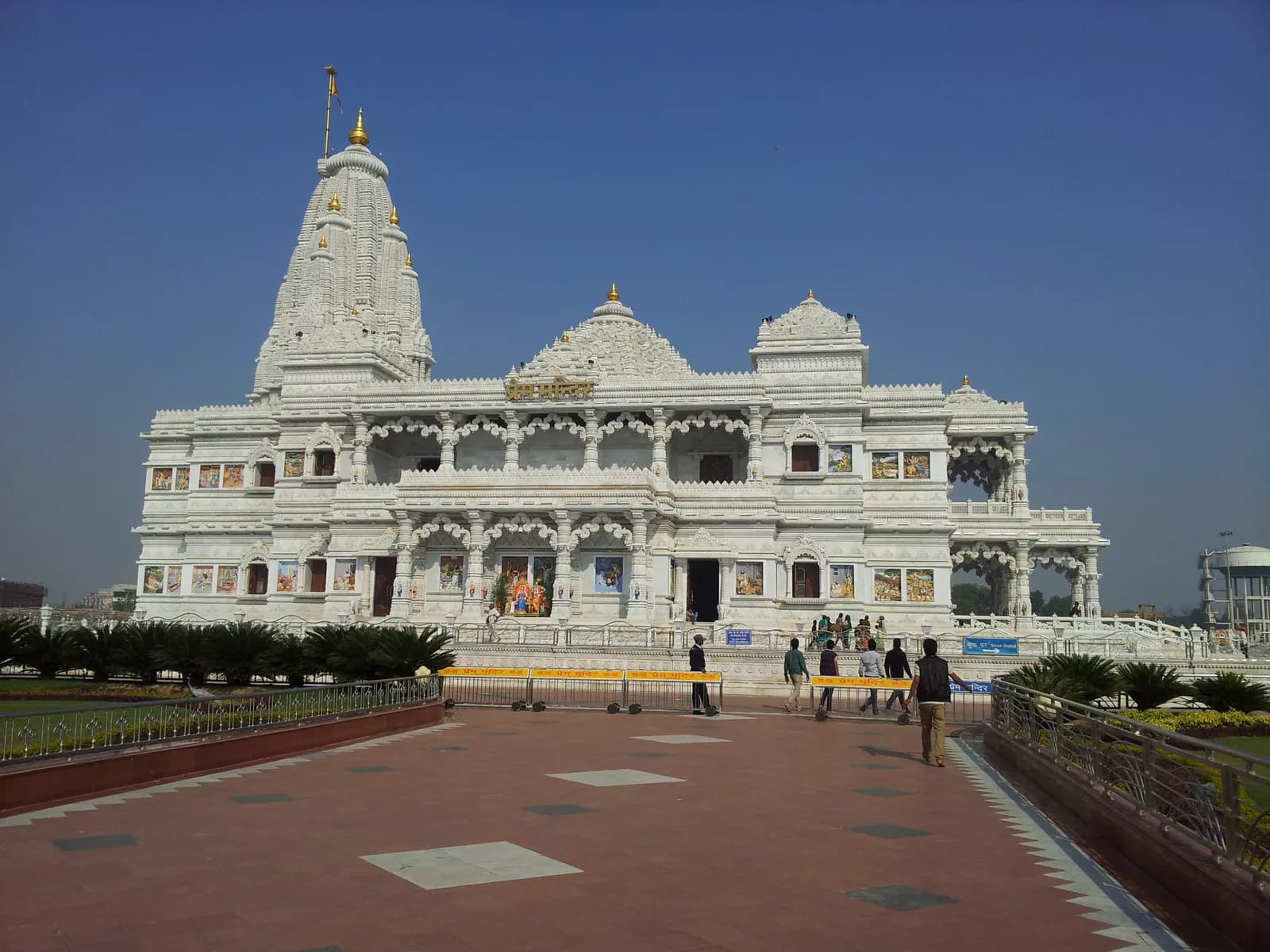
Vrindavan
Vrindavan, the town of Krishna's childhood: its temples, the Yamuna ghats, the 10 km parikrama, when to go, and what first-time visitors get wrong.
Krishna Janmashtami
Krishna Janmashtami explained: the Bhagavata account of the birth, why it is kept at midnight, the tithi, the fast, Dahi Handi and Braj.
The Birth of Srimati Radharani
How Srimati Radharani was born, told scripture by scripture: the Garga Samhita, the Brahma Vaivarta Purana, her parents, the lotus, and Radhashtami.